CERN scientists discover a subatomic particle heavier than proton
What's the story
Scientists at CERN, a nuclear physics laboratory near Geneva, have discovered a new subatomic particle. The newly discovered particle is a heavier version of a proton, the building block of all known atoms in the universe. It was detected during experiments at the Large Hadron Collider (LHC), which recreates conditions similar to those just after the Big Bang by smashing protons together at nearly light speed.
Scientific implications
Heavier version of proton detected
The newly discovered particle, which is four times heavier than a regular proton, could help scientists better understand the strong nuclear force.
This is the fundamental interaction that holds atomic nuclei together and behaves like a rubber band, getting stronger as subatomic particles move farther apart.
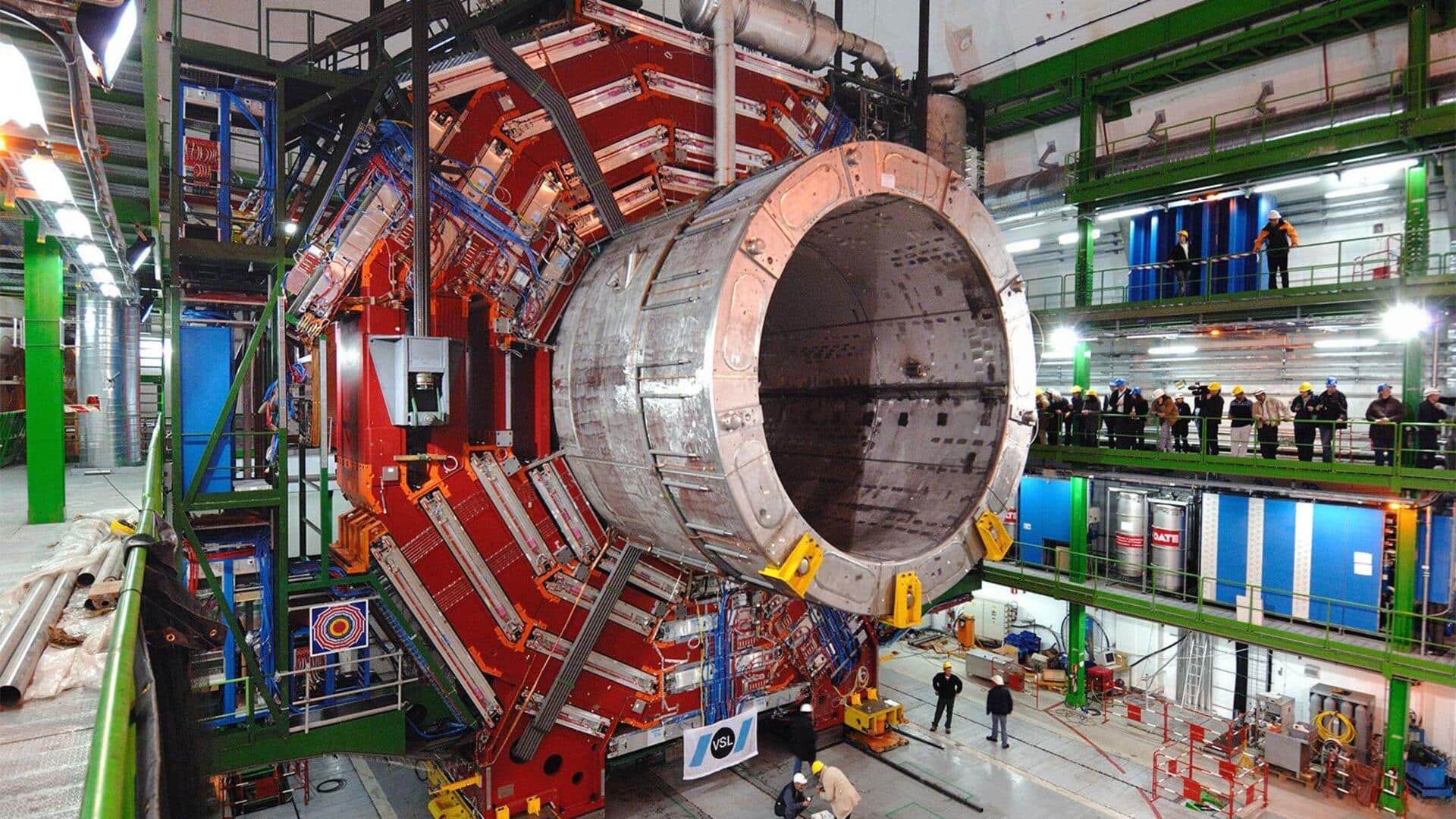
The heavy proton was detected by physicists working on the LHCb experiment after an upgrade made their detector more powerful.
Technological advancement
Upgrade to LHCb detector enabled discovery
The discovery of the heavy proton, dubbed Xi-cc-plus, was made possible by an upgrade to the LHCb detector.
This enhanced detection capability allowed scientists to find the particle in just one year, a feat that eluded them for nearly a decade with the original LHCb.
Professor Tim Gershon from the University of Warwick said this is just "the first of many expected insights" that can be gained with their new detector.
Particle details
Heavy proton has unique quark composition
The heavy proton detected at CERN has a unique composition of quarks. Instead of the usual two up quarks and one down quark, it has two charm quarks.
These are heavier and unstable versions of elementary subatomic particles called quarks.
The particle was identified by its signature decay into other particles, hinting that it survives for less than a millionth of a millionth of a second before breaking down.
Funding controversy
UK government criticized for cutting funding for research
The groundbreaking discovery comes amid criticism of UK Research and Innovation (UKRI) for its plan to withdraw £50 million in funding for the LHCb's final upgrade in the 2030s.
The revamp would have ensured that the detector made full use of a major transformation to the LHC, significantly improving its discovery potential.
British scientists working on particle physics, astronomy, and nuclear physics have been told their grants will be slashed due to cost overruns at major science facilities.