Total lunar eclipse tomorrow: When, where, and how to watch
What's the story
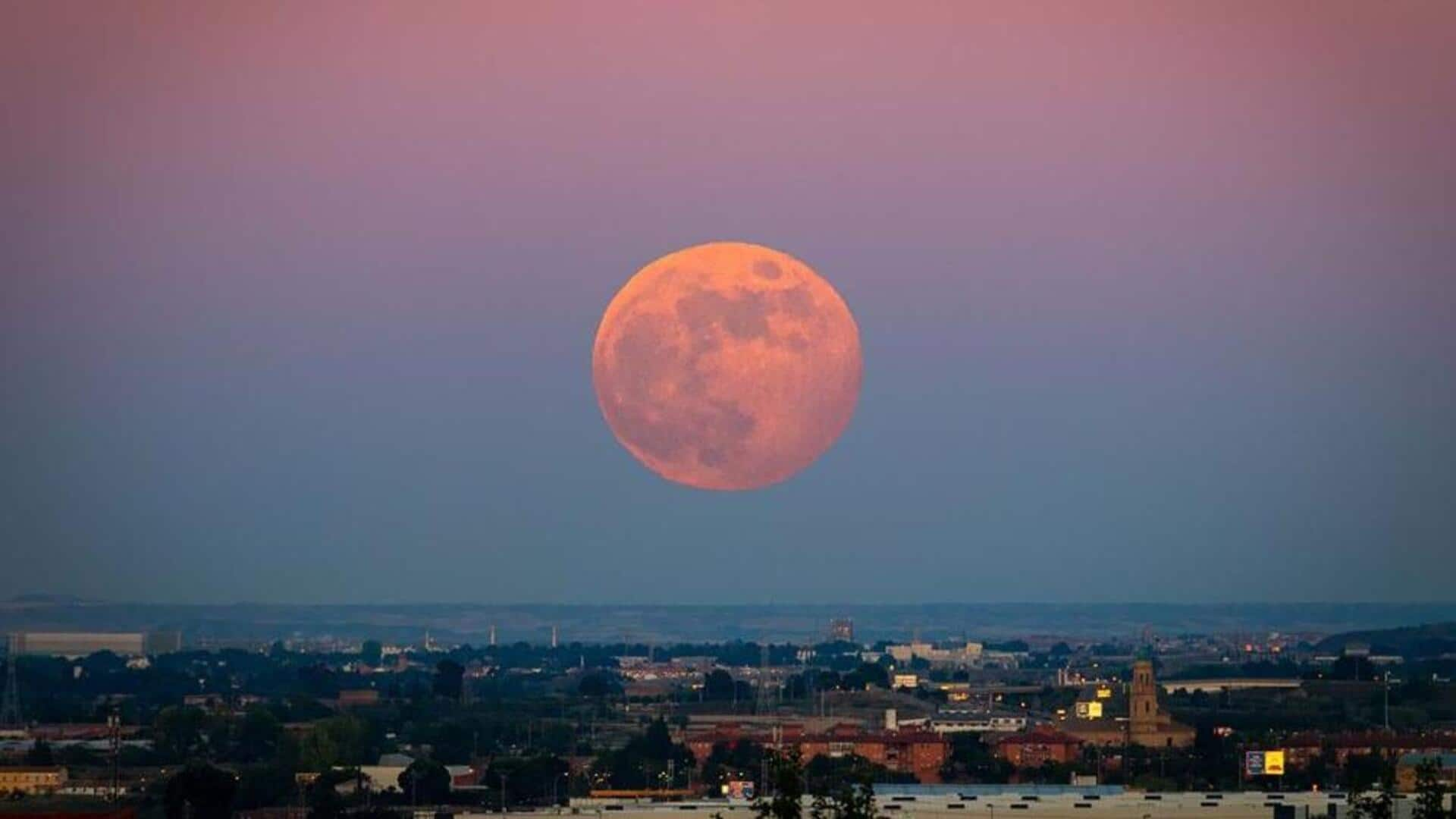
A total lunar eclipse will take place on March 3, turning the Moon into a dramatic red "blood moon." The celestial event will be visible from North America, Australia, and East Asia. During this time, the Moon will pass through Earth's shadow completely, giving it a reddish hue. This is because sunlight scattering through Earth's atmosphere illuminates the Moon with a reddish glow during totality.
Eclipse details
Totality will last for approximately 58 minutes
The total phase of the lunar eclipse, known as totality, will begin at 6:04am EST (11:04 GMT) on March 3.
It will reach its peak at 6:33am EST (11:33 GMT). This is when the Moon will be completely covered by Earth's dark umbral shadow and appear blood-red in color.
The totality phase will last for approximately 58 minutes before the Moon starts moving out of Earth's shadow.
Worldwide visibility
Last total lunar eclipse until 2028-2029
The upcoming lunar eclipse will be a global spectacle, with over 40% of the world's population being able to witness some part of it.
This translates to more than three billion people, according to Time and Date.
The March 3 event will be the last total lunar eclipse visible from anywhere on Earth until New Year's Eve 2028-2029.
Viewing schedule
Time for different time zones in the US
The total lunar eclipse will be visible at different times across various time zones.
In Eastern Time, the event will be visible from 6:04am to 7:02am on March 3.
For Central Time viewers, it will be between 5:04am and 6:02am
Mountain Time observers can catch it between 4:04am and 5:02am
Pacific Time viewers have their window from 3:04am to 4:02am.
International timings
Time for different cities in Australia
In Australia, the lunar eclipse will be visible at different times depending on the city.
Sydney residents can catch it from 10:04pm to 11:02pm AEDT on March 3 while those in Brisbane have their window from 9:04pm to 10:02pm AEST.
Adelaide residents can see it between 9:34pm and 10:32pm ACDT while Darwin viewers have their chance from 8:34pm to 9:32pm on March 3.