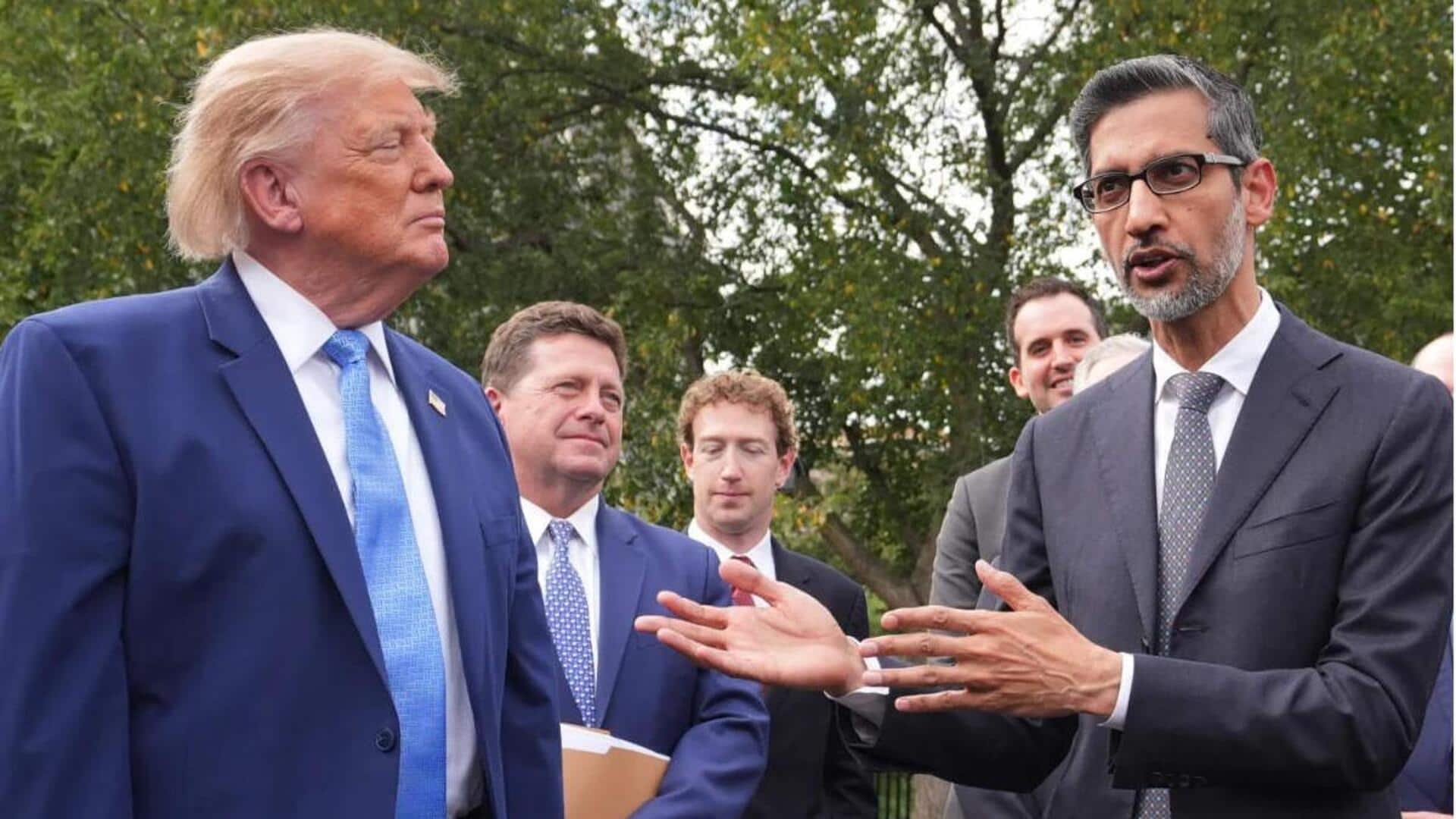
Why Donald Trump called Google CEO Sundar Pichai a 'monster'
What's the story
During a White House meeting with top artificial intelligence (AI) executives, US President Donald Trump called Google CEO Sundar Pichai a "monster." The comment was made while Trump was introducing Pichai to reporters. Despite the seemingly derogatory remark, it was all in good humor as the President praised Pichai's success in the tech industry and joked about his life without daily media interactions.
Banter exchange
'This guy is a monster...': Trump's introduction of Pichai
Trump said, "This guy is a monster, and nobody knows him. What a great life! To be a MONSTER and not have to go through this."
He then asked everyone to remember Pichai's first name.
In response, Pichai joked, "Hopefully a better tagline than I'm a monster!"
The exchange left people around them laughing.
Attendees
Other tech leaders in attendance
The AI meeting was attended by several other tech leaders, including Meta CEO Mark Zuckerberg and Anthropic CEO Dario Amodei.
NVIDIA CEO Jensen Huang, Microsoft CEO Satya Nadella, OpenAI co-founder Greg Brockman, and Palantir CEO Alex Karp were also present.
The purpose of the meeting was to discuss the future of AI and how companies can improve safety measures around advanced systems.
AI governance
Pichai and Zuckerberg on corporate governance in AI development
Pichai emphasized that companies are applying established corporate governance practices to AI development.
He said, "We are signing up to a set of processes and controls as we do in other areas, like financial controls, in a company."
Zuckerberg added the agreement would include internal risk reviews, external audits, and independent reviews by company boards to identify potential issues with their systems.
Terminology change
Trump replaces 'AI' with 'SI'
On the same day, Trump signed an executive order directing the federal government to replace "Artificial Intelligence" and "AI" with "Super Intelligence" and "SI."
The order, titled "Inaugurating the Era of Super Intelligence," mandates all federal executive departments and agencies to use these new terms in their official communication.
However, it does not retroactively affect existing regulations, contracts, or grants.