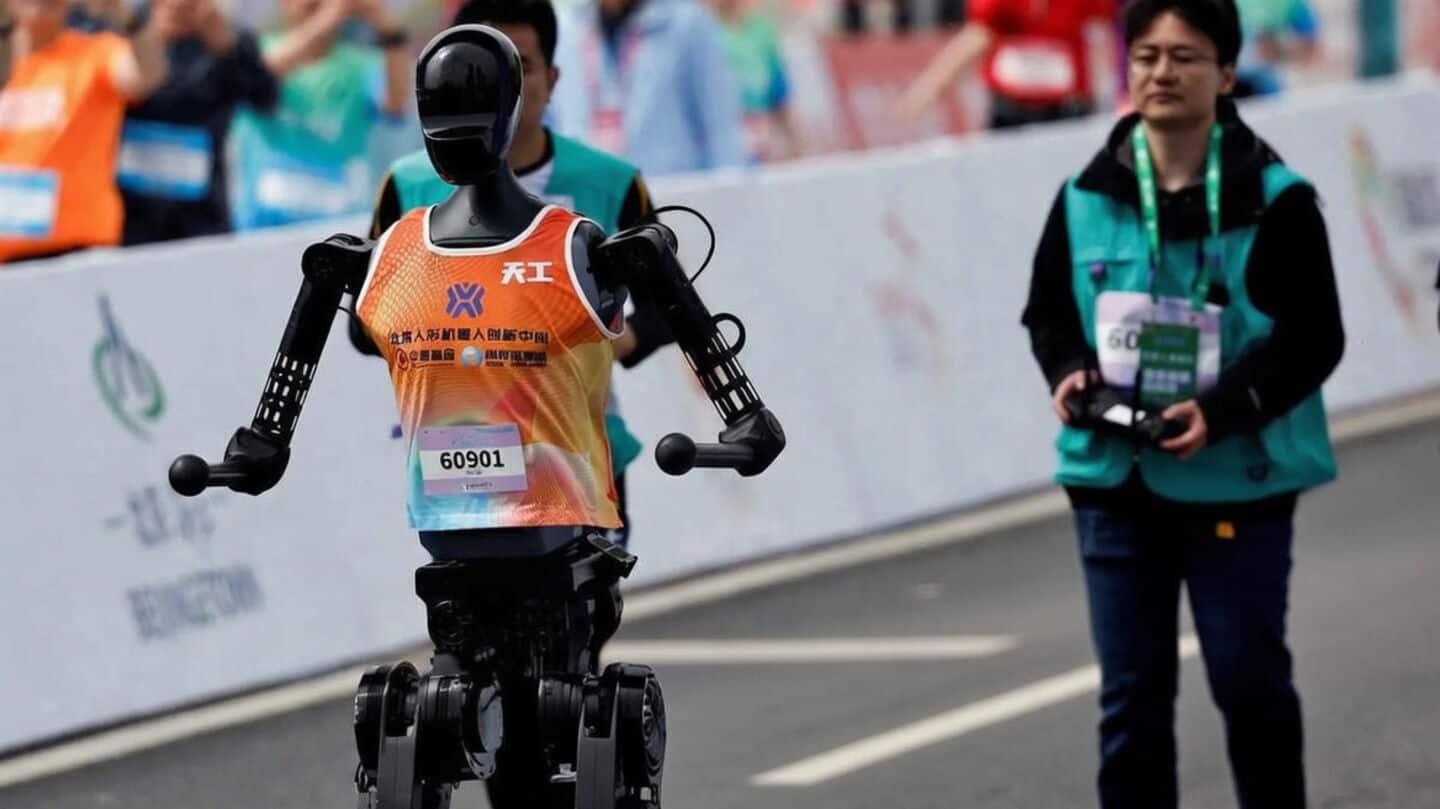
Over 300 humanoid robots to participate in China's half-marathon
What's the story
Over 300 humanoid robots are set to compete in China's second robot half-marathon tomorrow. The event, which will take place in Beijing, is part of China's efforts to develop the robotics industry into a key economic sector. This year, more than 70 teams will participate in the 21km race that includes paved slopes and parkland, almost five times as many as last year.
Technological progress
Shift toward autonomous operation
The half-marathon will be a platform for humanoid robots to demonstrate their technical advancements.
Unlike last year's event, where all participants were remotely controlled, this time nearly 40% of the robots will navigate the course autonomously.
This shift highlights the industry's growing capabilities and progress in durability of components and battery lifetime compared to previous years, according to Georg Stieler, Asia Managing Director at technology consultancy Stieler.
Performance hurdles
Challenges in robot development
The half-marathon will also highlight the challenges Chinese companies face in developing robots that can mimic human movement and performance.
Last year's race saw some robots crashing and falling near the starting line.
The winning model, Tiangong Ultra, developed by state-backed Beijing Innovation Center of Humanoid Robotics with UBTech, finished in 2 hours and 40 minutes, more than double the time taken by a human winner of a conventional race.
Advanced capabilities
Tiangong Ultra's fully autonomous run
This year, Tiangong Ultra will navigate "fully autonomously," using only its sensors to avoid the obstacles and closely mimic human gait via large-scale data simulation training.
The Center of Humanoid Robotics said that when the robot runs at speeds close to those of professional human athletes, the time window for perception and decision-making is extremely short.
This places very high demands on computing power, algorithms, and system response speed.
Market leadership
China's dominance in humanoid robots
China leads the world in humanoid robot installations, accounting for over 80% of the global total of 16,000 units by 2025.
According to Counterpoint Research, domestic market leaders AgiBot and Unitree each shipped over 5,000 units last year, the highest globally.
Despite this success, experts say that the skills on display at events like these do not translate to widespread commercialization of humanoid robots in industrial settings.