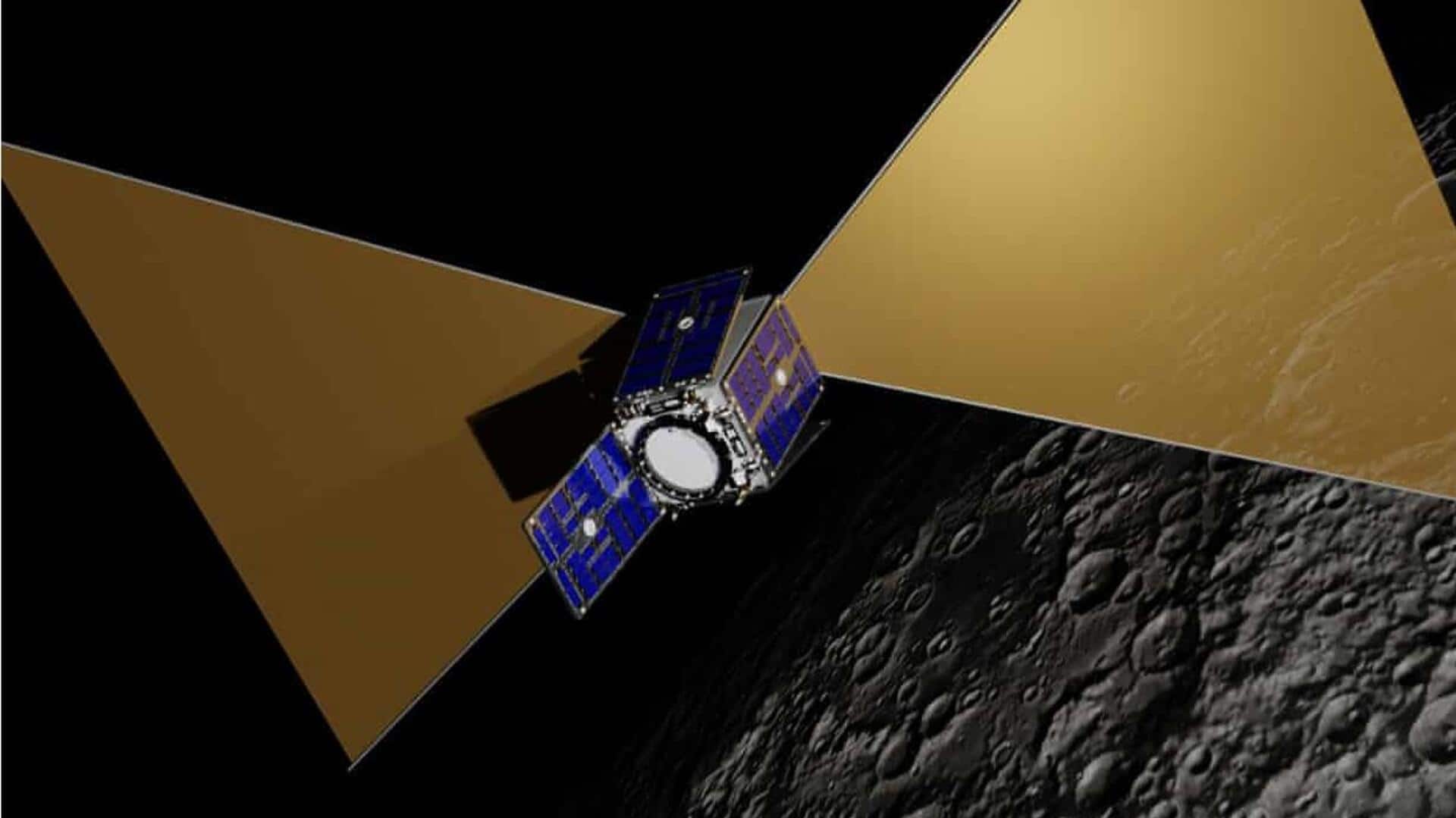
Scientists to use Moon's far side for Big Bang clues
What's the story
UK scientists are gearing up to use the Moon's far side as a unique vantage point to study the early universe. The research team plans to launch a suitcase-sized satellite, dubbed CosmoCube, into lunar orbit. The mission's primary goal is to detect a radio frequency signal emitted by neutral hydrogen atoms shortly after the Big Bang. This signal, known as the 21cm line, will provide valuable insights into the physical temperature of gas during this period in cosmic history.
Mission goals
Mission aims to trace the universe's evolution
The CosmoCube mission will span two years.
During it, the team hopes to trace the evolution of the 21cm signal from the early universe's "dark ages" (about 380,000 years after the Big Bang) through cosmic dawn (when stars and galaxies first formed) to reionization's end (about one billion years post-Big Bang).
The research team believes that studying this signal could reveal how the 21cm signal was influenced during those early cosmic epochs.
Detection difficulties
Why is Moon's far side ideal for research?
Detecting the 21cm line from Earth has proven difficult due to its weak nature and interference from human-made technology.
This includes everything from FM radios to plane communication systems, as well as disturbances created by Earth's ionosphere.
The CosmoCube mission team believes that observations taken from the Moon's far side will sidestep many of these challenges, making it an ideal location for their research.
Financial backing
Challenges and considerations ahead
The total cost of the CosmoCube mission is estimated at just under £50 million. The project has received over £2 million in funding from UK Space Agency.
Phil Bull, a professor of cosmology at the Jodrell Bank Centre for Astrophysics who is not involved in the project, welcomed the mission and its potential to illuminate our understanding of cosmic origins.
However, he also cautioned about other planned lunar missions potentially creating human-generated radio noise that could interfere with CosmoCube's observations.