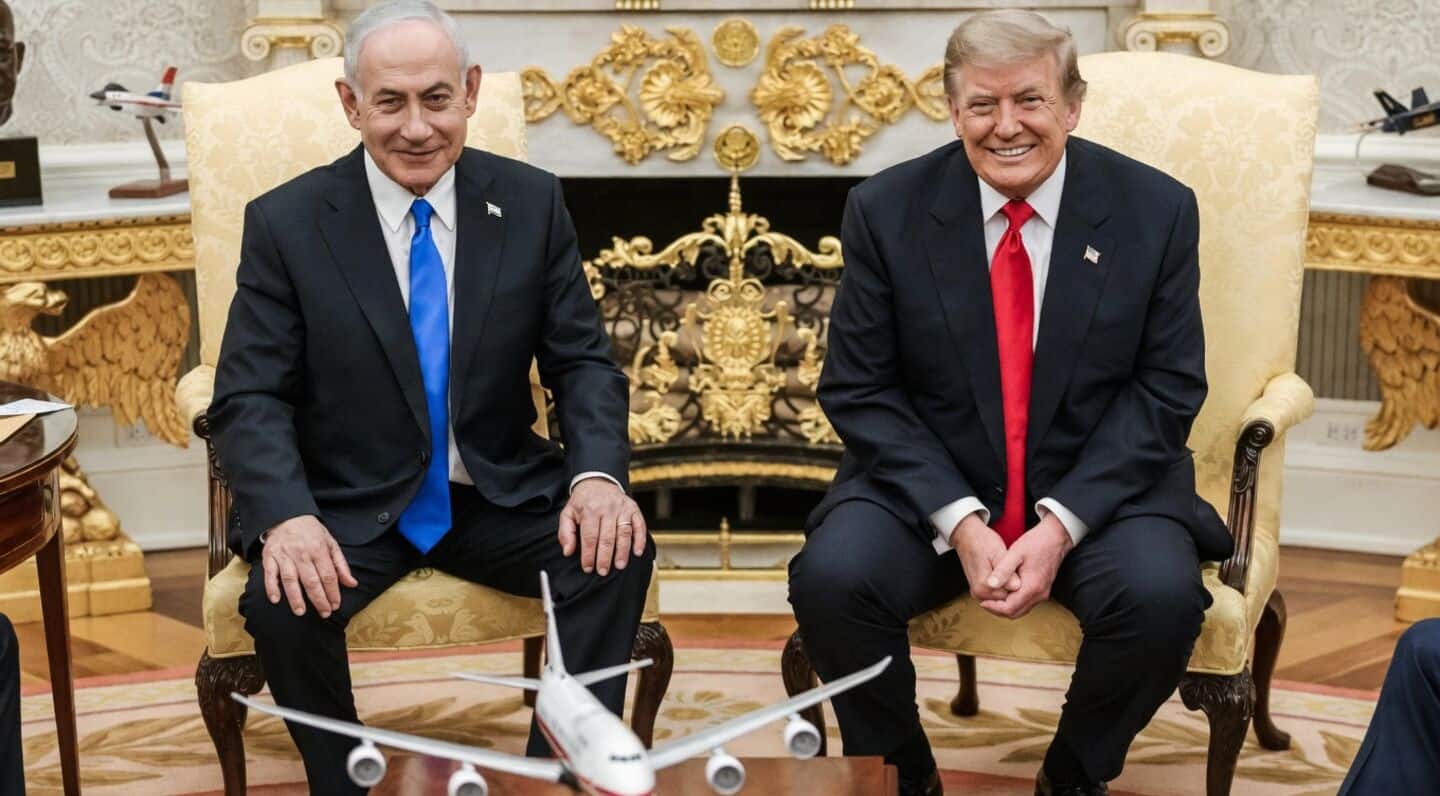
What Trump, Netanyahu discussed behind closed doors on Iran
What's the story
United States President Donald Trump and Israeli Prime Minister Benjamin Netanyahu held a closed-door meeting on Tuesday at the White House. The nearly 90-minute discussion focused mainly on Iran and its nuclear ambitions. Reportedly, the two leaders considered three potential strategies: pursuing a negotiated agreement with Tehran, maintaining a naval blockade while increasing economic pressure, and resuming and expanding military strikes if diplomacy and sanctions fail.
Diplomatic deliberations
Negotiated agreement with Tehran, naval blockade discussed
During the meeting, Trump envoys Steve Witkoff and Jared Kushner were said to be in talks with Iranian officials.
However, significant differences remain between the two sides, an official told Axios.
Netanyahu also expressed skepticism over Tehran's willingness to agree on a deal that would stop its nuclear ambitions.
The second option discussed was maintaining a naval blockade around Iran while tightening economic pressure through additional measures.
Strategic considerations
Resuming and expanding military strikes option
The third option discussed was resuming and expanding military strikes if diplomacy and sanctions fail.
The New York Post, citing an official familiar with the talks, said Israel would be willing to join the strikes if asked and will do so regardless should Tehran attack the Jewish state again.
The individual declined to go into detail about military possibilities but claimed Netanyahu mentioned ways to "advance the possibility" of Iran's regime collapse.
Regional dynamics
Discussion on Iran's internal decision-making and Syria
Axios reported that Trump also raised concerns over soaring energy prices and the impact of prolonged fighting on the global economy.
Furthermore, the discussion included Syria and Saudi Arabia.
Netanyahu showed Trump a map comparing Israeli and Turkish military presence inside Syria, arguing that Ankara controls larger portion of Syrian territory than Israel.
"Because sometimes he (Trump) forms certain opinions based on inaccurate information that some people give him. So we wanted to present the facts, visually," the official said
Defense discussions
US-Saudi nuclear agreement, Israel's defense independence discussed
The two leaders also discussed a potential US-Saudi nuclear agreement, linking it to future normalization between Saudi Arabia and Israel.
Netanyahu also pushed for Israel's defense independence from American military aid over the next decade. This included negotiating a new memorandum of understanding for direct military assistance while expanding joint missile defense and weapons development programs.
He even instructed Israel's defense industry to develop a next-generation fighter aircraft within 10 years to reduce dependence on US-made F-35s.