New cat species identified in Bolivia after over 100 years
What's the story
A new species of cat has been discovered in Bolivia's Yungas region, marking the first addition to the Felidae family in over a century. The tiny, leopard-spotted feline was officially named Leopardus tilcayo by researchers who published their findings in Current Biology. The discovery process began back in 2016 when Bolivian biologist Paola Nogales-Ascarrunz was contacted by a wildlife sanctuary about an unusual "weird cat."
Misunderstood identity
Initially thought to be a domestic cat
The animal was initially thought to be a domestic cat. However, after being kept for a year, it was taken to Senda Verde wildlife sanctuary when its wild nature became apparent.
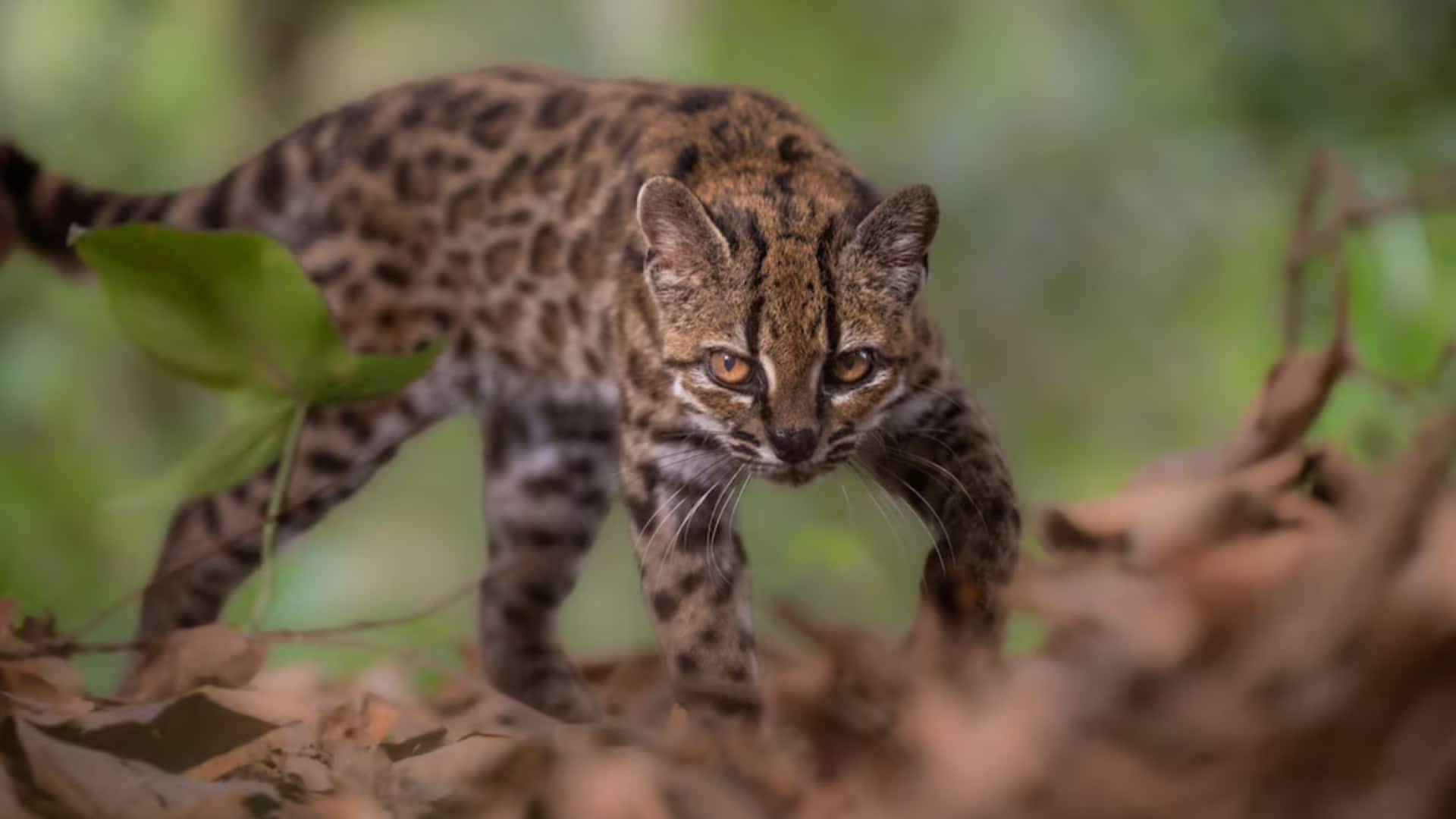
Nogales-Ascarrunz observed the cat's unique features: a small face, short ears, long whiskers, and leopard-like spots on its coat.
Initially classified as part of the Leopardus tigrinus group (known as tiger cats or oncillas), further investigation revealed something different.
Genetic confirmation
Genetic analysis confirmed it was a separate lineage
In 2019, while preparing a booklet on Bolivia's cat species, Nogales-Ascarrunz noticed the Bolivian animal had larger rosettes than its Brazilian counterparts.
This observation led to further investigation with geneticist Eduardo Eizirik and study co-lead author Jonas Lescroart.
Their genetic analysis confirmed that L. tilcayo is a separate evolutionary lineage from other tiger cats, having diverged around 1.4 million years ago.
Size and habitat
Spotted coat gives it a miniature-leopard appearance
The newly recognized species is significantly smaller than an average domestic cat.
The male specimen photographed by National Geographic was about 45 centimeters long and weighed around 1.35 kilograms. Its spotted coat gives it a miniature-leopard appearance.
Currently, L. tilcayo's habitat is known to be limited to Bolivia's Yungas forest ecoregion on the eastern slopes of the Andes Mountains.
However, much about its population size, diet, reproduction, and behavior remains unknown.
Conservation implications
Raises conservation concerns
The formal identification of L. tilcayo also raises immediate conservation concerns as its population size and distribution are still unknown.
Its known habitat, the biologically rich Yungas forest, is part of one of the biologically rich mountain ecosystems in the Andes.
The discovery serves as a reminder that even among well-studied animal groups, new species can remain hidden in plain sight.
Researchers hope this combination of field observations and genetic analysis could help discover other overlooked species.