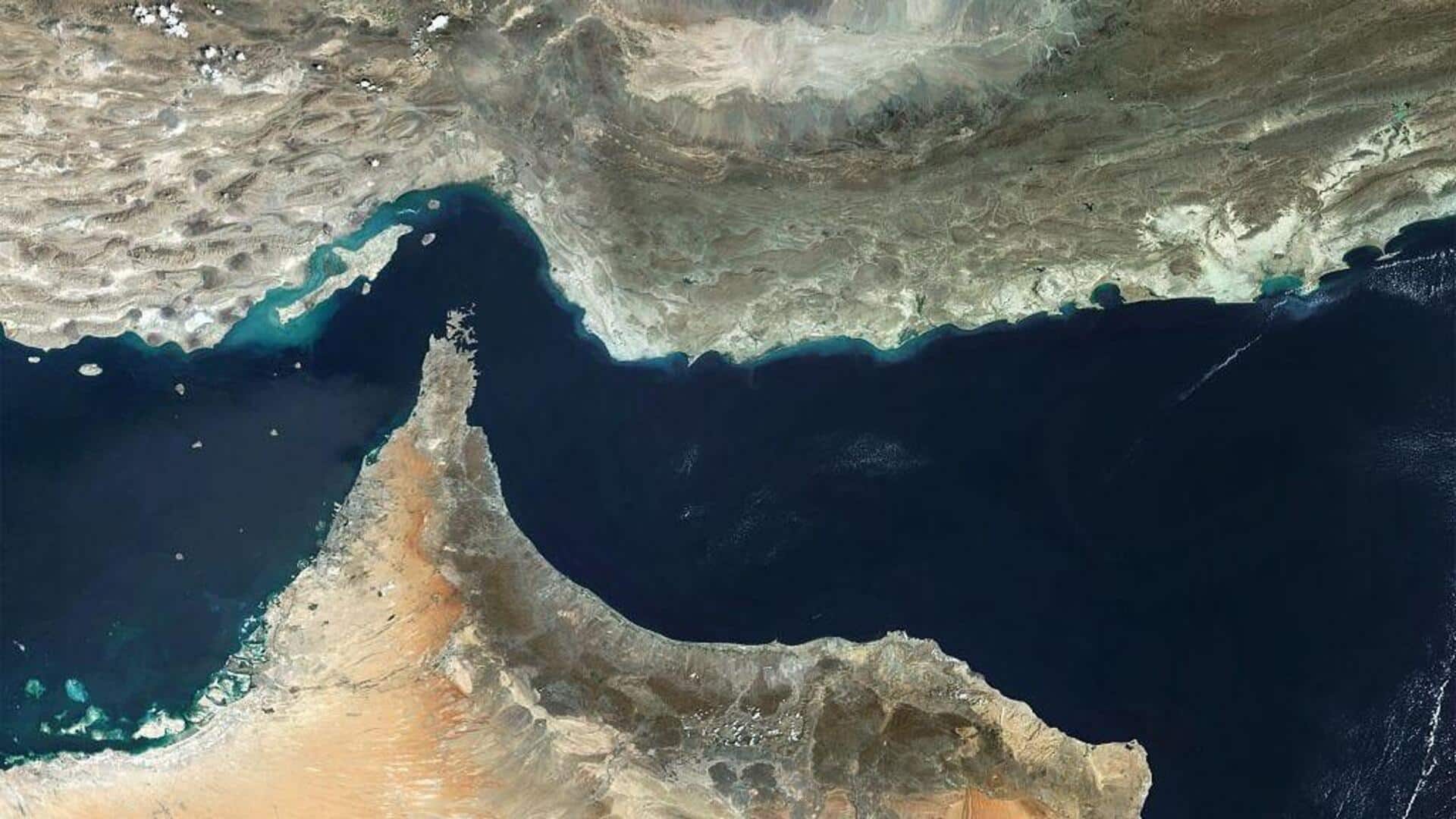
Iran might be losing control over Strait of Hormuz
What's the story
Over the last few months, both Iran and the US have claimed control over the critical Strait of Hormuz. On Tuesday, US President Donald Trump posted a map on his social media platform, Truth Social, marking the strait as US territory. He also claimed that all Iranian water mines in the area have been cleared or detonated. "The Hormuz Strait is open and operating," Trump wrote in his post.
Maritime data
Shift in shipping data
For now, maritime data indicates that the US has the upper hand.
According to Kpler, more than 80% of liquid transits across Hormuz in the last two weeks have taken the Omani route, a UN-authorized maritime channel that Iran adamantly opposes, or have been "dark" transits that likely took the Omani route.
"It increasingly looks like Iran has at least partially lost control of the strait," Homayoun Falakshahi, head of crude oil analysis at Kpler, said, as per CNN.
Shipping data
MoU with US and Iran expired
The shift in shipping data comes after a Memorandum of Understanding between the US and Iran expired this week. This allowed Tehran to collect tolls from ships passing through its preferred route.
However, with traffic now diverted to the Omani route, Iran is unable to charge these fees.
Dan Pickering of Pickering Energy Partners told CNN, "Iran's request to collect tolls is something that most Middle East folks don't want to do and haven't been doing."
Alternative routes
Gulf nations diverting oil shipments
Oil-producing Gulf nations like Saudi Arabia, Kuwait, and the United Arab Emirates are also using larger oil tankers to avoid Iran's control.
These nations are now using Very Large Crude Carriers (VLCCs) to transport oil out of the Persian Gulf through Hormuz. The crude is then transferred to other tankers outside the danger zone in the Gulf of Oman
The vessels reportedly turn off their transponders for weeks to evade detection, creating "dark traffic."
Shipping surge
Surge in maritime traffic
The United States is now tracking more oil shipping through the strait than previously estimated.
US Energy Secretary Chris Wright said last week that oil shipments through the strait, combined with cargoes rerouted around the waterway, totaled about 15 million barrels per day over one week.
This figure is close to pre-war levels and strengthens Washington's argument that Iran hasn't completely shut down the waterway.
Talks
Iran-Oman talks on restoring freedom of navigation
However, this is not to say that the US has complete control over Hormuz.
The situation is further complicated by separate discussions between Iran and Oman on restoring freedom of navigation through the strait. These talks are being held without direct US involvement.
It remains unclear whether any agreement would change shipping patterns or alter control over the strait.