What's '4F crisis' Jaishankar mentioned at UN
What's the story
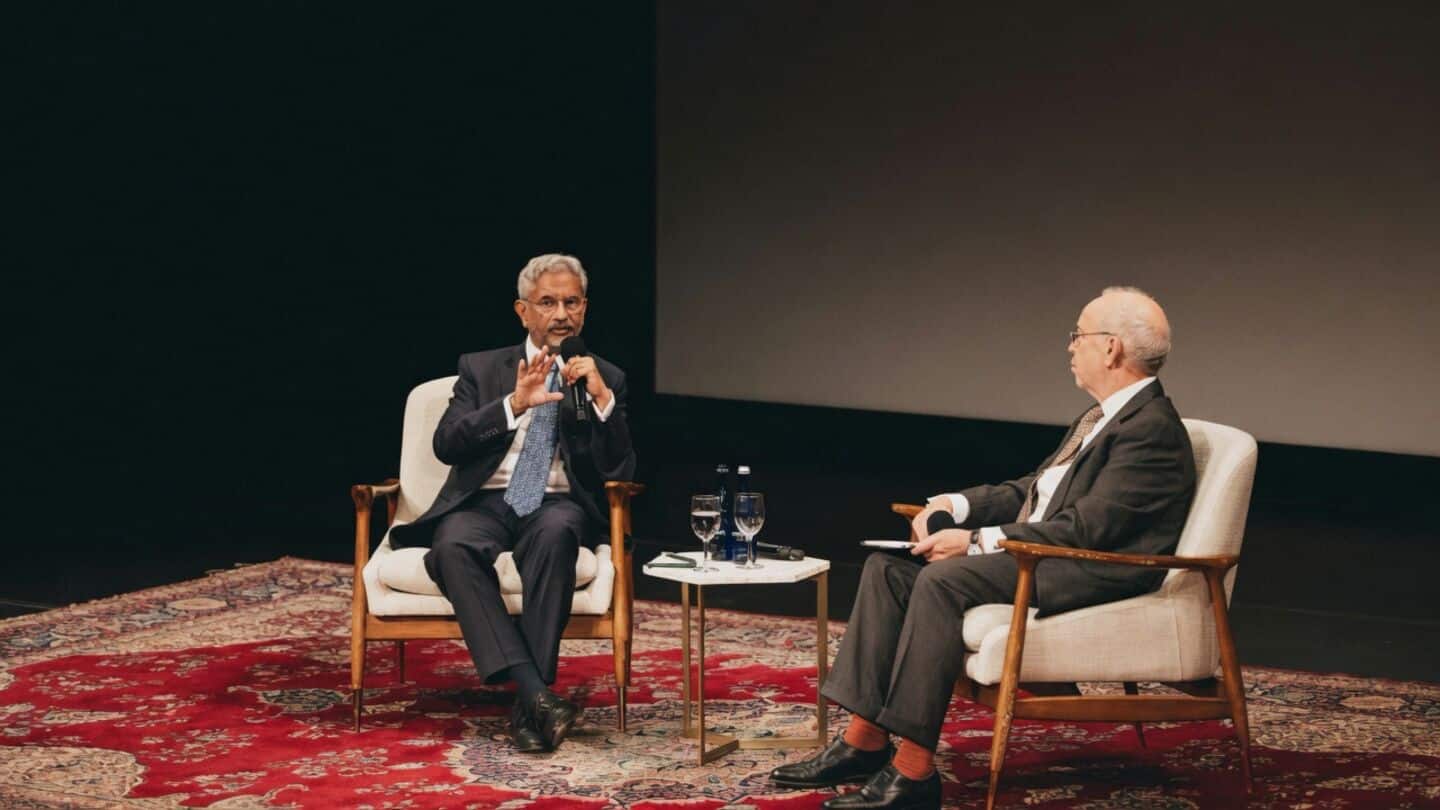
India's External Affairs Minister S Jaishankar addressed the Asia Society in New York, wrapping up the United Nations High-Level Week. He spoke about the current state of global conflicts and introduced what he called the "4F" crisis: food, fuel, fertilizer and finance. The minister pointed out two major ongoing conflicts, "each one of whom has a consequence for every country in the world," the Middle East situation and conflicts in Africa, especially Sudan.
Global interdependence
Need for cohesive outlook
Jaishankar said that "a large part of the world faces what I, in my address to the General Assembly, called the 4F crisis."
"On top of this, supply chain vulnerabilities are growing," he added.
He also shared highlights from his conversation on X, saying the current global landscape was marked by a paradox of "obsessive competition and deep interdependence."
"The interdependence is the reality, the competition is the sentiment," he said.
Twitter Post
Videos of interaction
Glad to speak at @AsiaSociety at the end of the #UNHighLevelWeek. Thank @dannyrrussel for the conversation. Highlighted the following points:
— Dr. S. Jaishankar (@DrSJaishankar) September 29, 2026
✅ The difficult state of the world, with multiple conflicts and the 4F (food, fuel, fertiliser & finance) crisis.
✅ The paradox of… pic.twitter.com/KBiGHPwf1e
Call for collaboration
'Diplomacy has become an extreme sport'
Jaishankar noted that when one country depended on another for a critical need, fierce competition provided an incentive to use that dependence as a means of pressure.
He said "diplomacy has become an extreme sport," with diplomats needing to navigate high-risk decisions and long disputes.
He identified "choke points," like geographical routes, economic sanctions, travel restrictions, and market access points, with states possessing direct influence over any of these gateways showing an increased readiness to deploy them against strategic rivals.
UN
India calls for comprehensive UN reforms
Jaishankar also questioned if institutions created under earlier power balances could adapt to present-day realities.
He said the United Nations started with 51 members in a different world, and its future relevance depends on how it responds to current challenges.
India, Brazil and South Africa have called for comprehensive reforms of global governance institutions, including the UN Security Council (UNSC), while reaffirming their commitment to strengthening multilateralism and advancing the interests of the Global South.