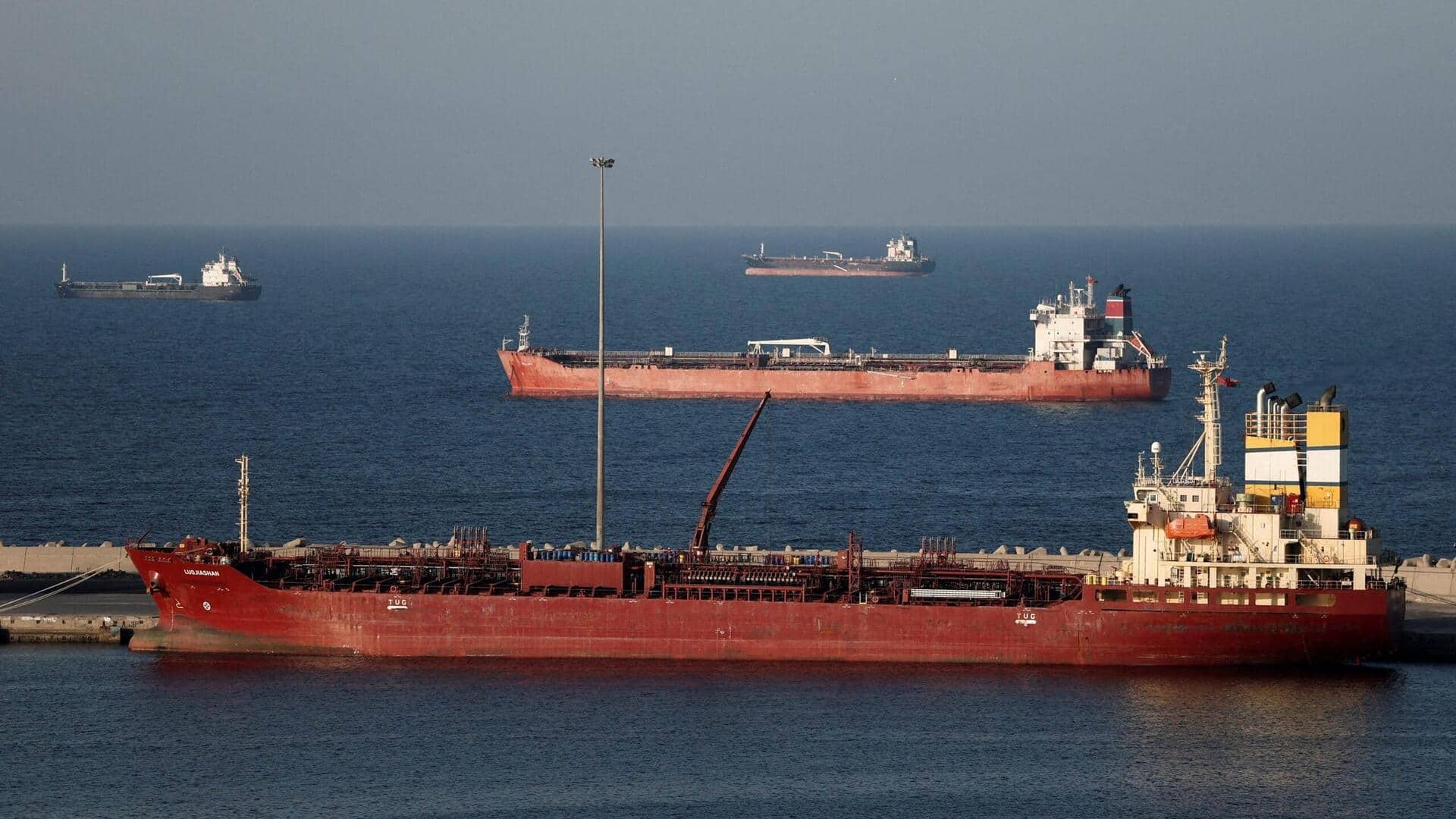
Why tankers are making U-turns in Hormuz strait
What's the story
The Persian Gulf is witnessing a spike in tensions, with at least eight vessels, including oil tankers, making U-turns near the Omani coast. The move indicates Iran's continued dominance over the strategic Strait of Hormuz. This comes despite a US-Iran agreement to reopen the waterway. Vessels have reported warnings from Iranian forces amid increased traffic that still falls short of pre-war levels, highlighting ongoing complexities for global oil markets.
Route changes
Iranian stance on vessel crossings
The affected ships, which include oil tankers, bulk carriers, and vehicle carriers, were headed toward the Strait of Hormuz.
Some vessels even reached as far as the tip of Musandam Peninsula before making sharp reversals.
A crude tanker, two products tankers, and one bulk carrier then sailed northward to take an outbound route as dictated by Iran.
The exact reason for these U-turns remains unclear but Iran has repeatedly insisted that vessels can only transit through authorized routes.
Warning signals
Radio warnings to vessels
In recent months, vessels leaving the Persian Gulf have reported receiving radio communications from Iranian forces warning them that they need permission from Tehran for their crossings.
Some have even been attacked for continuing with their journeys, raising wider concerns over coordinating transits.
The risk tolerance of tanker companies and their crews is critical to normalizing the global oil market.
Market impact
Daily average of commodity vessels crossing strait
Since Monday, an average of 34 commodity vessels have crossed the Strait daily.
This is a significant increase from the daily averages during much of the war but still far from pre-war levels.
Between June 30 and July 1, 65 ships crossed along the Omani side with 59 supported by the US, data from Joint Maritime Information Center shows.