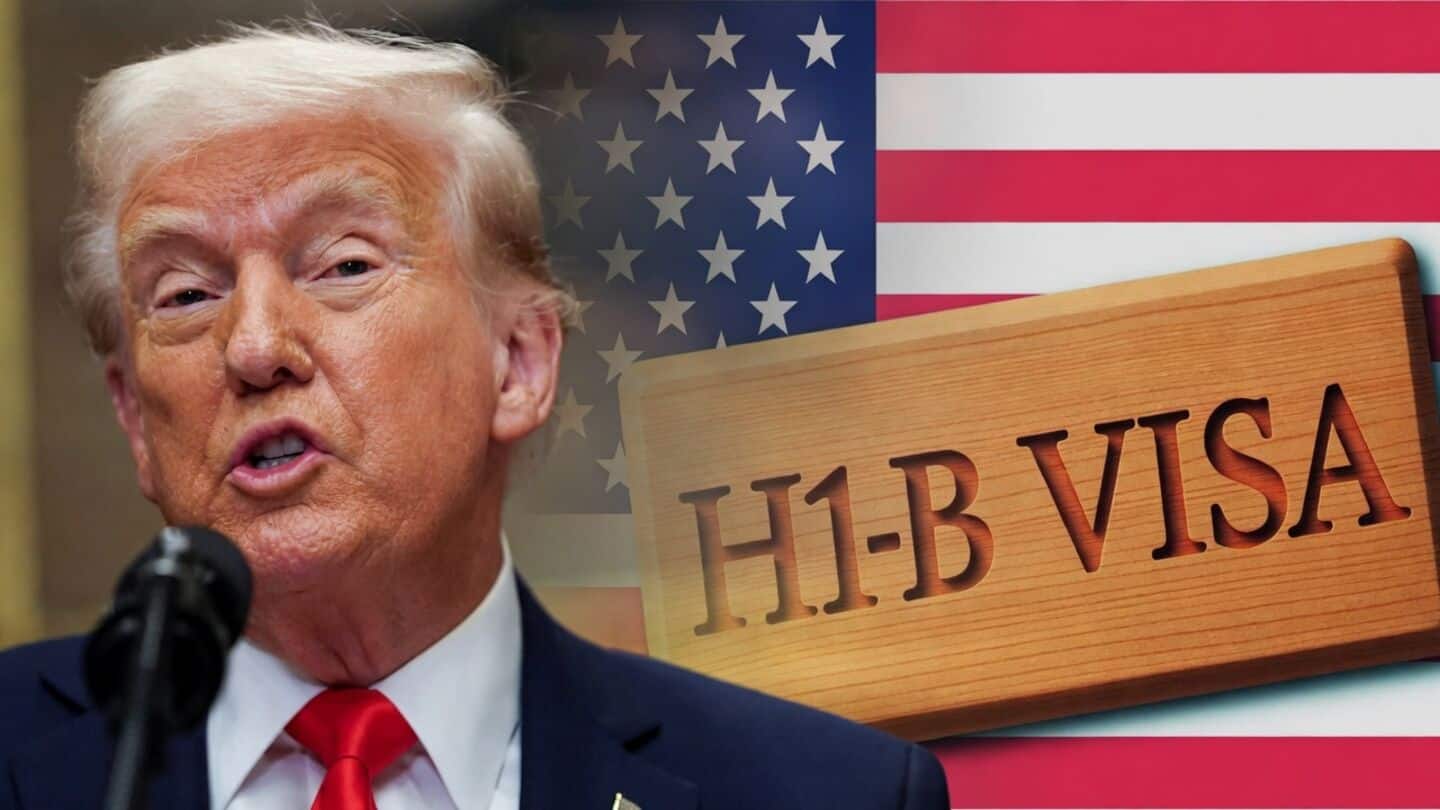
US judge strikes down Trump's $100,000 fee on H-1B visas
What's the story
A United States federal judge has struck down the $100,000 fee on new H-1B visas imposed by President Donald Trump. The ruling was delivered by US District Judge Leo Sorokin, who found that Trump lacked the authority to impose such a fee without congressional approval. The decision is a major win for businesses and universities that rely on highly skilled foreign workers. Notably, Indians make up the largest share of H-1B visa holders.
Ruling details
Fee hike was unauthorized tax: Judge
Judge Sorokin ruled that the $100,000 fee was not a lawful immigration penalty but an unauthorized tax.
He wrote, "Here, the substance and application of the $100,000 payment reveal that it is a tax, regardless of what the payment is called."
The judge ordered that this measure was unlawful and must be invalidated.
Legal challenge
Lawsuit filed by 20 Democratic state attorneys general
The lawsuit challenging the fee was filed by 20 Democratic state attorneys general.
They argued that the exorbitant fee would hurt employers, universities, hospitals, and tech companies dependent on skilled foreign workers.
Before this hike, employers paid between $2,000-$5,000 in fees to sponsor an H-1B worker, depending on company size and other factors.
Visa impact
H-1B visa program crucial for hiring professionals in specialty occupations
The H-1B visa program is crucial for hiring foreign professionals in specialty occupations such as technology, engineering, healthcare, and finance.
It issues 65,000 visas annually, with an additional 20,000 for advanced degree holders from US institutions.
According to immigration advocacy group FWD.us, about 730,000 H-1B visa holders live in the US along with around 550,000 dependents, including spouses and children.
Application drop
Fee hike discouraged employers from seeking H-1B visas
Court filings revealed that the steep fee hike discouraged employers from seeking H-1B visas.
As of February 15, only 85 payments of the $100,000 fee had been received by US Citizenship and Immigration Services.
The Trump administration had argued that this charge was a monetary penalty aimed at limiting entry for certain foreign nationals and claimed federal immigration law permitted such an imposition.