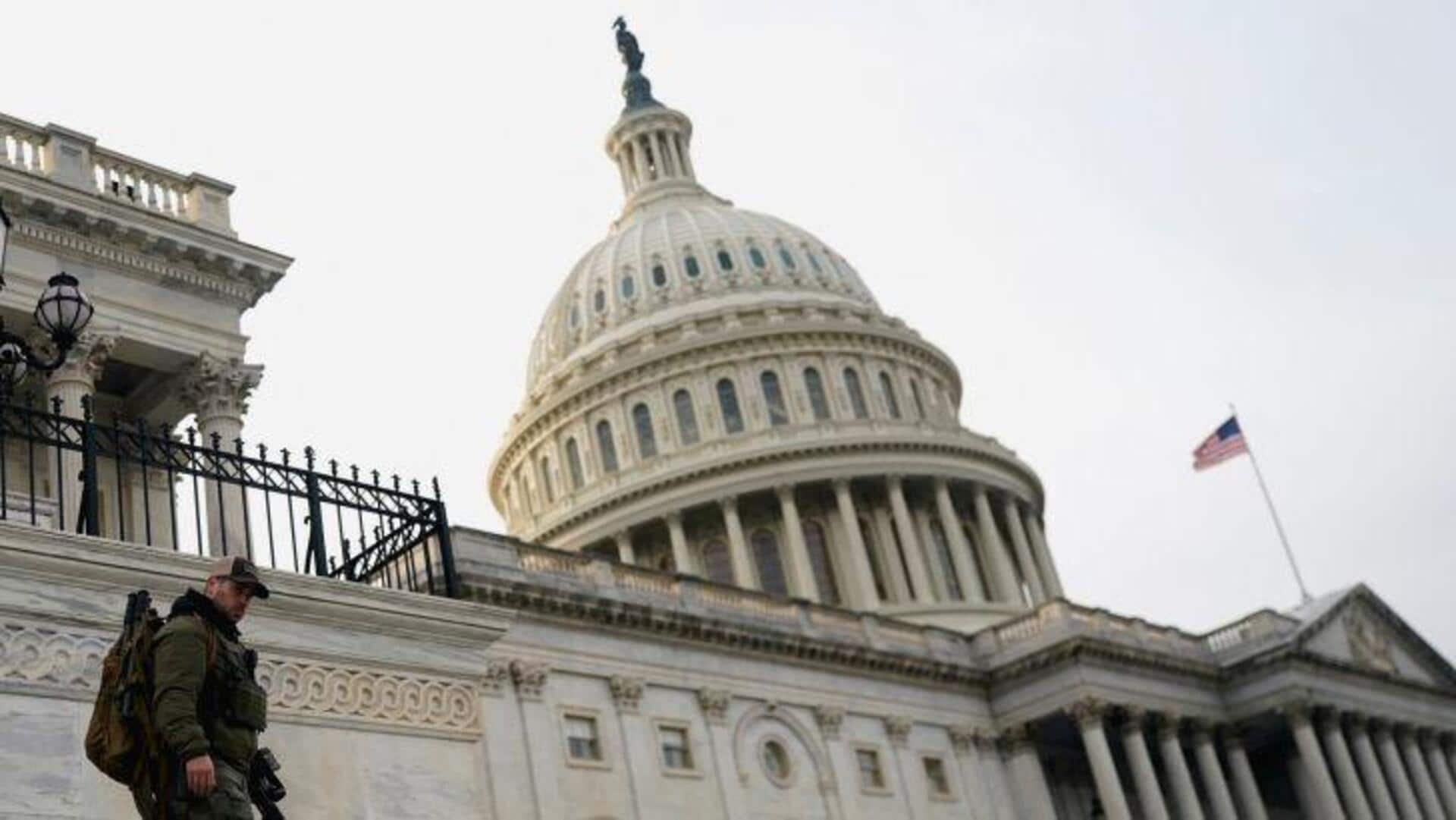
US House passes resolution directing Trump to end Iran war
What's the story
The United States House of Representatives has passed a war powers resolution calling on President Donald Trump to end hostilities with Iran. The resolution was approved with a narrow bipartisan majority, 215-208, in the Republican-led House. Notably, four Republicans, Thomas Massie of Kentucky, Brian Fitzpatrick of Pennsylvania, Warren Davidson of Ohio and Tom Barrett of Michigan, joined Democrats in backing the measure. This marks a major rebuke of Trump's handling of the ongoing conflict and its economic repercussions.
Conflict continuation
House Speaker defends Trump's decision to attack Iran
Ahead of the resolution's passage, House Speaker Mike Johnson defended President Trump's decision to attack Iran.
He argued that Iran had declared war on the US 47 years ago and continues to chant "death to America."
Johnson said, "The president is trying to keep the people safe."
However, this vote is largely symbolic as Senate Democrats have failed to pass a similar resolution through their chamber.
Even if the measure passes in Congress, it would likely be vetoed by Trump.
Democratic response
House Democrats urge Senate Republicans to follow suit
Nonetheless, House Democrats celebrated the vote and urged Senate Republicans to follow suit.
Minority Leader Hakeem Jeffries and his deputies issued a statement saying, "Following repeated attempts to get sycophants in the Republican-controlled House to join us, House Democrats successfully passed our War Powers Resolution today to stand up for the American people and hold Donald Trump accountable."
"It is now time for Senate Republicans to do the right thing," they said.
Ongoing hostilities
Conflict with Iran continues, war powers act mandates end hostilities
Under the 1973 War Powers Act, the president has 60 days to halt hostilities if there is no congressional authorization. But he can also seek a 30-day extension.
The same statute also empowers Congress to end hostilities by voting on a resolution to do so, subject to the president's veto.