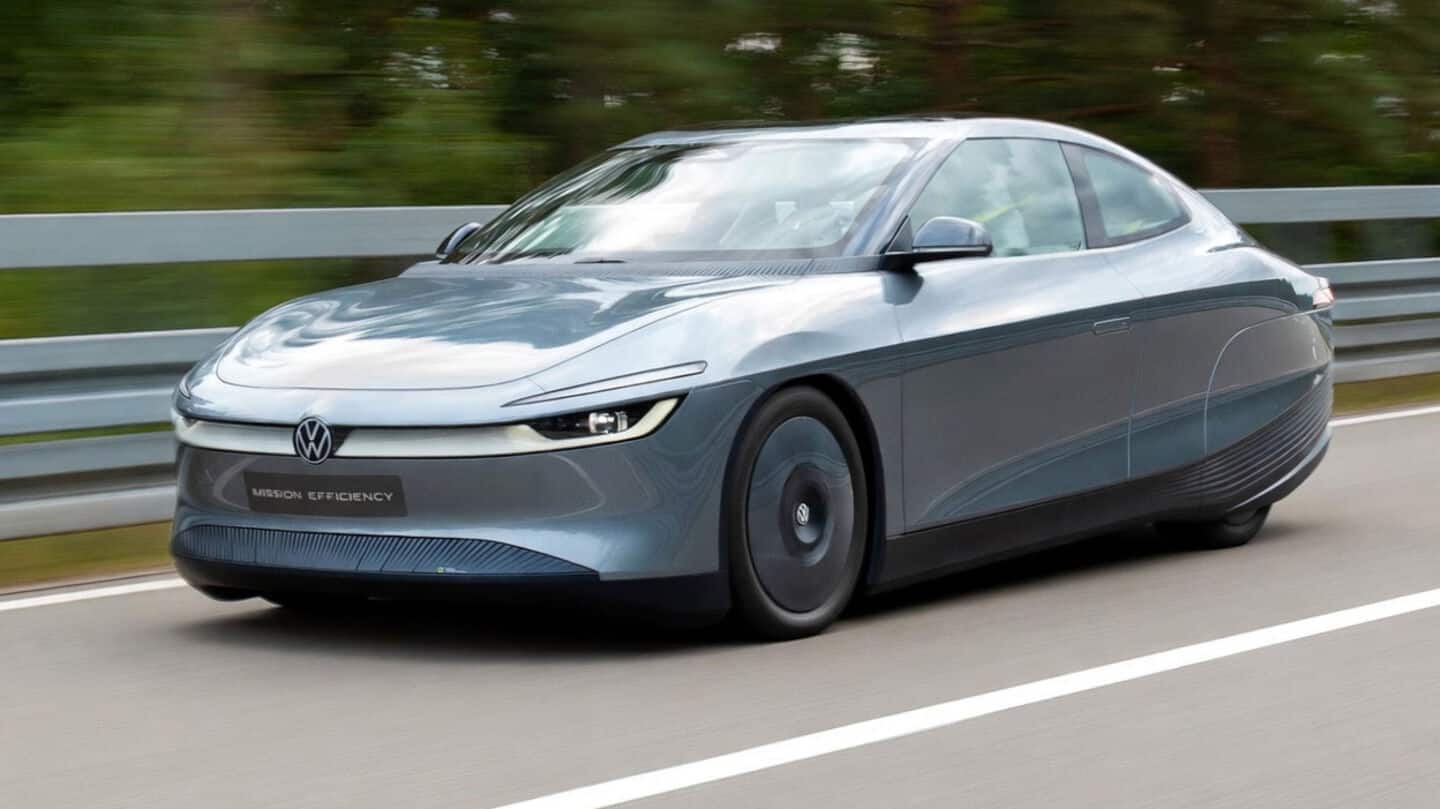
Volkswagen's futuristic concept EV sets new benchmark for efficiency
What's the story
Volkswagen has channeled the spirit of the 313mpg XL1 hypermiler for a new long-range electric vehicle (EV) concept, the Mission Efficiency. The prototype is based on the same MEB+ platform as the new ID. Polo and has set a new benchmark for efficiency. During a 794-mile journey from Wolfsburg to Vienna, it achieved an impressive 13.31km per kWh (mpkWh). Excluding energy lost while charging, it even hit up to 9.02 mpkWh.
Performance
It offers a real-world range of 653km
The Mission Efficiency's 52kWh battery provided a real-world range of 653km on a single charge, which is 200km more than the ID. Polo's WLTP range.
The journey, which passed through Poland and Berlin, included speeds of up to 138km/h on the autobahn and averaged at 68km/h.
A separate test under controlled conditions pushed the concept car beyond 805km without stopping.
Innovative design
What do we know about the design?
The Mission Efficiency combines the entry-level ID Polo's 114hp front-mounted motor with the top-spec version's battery.
By reducing the 'safety' buffer of the 52kWh pack, VW boosted its usable capacity to 54kWh.
The car also features a lower and longer body, narrower at the rear than other models on the same platform.
This design change has made it more aerodynamic with a drag coefficient of just 0.158.
Spacious interior
It has a spacious 600-liter boot
Despite its size increase, the concept car is less than 50kg heavier than the ID. Polo, at 1.6 tons.
It offers two rear seats and a spacious 600-liter boot within its 4.2m-long frame.
The rear wheel covers can even be folded out to reveal small storage boxes for charging cables.
Tech advancements
The car uses conventional mirrors
The front seats of the Mission Efficiency are 3D-printed versions of those in the T-Roc Cabriolet model.
It also features a removable tablet touchscreen dashboard, mounted via a detachable arm.
However, unlike its predecessor XL1, this concept car doesn't have screens for a digital rear-view camera.
Instead, it uses conventional mirrors with unpowered door handles to save energy and enhance efficiency.