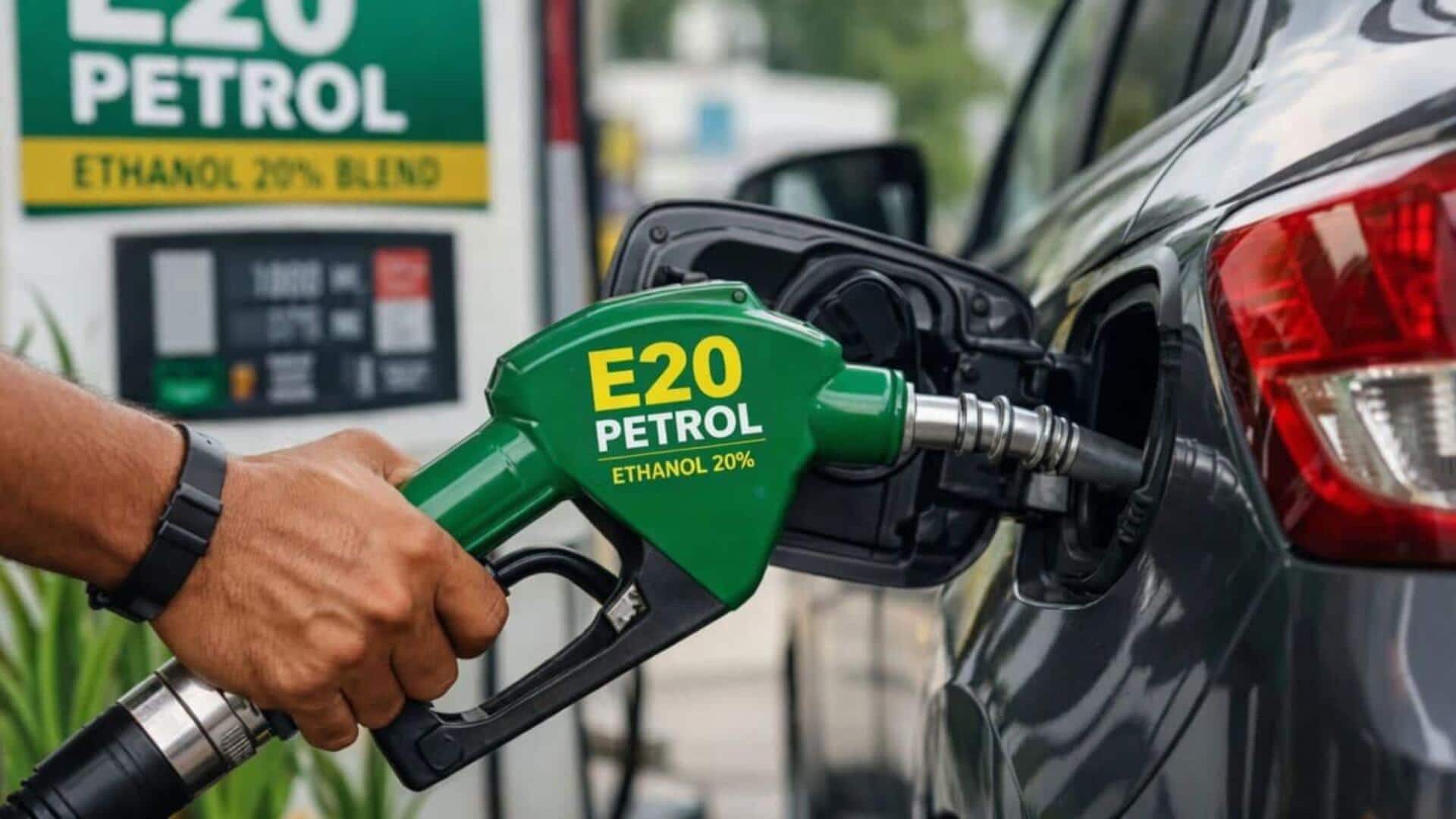
E20 can lower mileage of your older vehicle by 3-5%
What's the story
The Indian government has revealed that the new 20% ethanol-blended petrol (E20) may lead to a slight reduction in fuel efficiency for some older vehicles. The decrease is estimated to be around 3-5%. However, extensive testing and real-world use have not shown any major engine damage or vehicle breakdowns due to ethanol blending, the Centre informed Parliament today.
Efficiency determinants
Fuel efficiency affected by multiple factors
In a written reply to the Rajya Sabha, Minister of State for Petroleum and Natural Gas, Suresh Gopi, said fuel efficiency is affected by many things like driving style, vehicle upkeep, tire pressure, wheel alignment, and air-conditioning load.
The government also emphasized that E20 offers better octane rating, anti-knock properties, combustion quality, and acceleration.
Fuel usage
Extensive use of E15+ blends
The government further noted that E15+ and E19-E20 fuels have been widely used for over 3.5 years and 2.5 years, respectively.
Over 20 crore two-wheelers and over three crore petrol cars, including older models not certified for E20, have been using these blends without any proven case of widespread engine damage due to ethanol blending.
Damage reports
No damage reported by manufacturers
Data from manufacturers also supports the government's claim.
One major four-wheeler maker serviced 2.84 crore vehicles in FY 2025-26, including about 1.5 crore older non-E20-certified vehicles, without any report of vehicular damage due to E20 fuel.
A leading two-wheeler manufacturer also found no increased incidence of damage in vehicles running on E20 compared to earlier fuel blends.
Warranty commitments
Other key takeaways from the report
The government has also said that manufacturers are still honoring their warranty commitments for vehicles running on specification-compliant E20 fuel.
It added that extensive laboratory studies and field trials have shown no major difference in legacy vehicles on parameters like drivability, startability, metal compatibility, as well as the plastic compatibility.
Fuel transition
Stance on reverting back to E0 or E10 petrol
The government has no plans to revert back to E0 or E10 petrol.
It argued that maintaining parallel supply chains across over one lakh retail outlets for these fuels would only increase logistics complexity, inventory, and handling costs.
This stance comes amid a growing political and public debate over mandatory E20 petrol in India.