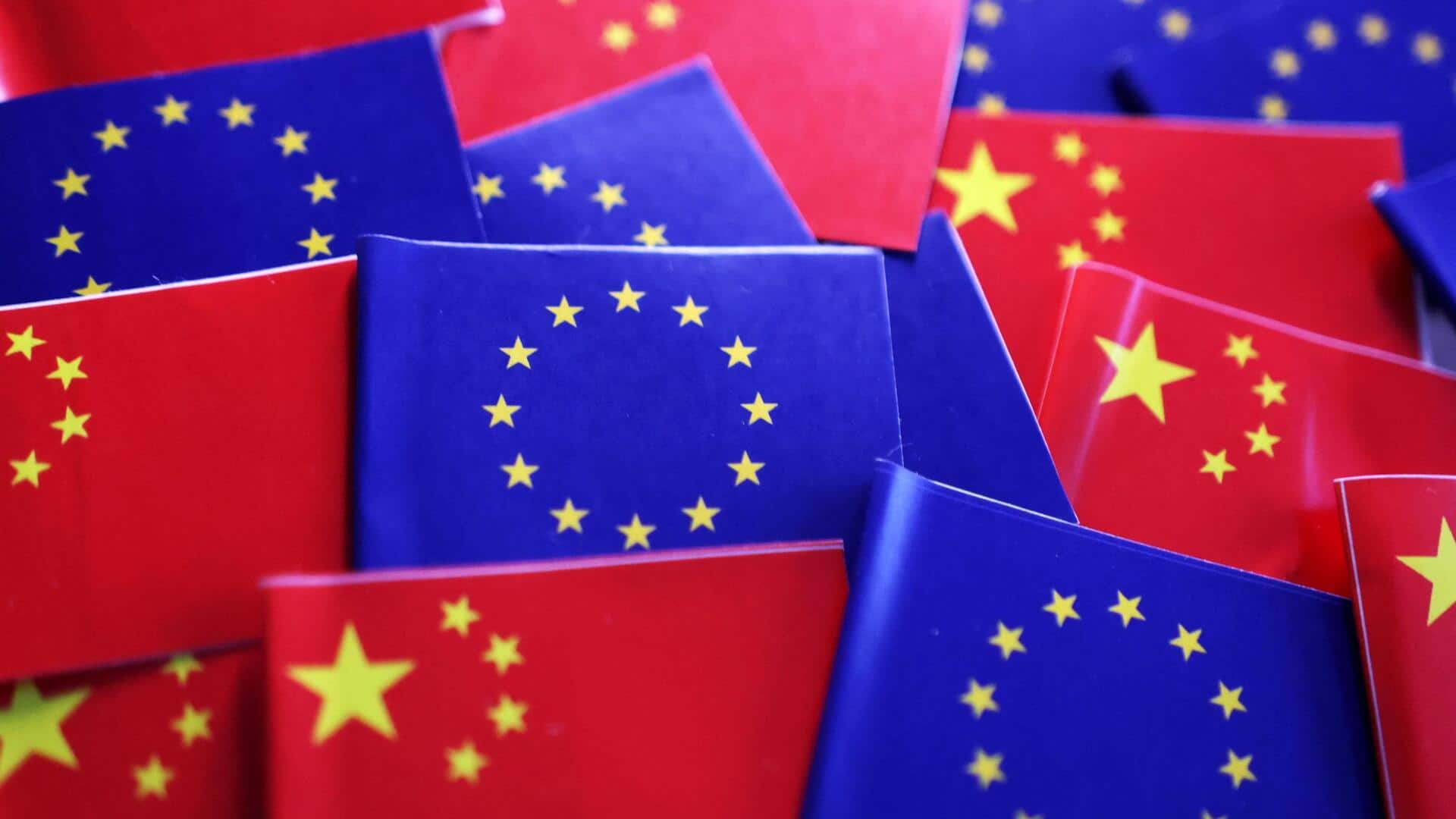
EU strikes a preliminary trade deal with China
What's the story
The European Union (EU) and China have struck a preliminary trade deal aimed at addressing trade imbalances between the two economic giants. The agreement, which was reached after two days of negotiations, is said to include lower tariffs on certain European goods imported into China and measures to ensure stable rare earth supply chains. The deal could potentially cut up to 50% of Chinese electric and plug-in hybrid vehicle imports to the EU.
Tariff reduction
Deal needs approval from all 27 EU member states
The preliminary trade deal could lower tariffs on products benefiting "almost every" EU nation.
This move is expected to prevent millions of car exports from China to the European Union, according to EU trade commissioner Maros Sefcovic.
However, the deal still needs approval from leaders across all 27 member states of the EU before it can be implemented.
Response
Chinese Commerce Minister's response to EU's recent measures
In response to the EU's recent restrictive measures, Chinese Commerce Minister Wang Wentao expressed concerns.
He said that China is not the root of the EU's problems but a partner in solving them.
The head of the European Automobile Manufacturers' Association, Sigrid de Vries, welcomed this deal as a way to avoid further instability in the EU and facilitate an orderly transition for China's presence in the European market.
Approval process
Sefcovic to seek EU leaders' approval for trade deal
Sefcovic plans to brief EU leaders meeting in Brussels next week and seek their approval for the trade deal.
He said, "They would have to see that this is convincing enough to take the other steps."
The EU has been trying to limit imports of Chinese-made electric vehicles and EV batteries while protecting its steel industry from competition.
Ongoing negotiations
Trade tensions between the 2 sides
Trade tensions have escalated in recent months, with both sides imposing or considering curbs on each other's imports.
The EU has restricted imports of Chinese-made electric vehicles and EV batteries while protecting its steel industry.
China has also launched an anti-dumping investigation into imports from the EU of p-nitrotoluene, a chemical compound used in dyes and pharmaceuticals.
The two sides will meet again via video conference in January before an in-person meeting scheduled for March.