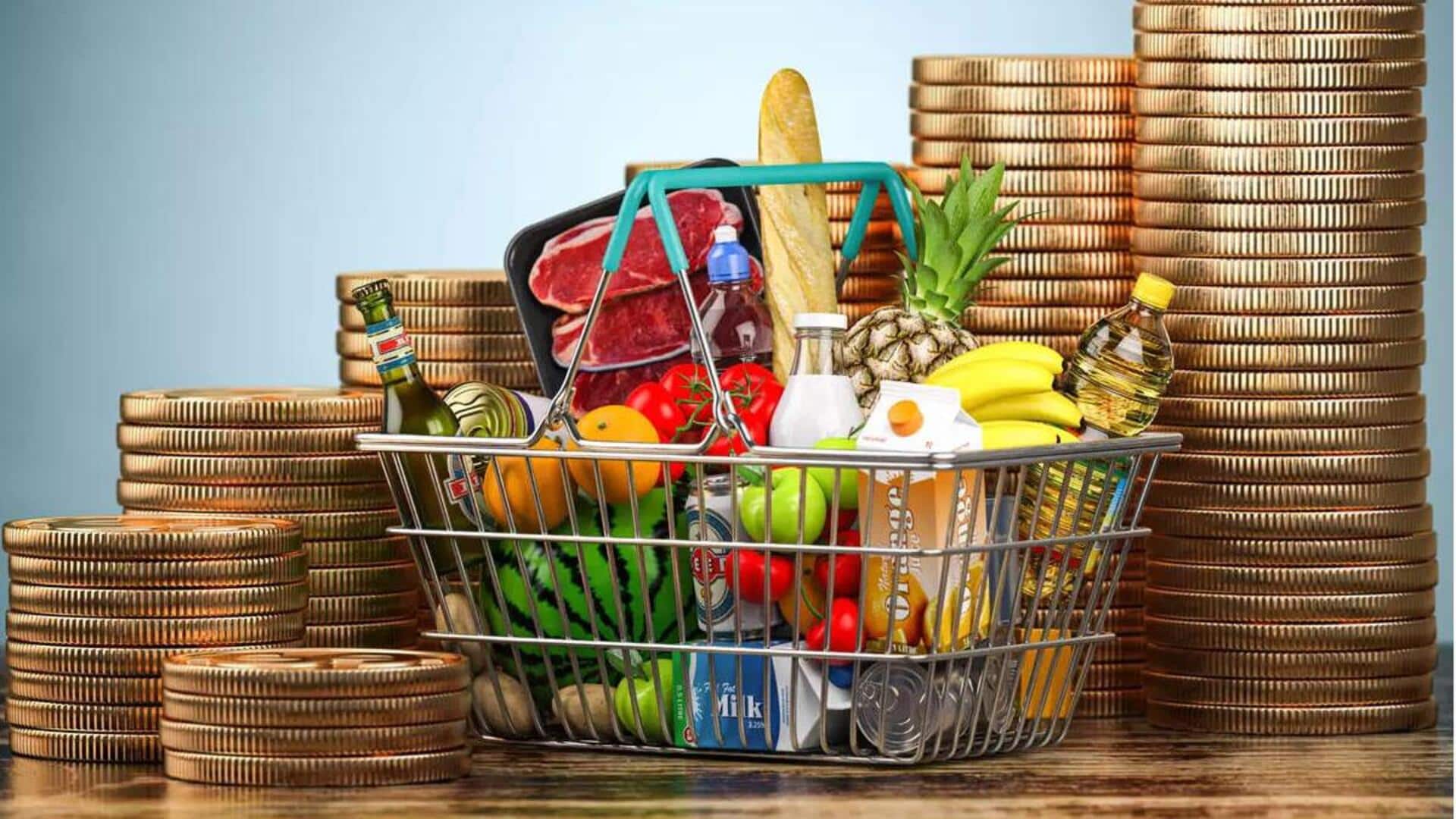
From groceries to OTT: How India is reshaping inflation basket
What's the story
India's Consumer Price Index (CPI) is getting a major update. The Ministry of Statistics and Programme Implementation (MoSPI) will launch a revised CPI series with a new base year of 2024, replacing the previous 2012 base year. The updated series uses data from the Household Consumption Expenditure Survey, 2023-24 to better reflect current Indian household spending patterns.
Weight adjustment
Major weightage shifts in spending categories
The CPI revamp primarily involves a recalibration of weights across different spending categories.
The most significant change is the reduced weightage for food and beverages, which has been lowered to 36.8% from 45.9%.
This change reflects changing consumption patterns as incomes rise and discretionary spending typically grows faster than food.
Inflation impact
Expected inflation readings under the new series
The revised CPI series will have a direct impact on inflation readings.
Economists estimate that under the new weights, CPI inflation for January 2026 could be around 3%, which is about 50 to 80 basis points higher than what the old series might have shown.
However, the final effect will also depend on base-year price levels and the new indexation methodology.
Digital integration
Digital economy and online prices
The revised CPI marks a major shift toward capturing a more digital, services-led economy.
For the first time, inflation measurement formally includes online prices. Airfares, OTT subscriptions, telecom plans and select services are now directly tracked through digital platforms.
To capture e-commerce pricing, 12 dedicated online markets have been added in large cities.
Enhanced scope
Expanded coverage and increased granularity
The CPI 2024 series also expands the scale and granularity of price collection.
Rural coverage now includes 1,465 villages across 686 districts, up from 1,181 villages and 582 districts earlier.
Urban coverage has also increased to include more markets in more towns.
The consumption basket itself has widened to track more goods and services than before.
Global alignment
Adoption of global COICOP standard
One of the most significant structural upgrades in the CPI 2024 series is the adoption of COICOP 2018, a UN-endorsed global standard for grouping household expenditure.
This brings India's inflation framework closer to international practice and improves cross-country comparability.
Several items have been carefully reclassified to match this global standard, including clothing and footwear which are now split into men's, women's and children's categories.
Methodological improvements
Addressing long-standing methodological issues
The revised CPI series also addresses several long-standing methodological issues.
A key improvement is the treatment of free items and missing prices.
Under the old series, when Public Distribution System (PDS) items such as rice and wheat were made free under government schemes, their weights were redistributed to other items—artificially skewing inflation readings.
In the new CPI, free social transfers are excluded altogether, recognizing them as government transfers rather than household consumption.