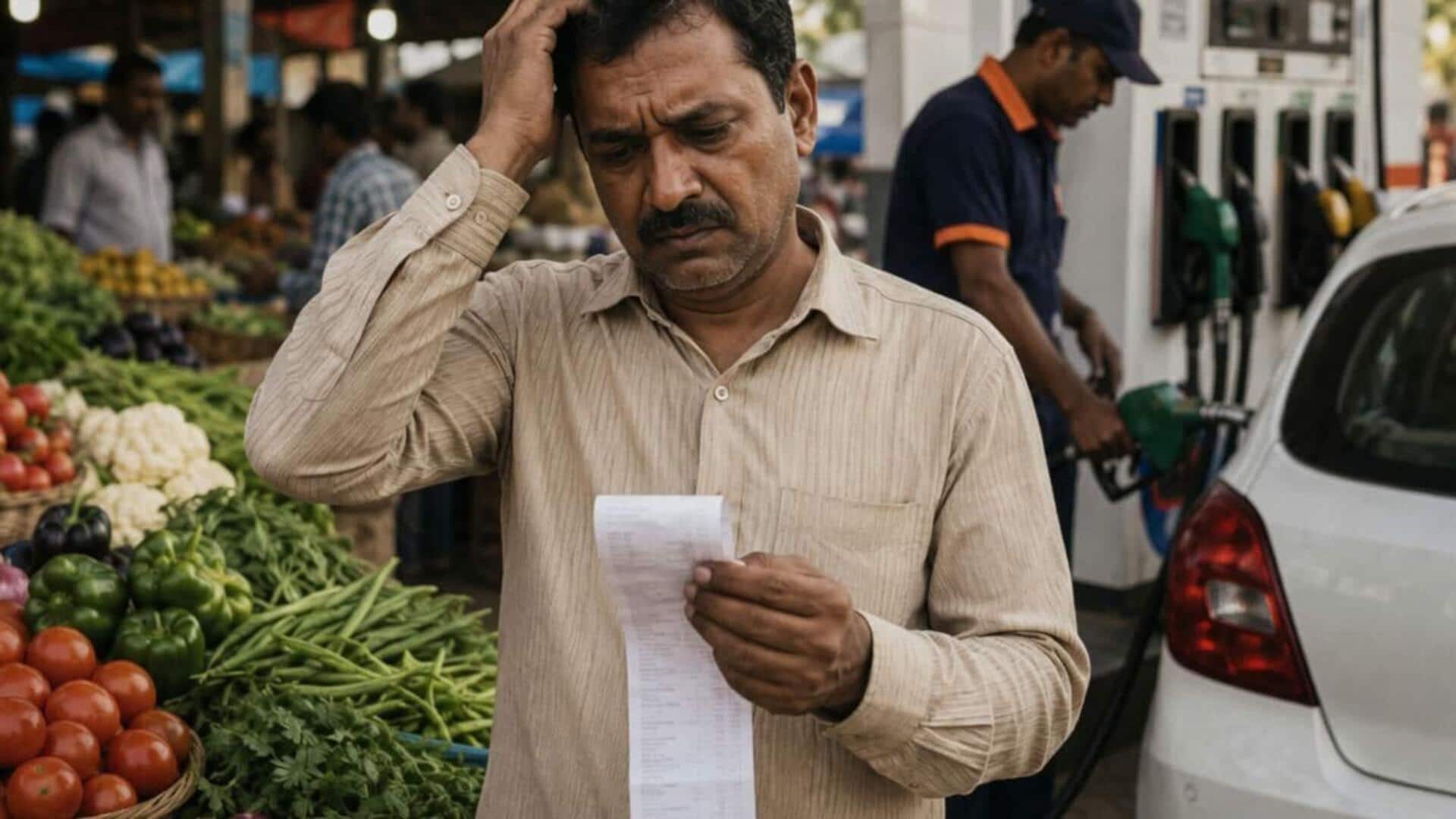
India's wholesale inflation spikes to over 11% in September
What's the story
India's wholesale inflation has surged to 11.39% in September, compared to 9.92% in August, official data from the Ministry of Commerce and Industry showed today. The sharp increase is mainly due to a steep rise in fuel and power prices, food costs, and manufactured goods prices. A Reuters poll had earlier estimated wholesale inflation at 10.18% for September.
Retail impact
Retail inflation also jumped to 5.54% in September
Along with wholesale prices, India's retail inflation has also witnessed a sharp spike.
It rose to 5.54% in September from 4.83% in August, primarily due to skyrocketing food prices, especially vegetables.
The increase in fuel and power inflation stood at 25.85% in September against August's 22.93%, while manufactured product inflation also rose from 8.37% to 9.76%.
Price surge
Rise in primary articles, including food items
Inflation in primary articles, including food and non-food items as well as minerals, rose to 8.67% in September from August's 7.76%.
The wholesale food index, which tracks prices of food articles and manufactured food products, also saw a spike.
It recorded an inflation rate of 8.66% in September against August's 7.05%.
Inflation drivers
Key contributors to rise in wholesale inflation
The Ministry of Commerce and Industry has identified mineral oils, food articles, crude petroleum and natural gas, coal, and lignite as key contributors to the rise in wholesale inflation.
Other factors include basic metals, chemicals, textiles, rubber and plastic products as well as electrical equipment.
An ET Online survey indicated that food inflation is likely to stay high in the coming months due to these factors.
Inflation concerns
El Nino, uneven monsoon risks flagged by economists
Economists have flagged El Nino and uneven monsoon rainfall as major risks to food inflation. They warn these factors could impact Kharif yields and delay Rabi sowing.
ICRA's Aditi Nayar and ANZ's Dhiraj Nim have also highlighted below-average reservoir levels as a concern for winter crops, with the effect on food prices depending on crop output and adverse weather conditions.
Cost pressure
Global commodity prices, energy costs putting pressure on food prices
Higher global commodity prices and energy costs are also putting pressure on food prices.
Rising crude oil prices can increase farm, irrigation, and transportation costs while higher liquefied natural gas (LNG) rates can push up fertilizer expenses.
India's reliance on imported edible oils makes this category vulnerable to global price fluctuations while higher freight, packaging, and crop-protection costs could further add to the cost of bringing food to market.