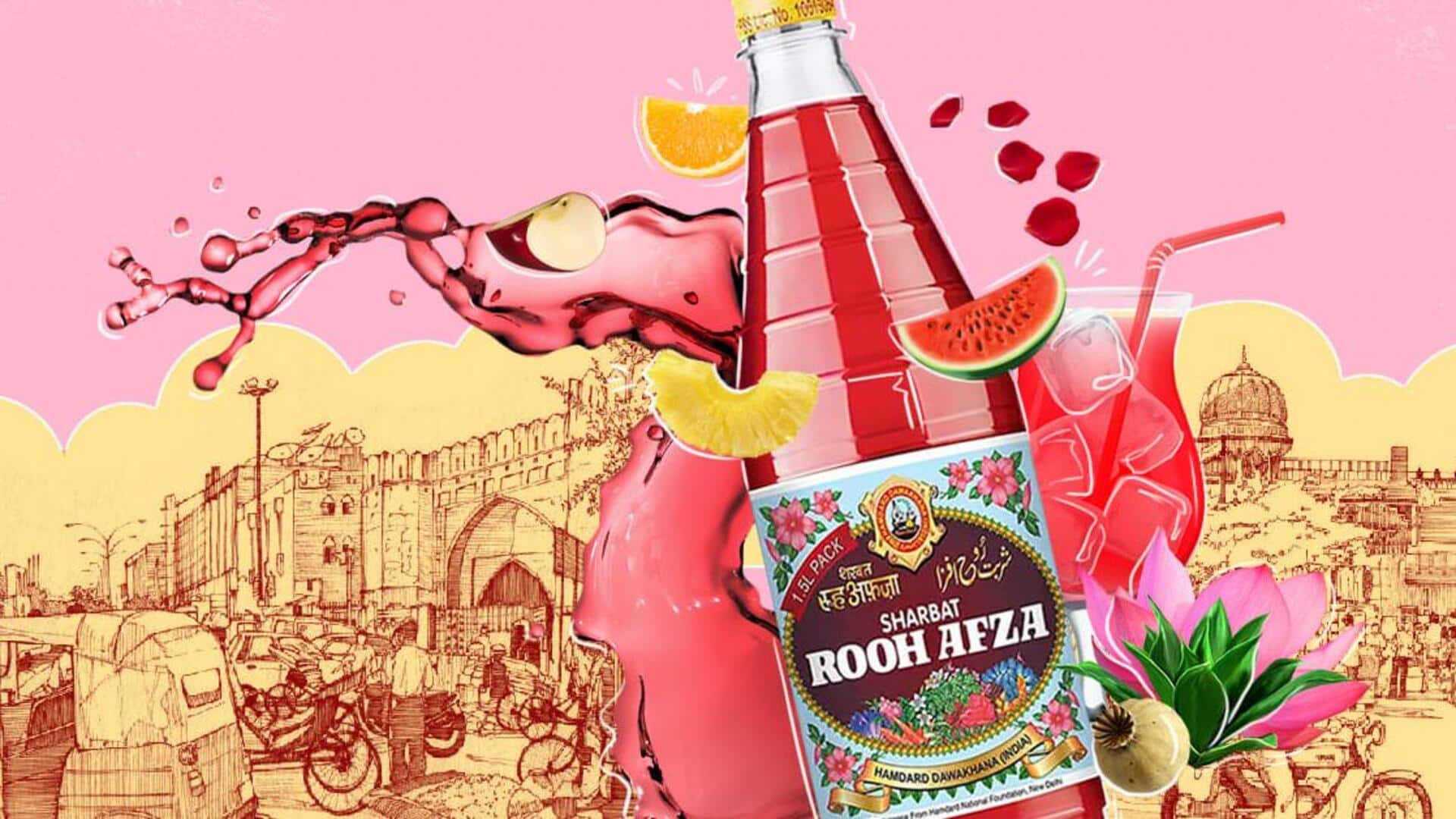
SC classifies Rooh Afza as fruit drink, gives tax relief
What's the story
In a major relief for Hamdard Laboratories, the Supreme Court of India has ruled that Sharbat Rooh Afza cannot be classified under a higher tax slab just because it is marketed as a sharbat. The court observed that the beverage's essential character comes from fruit-based ingredients and is meant to be diluted before consumption. It held that Rooh Afza qualifies as a "fruit drink" under the applicable tax framework.
Legal debate
Dispute centered on product's classification for taxation
The tax classification dispute centered on whether Rooh Afza, which contains 10% fruit juice (8% pineapple and 2% orange) mixed with invert sugar syrup and herbal distillates, should be classified as a "fruit drink."
For licensing purposes, the product was described as a "non-fruit syrup containing 10% fruit juice," because it didn't meet the higher fruit content requirement under food safety regulations for classification as a "fruit syrup."
Ruling details
Rooh Afza classifiable as 'fruit drink/processed fruit product': SC
The Supreme Court overturned the 2018 judgments of the Allahabad High Court and tax authorities, which had classified Rooh Afza as an "unclassified" item liable for 12.5% tax under the residuary entry of the UPVAT Act.
Instead, it held that Rooh Afza is classifiable under Entry 103 of Schedule II (Part A) of the UPVAT Act as a "fruit drink/processed fruit product," attracting a concessional VAT rate of 4% during January 1, 2008, to March 31, 2012.
Tax interpretation
Regulatory definitions don't automatically govern fiscal interpretation: Court
The revenue authorities had argued that Rooh Afza cannot be treated as a fruit drink for tax purposes since it only contains 10% fruit juice.
However, the Supreme Court clarified that regulatory definitions under food safety law do not automatically govern fiscal interpretation unless the tax statute expressly incorporates such standards.
It also emphasized that classification must depend on tangible factors such as composition, label, character, and intended use.
Tax classification
Burden lies on revenue to prove classification not possible: Court
The court also clarified that residuary entries can only be invoked when goods cannot reasonably be brought under a specific entry.
The burden lies on the revenue to prove that classification under a specific entry is not possible.
In this case, it noted, the department produced no trade enquiries, consumer surveys, or market evidence to demonstrate that Rooh Afza is not understood commercially as a fruit-based beverage preparation.
Tax relief
Court directs UP authorities to grant consequential relief
The court also noted that similar VAT entries in other states had classified the product as a fruit-based beverage eligible for concessional tax rates.
It said, "Where two plausible views exist, the interpretation favorable to the assessee must prevail," directing Uttar Pradesh authorities to grant consequential relief including refund or adjustment of excess tax paid under protest—amounting to over ₹26 million—in accordance with law.