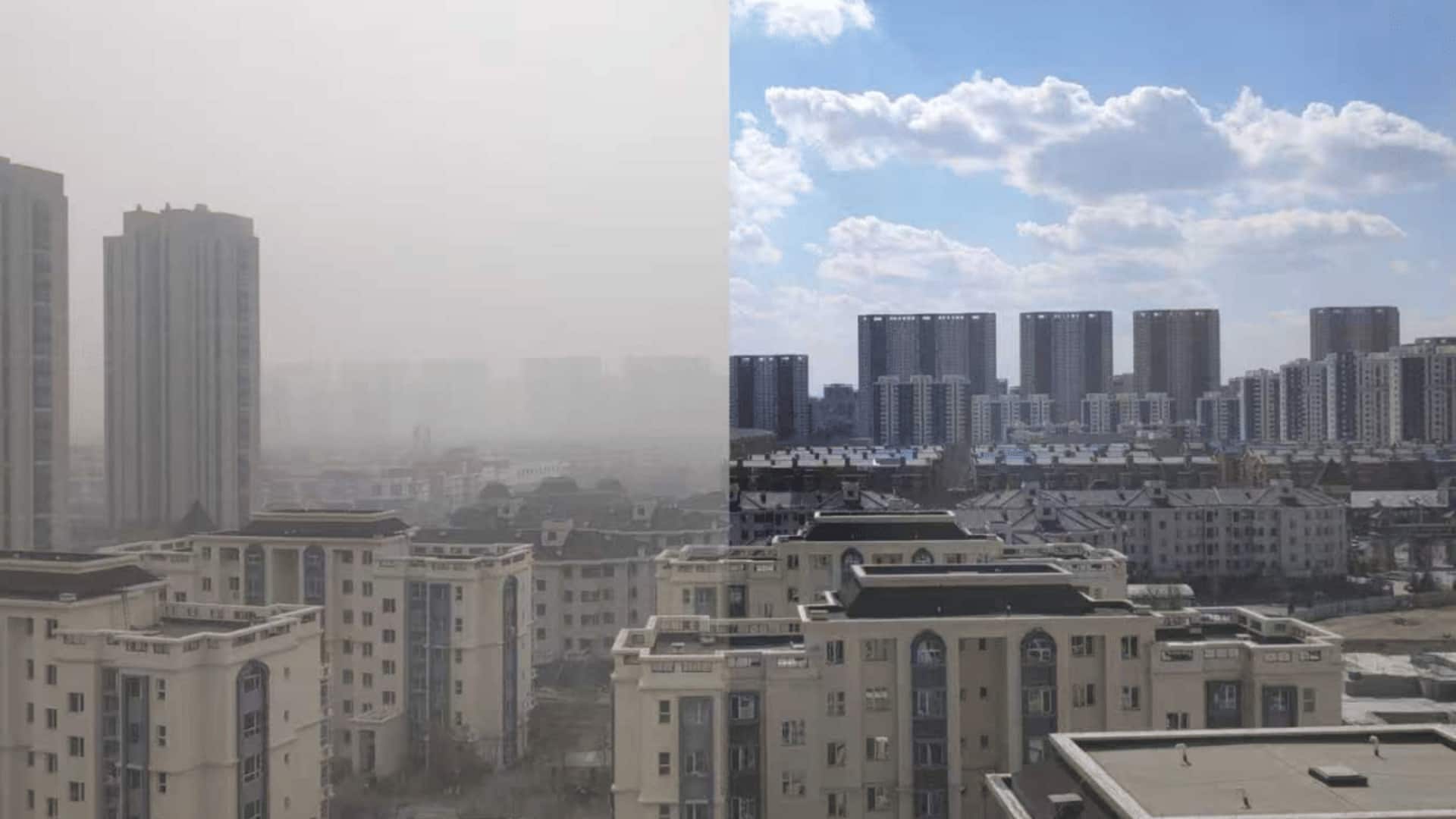
China offers 'step-by-step guide' to India for tackling pollution
What's the story
As Delhi and the National Capital Region (NCR) continue to battle severe air pollution, China has offered its experience as a "shared struggle." The Chinese embassy in India highlighted the stark contrast between the two cities' air quality indices (AQI). Beijing's AQI was 68, "satisfactory" on China's scale, while Delhi's stood at a "severe" 447, according to India's Central Pollution Control Board (CPCB).
Pollution progress
China's decade-long efforts yield positive results
Yu Jing, spokesperson for the Chinese embassy in India, acknowledged the complexity of air pollution challenges but noted that China's consistent policies over the past decade have resulted in significant improvements.
She said, "Both China and India know the struggle with air pollution amid rapid urbanization."
The embassy stated that it will share a bite-sized series on how China tackled air pollution step by step in the coming days.
Pollution crisis
Delhi's pollution crisis and Supreme Court observations
Delhi's air quality has once again deteriorated, prompting authorities to implement Stage 4 of the Graded Response Action Plan (GRAP). This includes a ban on construction activities and restrictions on polluting vehicles.
The Supreme Court has also noted that one major reason for Delhi-NCR's persistent pollution is the affluent class' reluctance to change lifestyles.
Despite strict protocols over the years, air quality remains dangerously poor.
Pollution measures
China's successful measures against air pollution
China has struggled with severe air pollution for years, especially in major cities such as Beijing.
However, over the past decade, Beijing has managed to significantly improve its air quality through strict and sustained measures.
The turning point came in 2013, when China launched the Air Pollution Prevention and Control Action Plan.
This plan laid out a comprehensive strategy to reduce emissions from energy production, transport, and industry.
Pollution reduction
Beijing's coal consumption and vehicle pollution measures
One of the most important steps was a sharp reduction in coal use. Beijing's coal consumption fell from about 21.8 million tons in 2012 to less than one million tons in later years.
The city shut down coal-fired power plants and shifted aggressively toward cleaner energy sources.
Vehicle pollution was another major focus, with tougher emission standards enforced and over two million old, highly polluting vehicles removed from roads.
Coordination efforts
Beijing's regional coordination and Delhi's challenges
Regional coordination also played a key role in China's success against air pollution. Beijing worked closely with neighboring regions such as Tianjin and Hebei to ensure joint enforcement and shared pollution reduction targets.
However, Delhi cannot easily replicate China's model due to differences in governance structures. Delhi faces fragmented responsibilities across multiple agencies and state governments within the NCR, making interstate coordination a major challenge.
Twitter Post
Post by Spokesperson for Chinese Embassy in India
Both China and India know the struggle with air pollution amid rapid urbanization 🌫️📊.
— Yu Jing (@ChinaSpox_India) December 15, 2025
🌫️➡️🌤️ While the challenge remains complex, China’s sustained efforts over the past decade have delivered noticeable improvements.
📌 In the coming days, we’ll share a bite-sized series… pic.twitter.com/0ZG4Rl8ISD