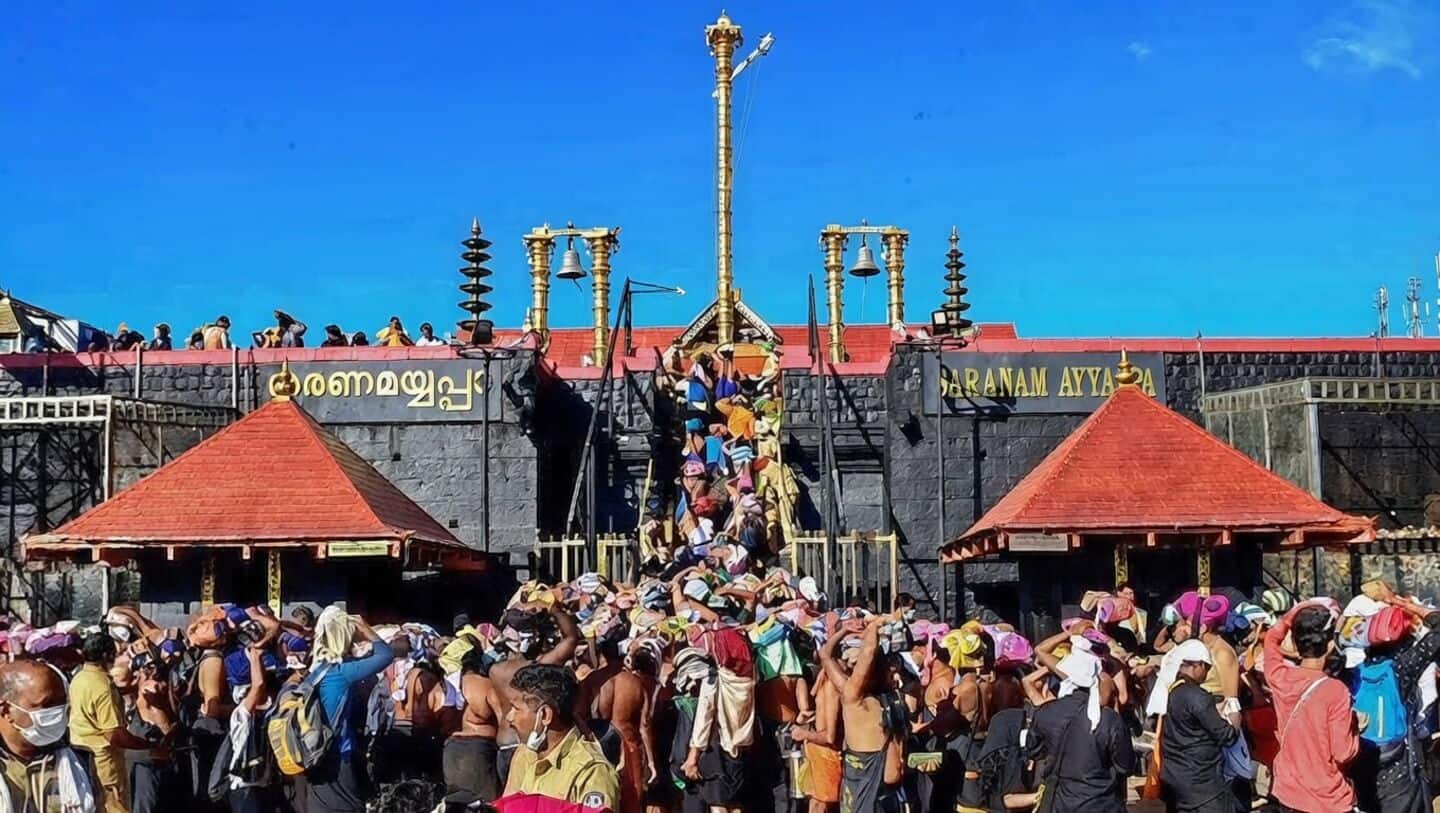
Sabarimala case: Supreme Court begins hearing before 9-judge bench
What's the story
The Supreme Court has started hearing the Sabarimala case before a nine-judge Constitution Bench headed by Chief Justice of India Surya Kant. The bench also includes Justices BV Nagarathna, MM Sundresh, Ahsanuddin Amanullah, Aravind Kumar, Augustine George Masih, Prasanna B Varale, R Mahadevan and Joymalya Bagchi. The court will examine constitutional questions that go beyond the Sabarimala temple dispute.
Legal examination
Key questions to be decided by SC
The court will look into the scope of religious freedom under Article 25 and its relation to other fundamental rights such as equality and dignity.
It will also decide how much courts can intervene in religious practices and what constitutes an essential religious practice.
The seven key questions include whether the rights of religious denominations are subject to other fundamental rights, the meaning of constitutional morality, and if outsiders can challenge faith practices through public interest litigation.
Wider implications
Wider implications for other faiths, practices
While the lead case is about women's entry into the Sabarimala temple, its outcome could have wider implications for other contentious issues across faiths.
These include Parsi women entering fire temples after marrying outside their community, excommunication among Dawoodi Bohras, and practices like polygamy and nikah halala.
The All India Muslim Personal Law Board and some Jain groups have also filed written submissions in this matter.
Past verdict
What happened in September 2018 verdict
In September 2018, a five-judge bench allowed women of all ages to enter the Sabarimala temple by a 4:1 majority.
The majority verdict struck down Rule 3(b) of the Kerala rules barring women's entry. However, Justice Indu Malhotra dissented.
A subsequent five-judge bench referred broader constitutional questions to a larger bench in November 2019.
Hearing schedule
Detailed schedule of hearings announced
The court has announced a detailed hearing schedule for the next three weeks.
Supporters of review petitions will be heard from April 7-9, while opposing parties will present their case from April 14-16.
Rejoinders are scheduled for April 21 and submissions from amicus curiae senior advocate K Parameswar on April 22.
So far, 81 parties have filed written submissions to present their arguments.
Government stance
Centre, Kerala government support review petitions
Both the Centre and Kerala government have supported the review petitions ahead of the hearing.
The Centre argued that restricting women's entry between ages 10 and 50 is linked to Lord Ayyappa's nature as a Naishtika Brahmachari and not impurity or inferiority.
"Allowing entry would alter the very nature of worship....undermining religious pluralism protected by the Constitution. Devotees, i.e., both men and women, have for centuries worshipped Lord Ayyappa...in accordance with the temple's established traditions," Solicitor General Tushar Mehta said.
Future hearings
Individual disputes may be examined separately later
The Kerala government also supported review petitions, saying customary practices shouldn't be overruled by judicial intervention.
In September 2018, a five-judge Bench ruled 4:1 in favor of allowing women of all ages to enter the Sabarimala shrine, stating that "devotion cannot be subjected to gender discrimination." The lone female judge dissented.
On November 14, 2019, a five-judge bench led by then Chief Justice Ranjan Gogoi referred broader constitutional matters to a larger bench.