
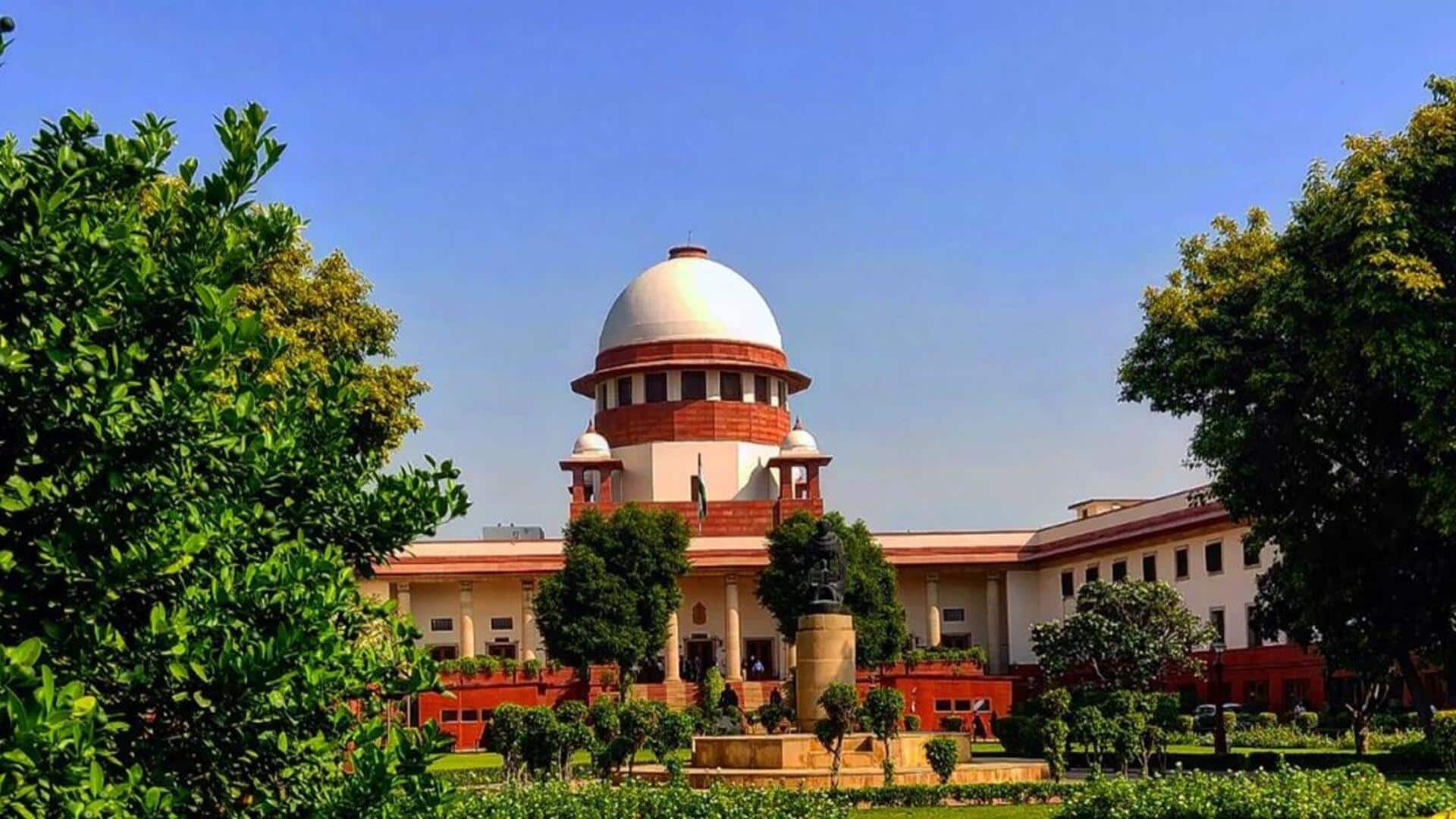
Supreme Court delivers split verdict on plea challenging corruption act
What's the story
The Supreme Court has delivered a split verdict on the constitutional validity of Section 17A of the Prevention of Corruption (PC) Act. The section requires prior sanction from the Union or State to investigate public servants for offenses related to official functions. While Justice BV Nagarathna deemed the provision arbitrary, Justice KV Viswanathan ruled that it is legally valid, subject to the caveat that instead of the government, the previous approval shall be based on the recommendation of the Lokpal.
Unconstitutional protection
Justice Nagarathna's criticism of Section 17A
Justice Nagarathna argued that Section 17A is an attempt to protect corrupt officials and is contrary to the objectives of the PC Act. She said, "This Section is nothing but an attempt to resurrect the Section which was struck down and is thus an attempt to protect the corrupt." She also expressed concern that approvals may not be granted by the State, defeating the Act's purpose.
Constitutional validity
Justice Viswanathan's defense of Section 17A
On the other hand, Justice Viswanathan defended Section 17A, saying it has no invalid classification. "Possibility of abuse is no ground to strike down Section 17A," he said. He argued that if Section 17A is invalidated on the grounds that prior approval is not required, it will result in coercive measures even against individuals who are carrying out their obligations honestly. He said the object of Section 17A was not to condone illegal acts but to have a screening mechanism.
Referral order
Court's decision to refer matter for fresh consideration
"Bhagavad Gita says 'for self respecting man death is more preferable than disrepute'. In this age of technology and social media, the act of parading in court etc is irreversible even if proven innocent later," Justice Viswanathan opined. Given the split verdict, the Supreme Court has ordered that the matter be placed before the Chief Justice of India for fresh consideration by an appropriate bench. The Centre for Public Interest Litigation had challenged Section 17A, which was introduced in 2018.