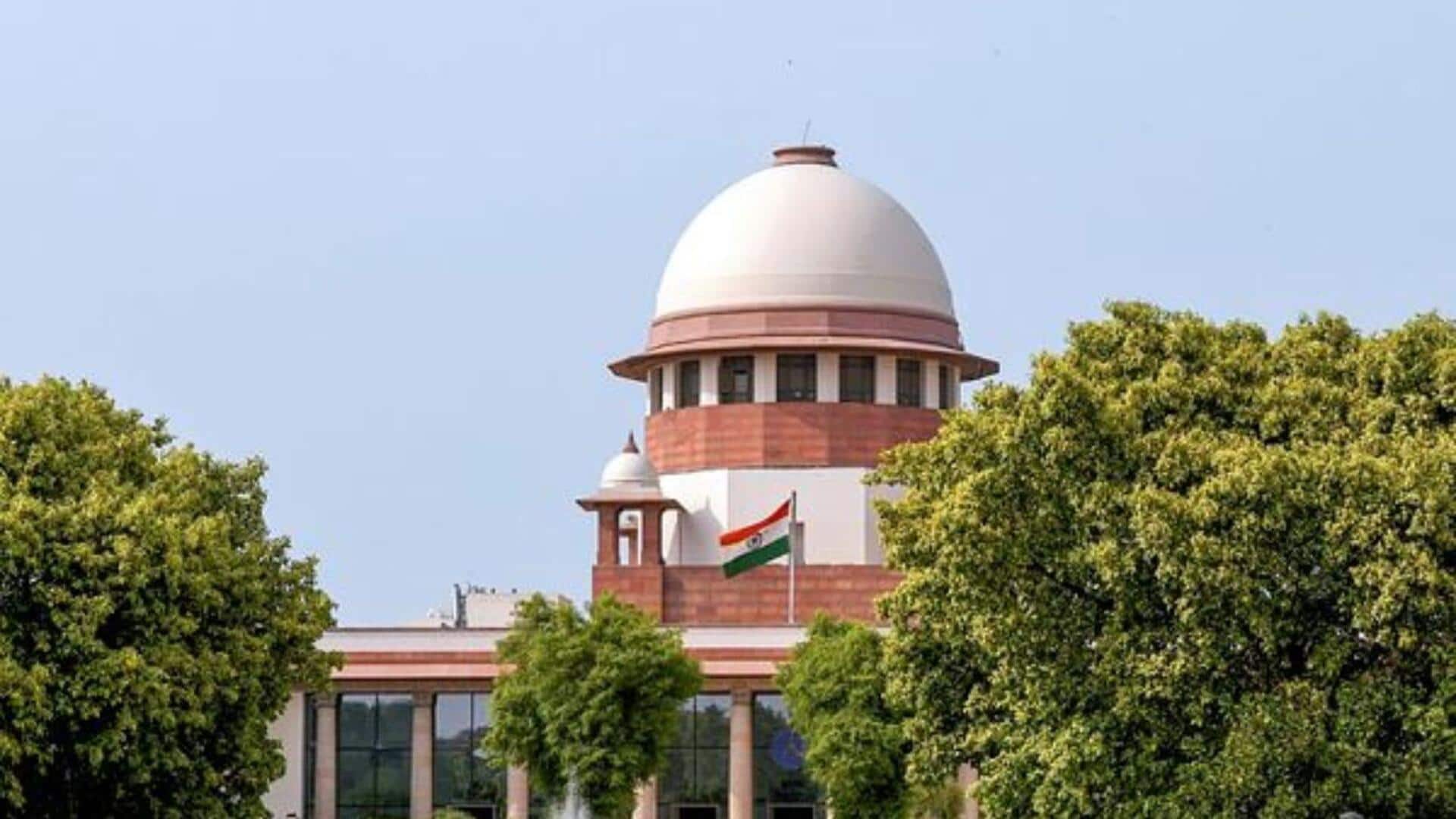
'It'll divide society': Supreme Court stays UGC's equity regulations
What's the story
The Supreme Court has stayed the University Grants Commission's (UGC) new regulations aimed at preventing caste discrimination in educational institutions. The decision was taken by a bench of Chief Justice of India Surya Kant and Justice Joymalya Bagchi. The court noted that without its intervention, the regulations could lead to societal divisions and dangerous consequences. "If we don't intervene it will lead to dangerous impact, will divide the society and will have grave impact," the bench said.
Review process
Regulations to be reviewed by expert committee
The court then ordered that the regulations be kept in abeyance. The bench observed that the language of the regulations is vague and needs to be modulated to prevent exploitation.
"Prima facie, we say that the language of the regulation is vague and experts need to look into for the language be modulated so that it is not exploited," the court said.
The court issued notices to both UGC and the central government, asking them to respond by March 19.
Inconsistencies highlighted
Court flags inconsistencies in regulations
During the hearing, the court also pointed out inconsistencies between Sections 3(c) and 3(e) of the regulations.
While Section 3(c) defines "caste-based discrimination" as discrimination against scheduled castes, tribes, and other backward classes, Section 3(e) has a broader definition of "discrimination."
It defines "discrimination" as any unfair or biased treatment or any such act against any stakeholder, whether explicit or implicit, on the grounds only of religion, race, caste, gender, place of birth, disability, or any of them.
Court
'How does Section 3(c) become relevant when Section 3(e) exists'
The court questioned why Section 3(c) was necessary if its provisions are already included in Section 3(e).
It observed that Section 3(c) would prevent upper-caste individuals from complaining about discrimination based on place of birth or gender, although the definition of discrimination under Section 3(e) is broader and encompasses everything, including caste discrimination.
"How does Section 3(c) become relevant when Section 3(e) is existing. When 3c() is already ingrained in 3(e) why...bring it as a separate provision," the court asked.
Regulations' goals
Regulations aim to promote equity, inclusion in higher education
The UGC regulations were notified on January 13 and seek to promote equity and inclusion.
The objective is to "eradicate discrimination only on the basis of religion, race, gender, place of birth, caste...disability, particularly against the members of scheduled castes and scheduled tribes, socially and educationally backward classes."
They mandate the establishment of Equal Opportunity Centers and Equity Committees to implement policies for disadvantaged groups.
However, these provisions have sparked protests from upper-caste persons who argue that they are one-sided.
Legal challenge
Petitioners challenge regulations, seek broader definition of discrimination
Petitioners have challenged the regulations for being exclusionary and sought a broader definition of discrimination.
They argued that denying grievance redressal based on caste identity is "impermissible State discrimination."
According to the petition, a selective framework not only condones but effectively fosters unchecked hostility against non-reserved categories, turning the regulations into an instrument for division rather than equity.