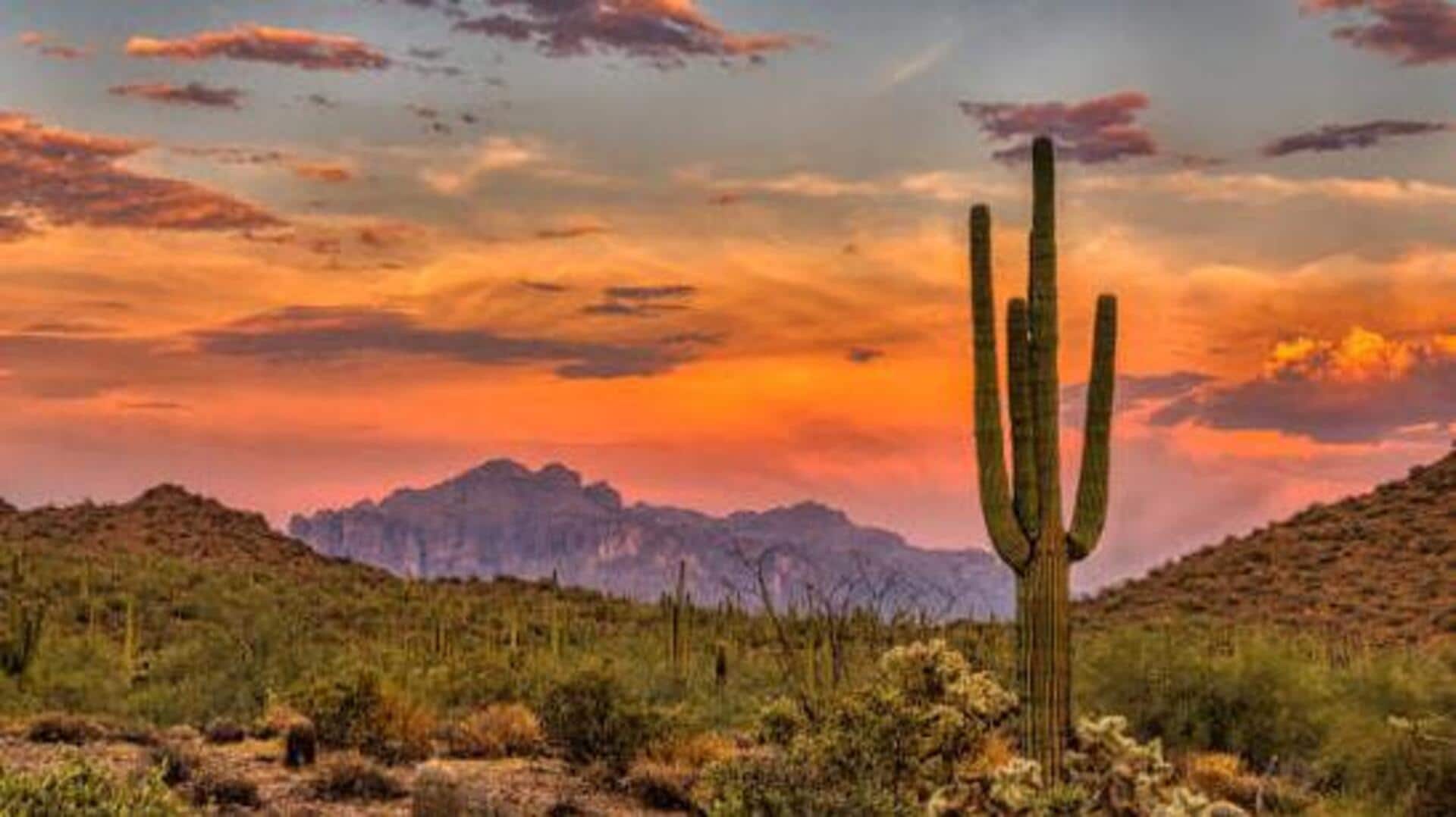
Namibia's deserts are home to some truly incredible plants!
What's the story
Namibia's deserts are home to some of the most unique plant species on the planet. These hardy plants have adapted to survive in the harshest of conditions, making them a must-see for anyone interested in botany or ecology. From the iconic Welwitschia mirabilis to the lesser-known species, these plants give an insight into nature's resilience and adaptability. Here's a peek into Namibia's hidden desert gems.
#1
Welwitschia: A living fossil
Welwitschia mirabilis is one of Namibia's most iconic plants, famous for its unique appearance and longevity.
It can live up to 1,500 years and grows only two leaves throughout its life.
Found in the Namib Desert, this plant has adapted to survive with minimal water by extracting moisture from fog.
Its unusual form and resilience make it a fascinating subject for botanists and nature enthusiasts alike.
#2
The resilient Hoodia plant
Hoodia, another remarkable plant of Namibia's deserts, is known for its fleshy leaves and star-shaped flowers.
This succulent has adapted to store water efficiently, making it perfect for arid environments.
Hoodia species are mostly found in sandy soils, where they thrive under extreme temperatures.
Their unique appearance and survival strategies make them an interesting study for those interested in desert flora.
#3
Unique adaptations of Lithops
Lithops, also known as living stones, are small succulent plants that mimic the appearance of pebbles or stones on the ground.
This camouflage protects them from herbivores, as well as harsh sunlight in their natural habitats.
Lithops have evolved to store water within their leaves, allowing them to survive long periods without rainfall.
Their intriguing adaptations make them a favorite among collectors.
#4
Discovering the desert cabbage
Desert cabbage (bitter bush) is another fascinating plant that grows in Namibia's arid regions.
It has thick leaves that retain moisture efficiently, enabling it to thrive even when water is scarce.
Desert cabbage usually grows in clusters, providing a unique sight against the barren landscape of the Namib Desert.
Its hardiness and unusual growth patterns make it an interesting subject for botanical studies.