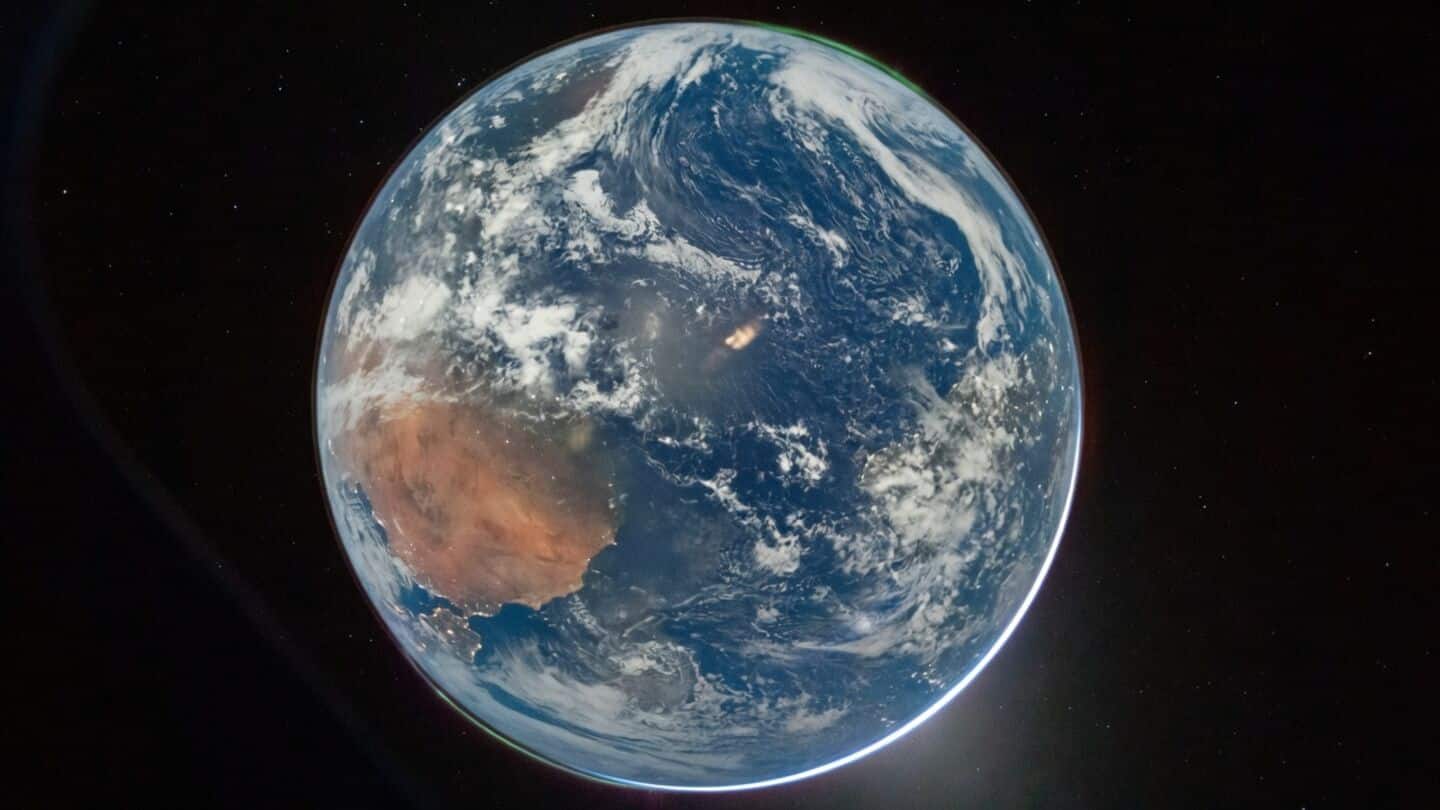
Earth's poles shifted rapidly during dinosaur era, says study
What's the story
A recent study has revealed that the geographic poles of Earth shifted at a surprisingly fast rate during the age of dinosaurs. The phenomenon, known as true polar wander, saw the poles move by up to 0.6 degrees per million years, faster than plate tectonics. This discovery was made by researchers from the Centre for Planetary Habitability at Norway's University of Oslo.
Climate influence
True polar wander v/s Milankovitch cycles
True polar wander is different from changes in Earth's rotational axis, which can vary due to Milankovitch cycles.
These shifts affect local and global climates by moving regions closer or farther from the poles.
Such changes have likely influenced the environments where life evolved, from dinosaurs to some of our earliest primate ancestors.
Balance restoration
What is true polar wander?
True polar wander helps maintain balance among Earth's multiple axes of inertia, the largest of which aligns with the rotational axis.
If one hemisphere has more continental crust than another, the crust and mantle may rotate toward that hemisphere to restore balance.
This process changes the geographic locations of poles, hence its name 'true polar wander.'
Research findings
Research team identified 4 true polar wander episodes
The research team used statistical modeling on sea level change maps over 10 million-year intervals.
They found four true polar wander episodes: early Jurassic (190-200 million years ago), late Jurassic to early Cretaceous (140-150 million years ago), mid-Cretaceous (90-100 million years ago), and from the Oligocene period (30 million years ago) to Miocene (20 million years ago).
The study was published in the journal Science.