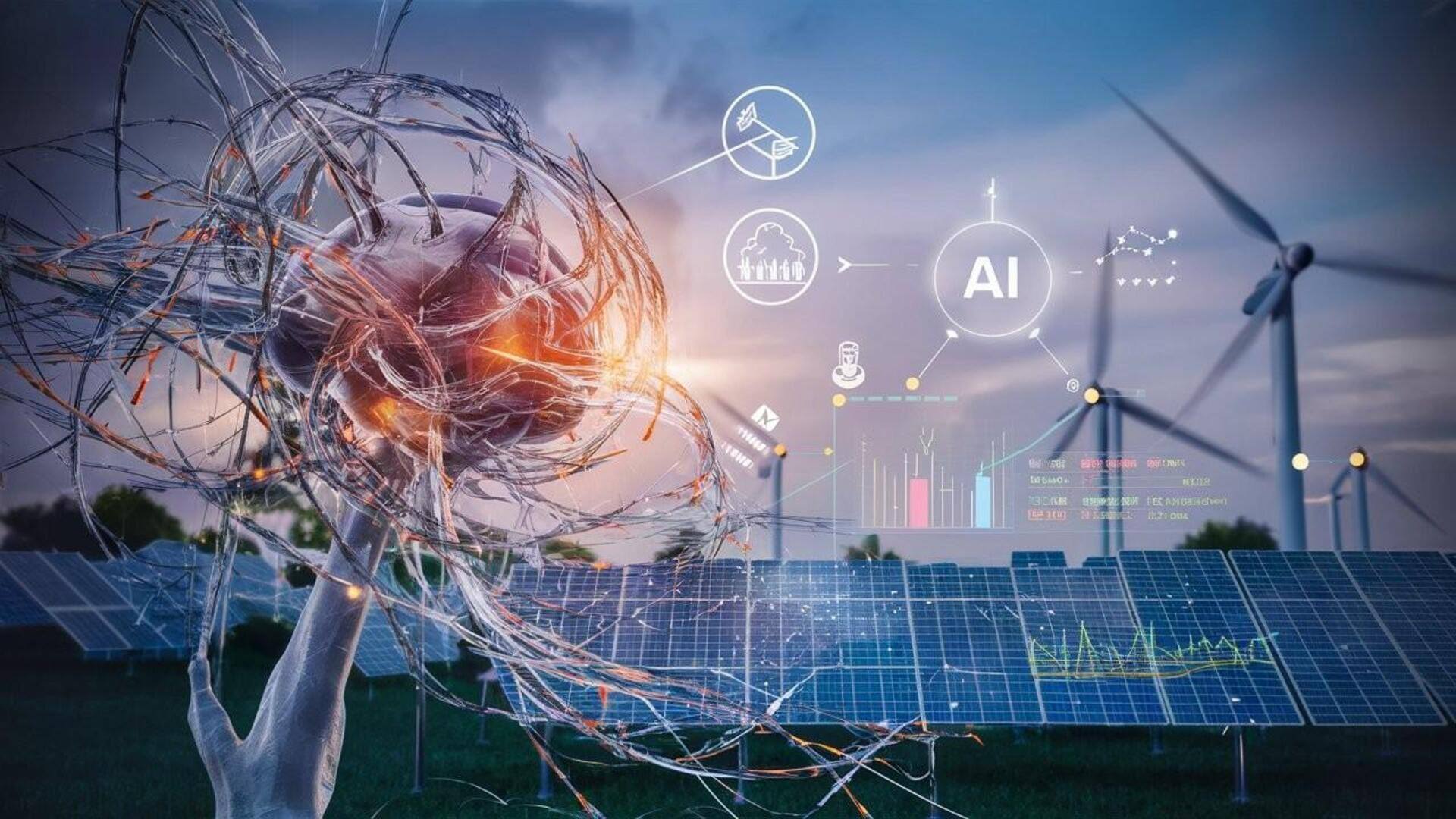
Is AI the missing link in renewable energy management?
What's the story
Artificial intelligence is revolutionizing the way we manage renewable energy by optimizing systems for maximum efficiency, cost savings, and reduced carbon emissions. Back in 2026, AI integration across all aspects of energy management is changing the way power is produced, stored, and distributed. Here, we take a look at some of the key AI-driven solutions that are making renewable energy management better.
#1
Predictive maintenance enhancements
Predictive maintenance employs AI algorithms to continuously monitor equipment data. By analyzing parameters such as vibration and temperature, potential failures are detected before they happen.
This way, you can cut down on downtime as well as costs associated with maintenance.
For example, SunPower leverages AI to analyze imagery captured by drones of solar panels to detect anomalies and predict failures.
#2
Improved energy output forecasting
Machine learning systems have revolutionized the forecasting of renewable energy outputs by examining trillions of datasets for weather patterns, and so on.
Google's DeepMind has applied the same technology to solar farms, significantly enhancing their value.
This is crucial, considering that renewable energy is intermittent, and accurate predictions are necessary for the stability of the grid.
#3
Smart grid management innovations
AI-powered smart grids allow for real-time optimization of energy distribution.
IoT devices can monitor solar panel output, and these systems can adjust the energy mix during the day according to production levels, reducing dependence on non-renewable sources.
They can even predict severe weather conditions to curb the impacts on supply.
#4
Advanced data center management tools
Advanced tools play a crucial role in controlling AI's energy consumption by forecasting demand and coolers in data centers.
Google's machine learning approach plays a critical role in realizing its vision of 24/7 carbon-free operations.
The strategy does a great job of minimizing electricity consumption as AI workloads grow, ensuring energy efficiency even as the need for computational power increases.
Tip 5
Optimizing renewable energy storage
Platforms like Stem's technology are the hallmark of modern-day solutions, as they determine the best times to store or use renewable energy.
This minimizes dependence on fossil fuels while also reducing costs and emissions by seamlessly integrating solar power, storage solutions, and electric vehicle charging infrastructure.