AI recreates face of volcanic eruption victim at Pompeii
What's the story
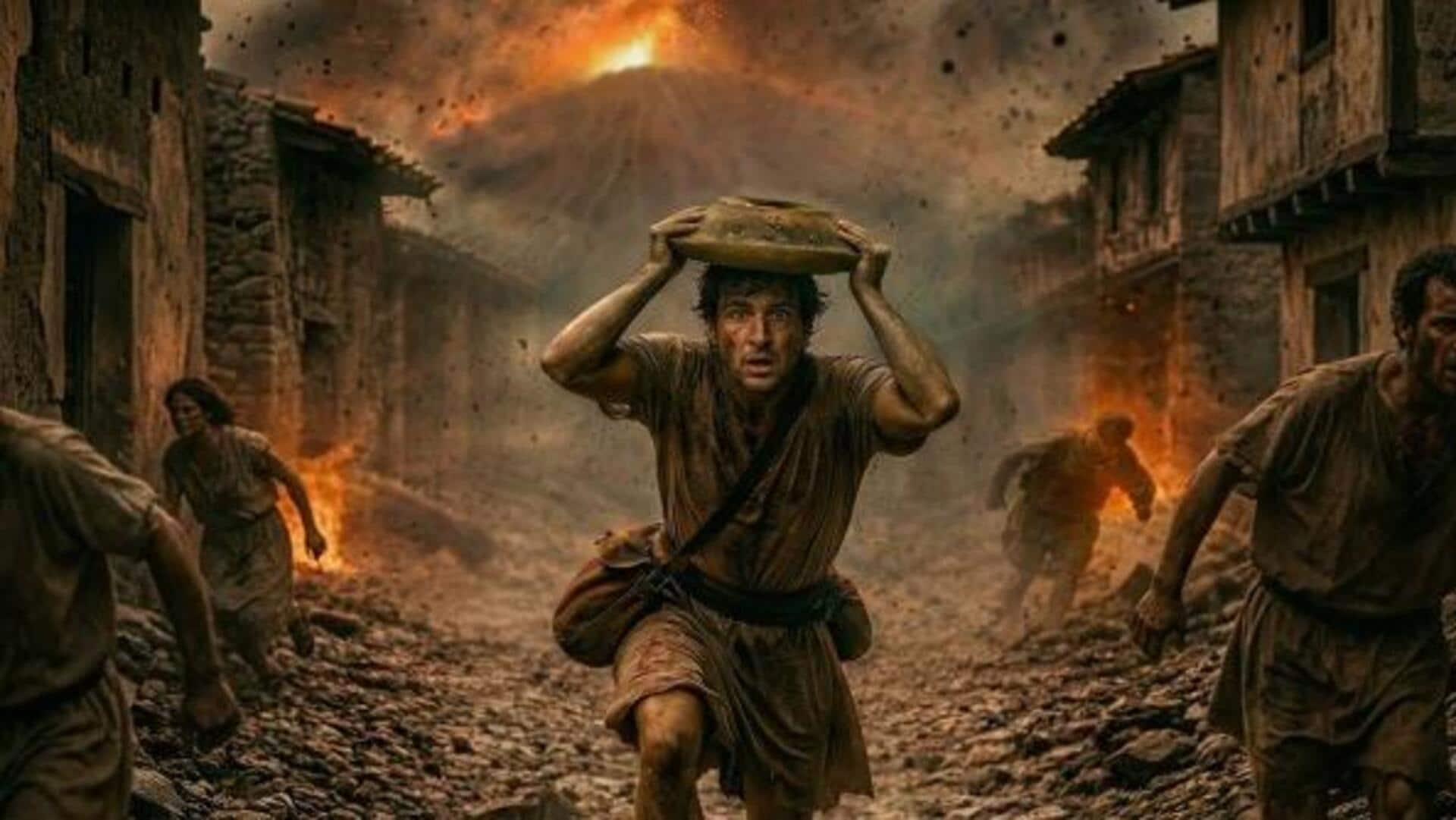
In a groundbreaking development, archeologists at the ancient Roman site of Pompeii have used artificial intelligence (AI) to digitally reconstruct the face of a man who died in the 79 AD eruption of Mount Vesuvius. The digital portrait depicts a man trying to escape toward the coast of modern-day Italy during the volcanic eruption. He is seen crouching and shielding himself with an object as volcanic debris rains down around him.
Collaborative effort
Digital reconstruction and its significance
The digital reconstruction was done by the Pompeii Archaeological Park in association with the University of Padua.
It is based on detailed excavation records from areas outside the ancient city walls.
The project aims to translate the skeletal data into a realistic human likeness, capturing the damage patterns on bones and surrounding artifacts found at the site.
This innovative approach offers deeper insight into victims' final moments during one of history's most famous natural disasters.
Discovery
Details about the victim
The remains of the man were found outside the city walls, near the southern exit routes.
He was identified as an adult male who appeared to have been trying to escape the eruption.
His body was found next to a terracotta mortar, interpreted as an improvised shield against the falling volcanic material.
The man also carried personal items such as an oil lamp, a small iron ring, and 10 bronze coins.
Tech application
AI in archeology
The Pompeii park director, Gabriel Zuchtriegel, emphasized the importance of AI in managing large archeological datasets.
He said, "The vastness of archeological data is now such that only with the help of artificial intelligence will we be able to adequately protect and enhance them."
The technology is being used to create visual reconstructions for educational and research purposes, making archeological research more accessible while maintaining a scientific foundation.