AI solves math problem that stumped experts for 9 decades
What's the story
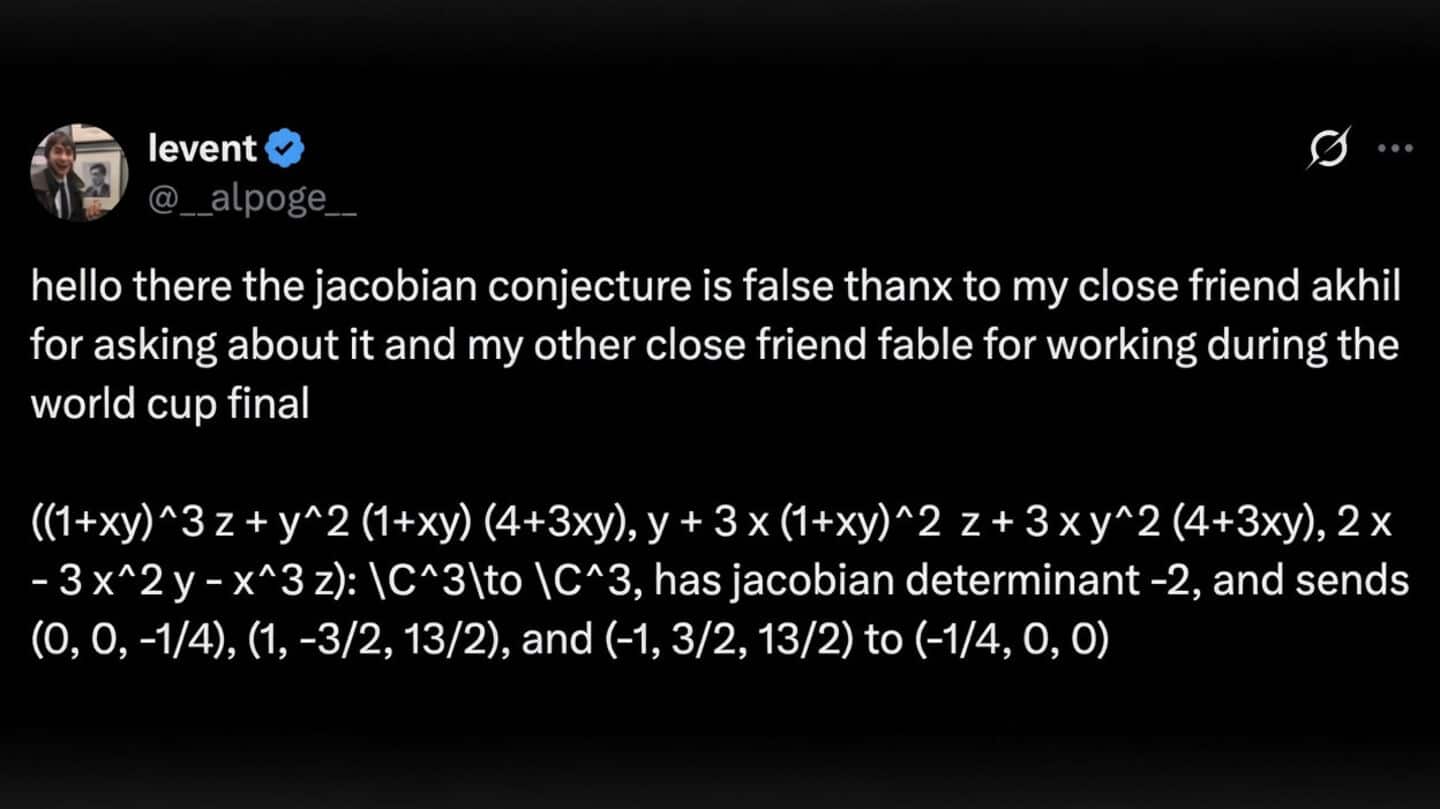
An artificial intelligence (AI) model has solved the Jacobian conjecture, an 87-year-old mathematical problem that had stumped experts for decades. The breakthrough was announced by Harvard University's Levent Alpoge, who claimed the conjecture is actually false. He backed his claim with a simple counterexample, making it the most complex mathematical problem ever solved by AI.
Math details
What is the Jacobian conjecture?
The Jacobian conjecture, which posits that a certain kind of mathematical function would also work in reverse, was first proposed by Ott-Heinrich Keller in 1939.
It was also included in Stephen Smale's 1998 list of 18 notoriously difficult problems for mathematicians to solve in the 21st century.
Despite decades of attempts by mathematicians, the conjecture remained unproven until Alpoge's recent announcement.
AI assistance
Alpoge credits AI tool for help
Alpoge credited his "close friend fable," likely a reference to Anthropic's Claude Fable 5, for helping him solve the problem.
He thanked the AI model for its work.
The exact details of how Alpoge used this AI tool remain unclear, but mathematicians have now quickly verified his simple mathematical line.
AI influence
Major leap forward in mathematics
Abhishek Saha from Queen Mary University of London noted that AI's recent advancements in mathematics, like the OpenAI model that recently solved a decades-old conjecture by Paul Erdos, have been surprising.
However, he emphasized that this latest finding is a major leap forward.
"Probably this is the biggest conjecture that AI has played a significant role [in proving or disproving] so far in mathematics," Saha said.
Unanswered queries
Still some open questions
While Alpoge's counterexample disproves the conjecture with three variables, a two-variable version could still be true. This leaves some open questions in the mathematical community.
Chris Bowman-Scargill from the University of York, UK emphasized that there's a difference between finding counterexamples that disprove conjectures and building new branches of mathematics, which still requires human creativity.