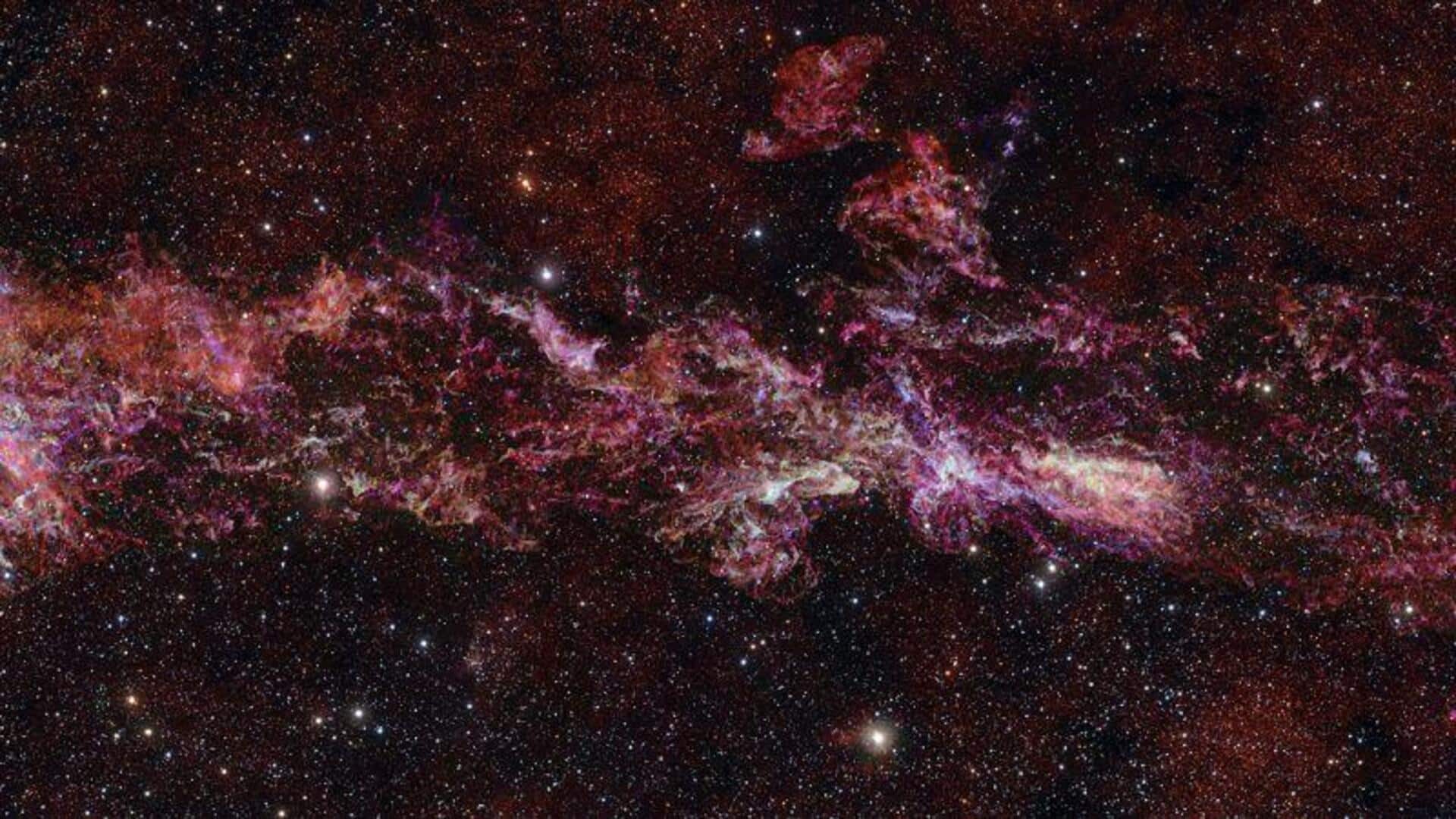
This is the most complete map of Milky Way's center
What's the story
Astronomers have unveiled a high-resolution map of the cold gas at the center of our galaxy, the Milky Way. The image is a product of a four-year international effort using ALMA, one of Earth's most powerful telescopes. The Central Molecular Zone (CMZ) is home to Sagittarius A*, a supermassive black hole some four million times heavier than our Sun.
Project details
The ACES survey
The Atacama Large Millimeter Array Central Molecular Zone Exploration Survey (ACES) was led by Steven Longmore, an astrophysicist at Liverpool John Moores University.
He said this is the first time we've had a complete map of the cold gas in the center of our galaxy.
The CMZ is much denser, hotter, and more turbulent than other regions of space close to Earth.
Galactic view
A top-down view of the galaxy
Longmore compared previous observations of the Milky Way to snapshots taken in different locations of a city.
However, the new image offers a top-down view of the entire city, or galaxy in this case.
He said this is because you don't get the full story of a city unless you have a total map of it.
Research goals
Mapping molecular gas
The new picture maps the molecular gas, which is made up of molecules including hydrogen and carbon monoxide.
These will eventually collapse under their own gravity to form new stars and planetary systems.
The ACES survey was designed to investigate when and where this collapse will happen in the galaxy.
Richard Teague, a planetary science professor at MIT, said it's "the first really detailed look at how that gas is distributed in 3D space."
Spectroscopy technique
Gas in motion
The ACES captured a map of the cold gas in the CMZ in motion.
By measuring the precise frequencies of light emitted by specific molecules, scientists can detect tiny shifts caused by the Doppler effect.
This principle can be applied to light from gas clouds, revealing whether they are moving toward or away from Earth and how fast.
Imaging achievement
Unique achievement in submillimeter astronomy
Longmore said the level of detail achieved in this map, consistently across the entire mapped area, has never been seen before.
Teague noted that previous surveys either covered wide areas at low resolution or zoomed in on small patches with high resolution.
But, ACES does both in a balanced way, making it a unique achievement in submillimeter astronomy.