This clock loses a second in twice the universe's age
What's the story
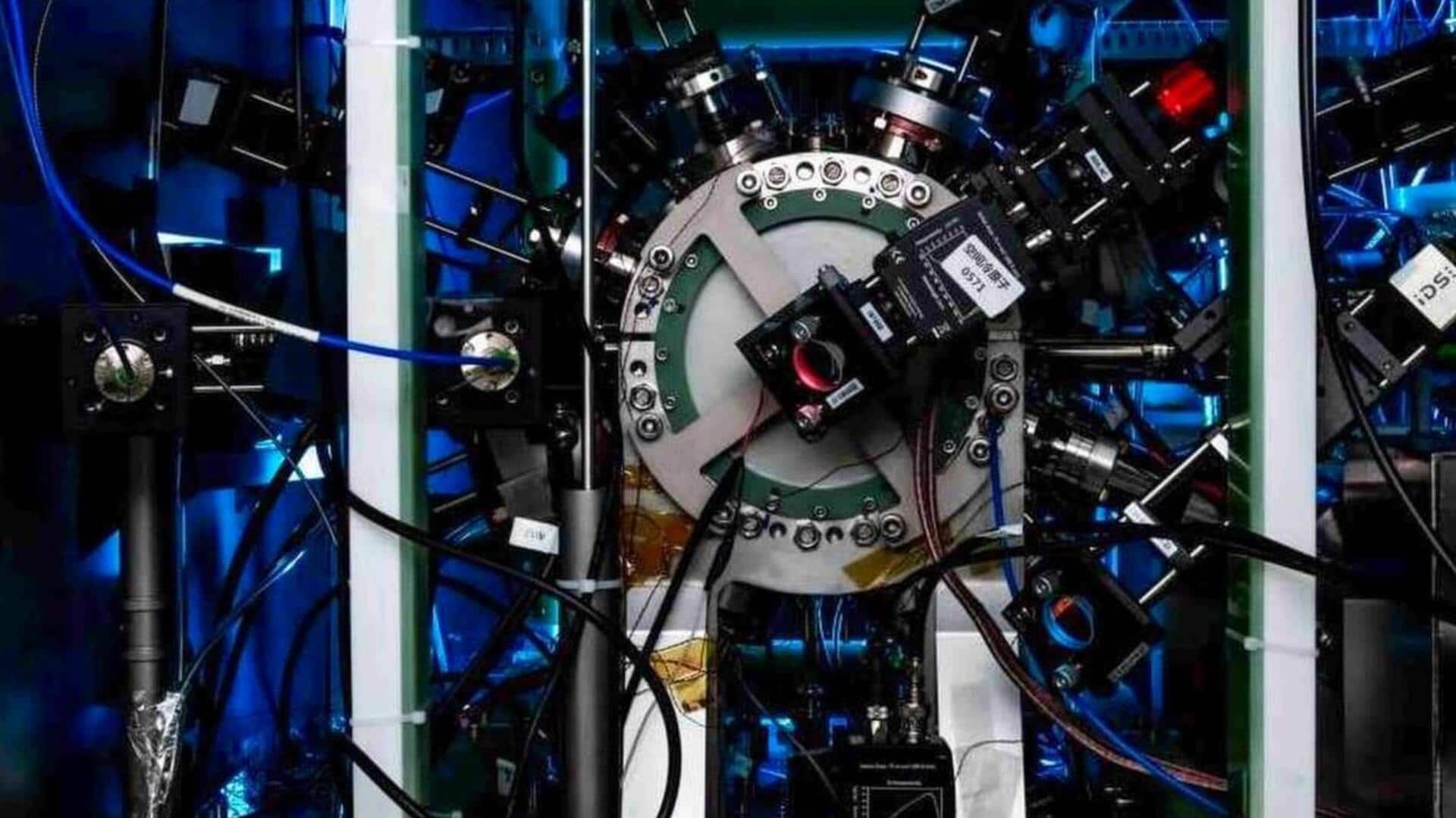
A team of scientists from China has developed an ultra-precise optical clock that could redefine global timekeeping standards. The strontium-based clock, created by scientist Pan Jianwei's team at the University of Science and Technology of China in Hefei, is so stable that it would lose or gain less than one second over some 30 billion years. This is more than double the estimated age of our universe.
Unmatched accuracy
Clock's stability, uncertainty surpasses level of 10^-19
The new optical clock's stability and uncertainty have both gone beyond the level of 10^-19, a feat only accomplished by a few labs across the globe.
These include the National Institute of Standards and Technology in the US and Germany's national standards laboratory.
The unprecedented precision of this Chinese optical clock exceeds what is needed to redefine the second, potentially positioning China at the forefront of this global effort.
Technological advancement
How optical clocks work
Optical clocks are the most accurate timekeeping devices we have.
They use lasers to trap atoms like strontium and rubidium at extremely low temperatures, measuring time from the frequency of light emitted as their electrons transition between energy levels.
This technology could pave the way for more stable and portable optical clocks, including space-based versions, according to Dai Hanning, a co-author on Pan's team.
Future applications
Implications of the new optical clock
Hanning told CCTV that this work lays a solid foundation for using optical clocks to test fundamental physics, improve next-generation satellite navigation systems, and establish a unified ultra-precise global time standard.
The development of such advanced timekeeping devices could have far-reaching implications in various fields, including space exploration and international communication.