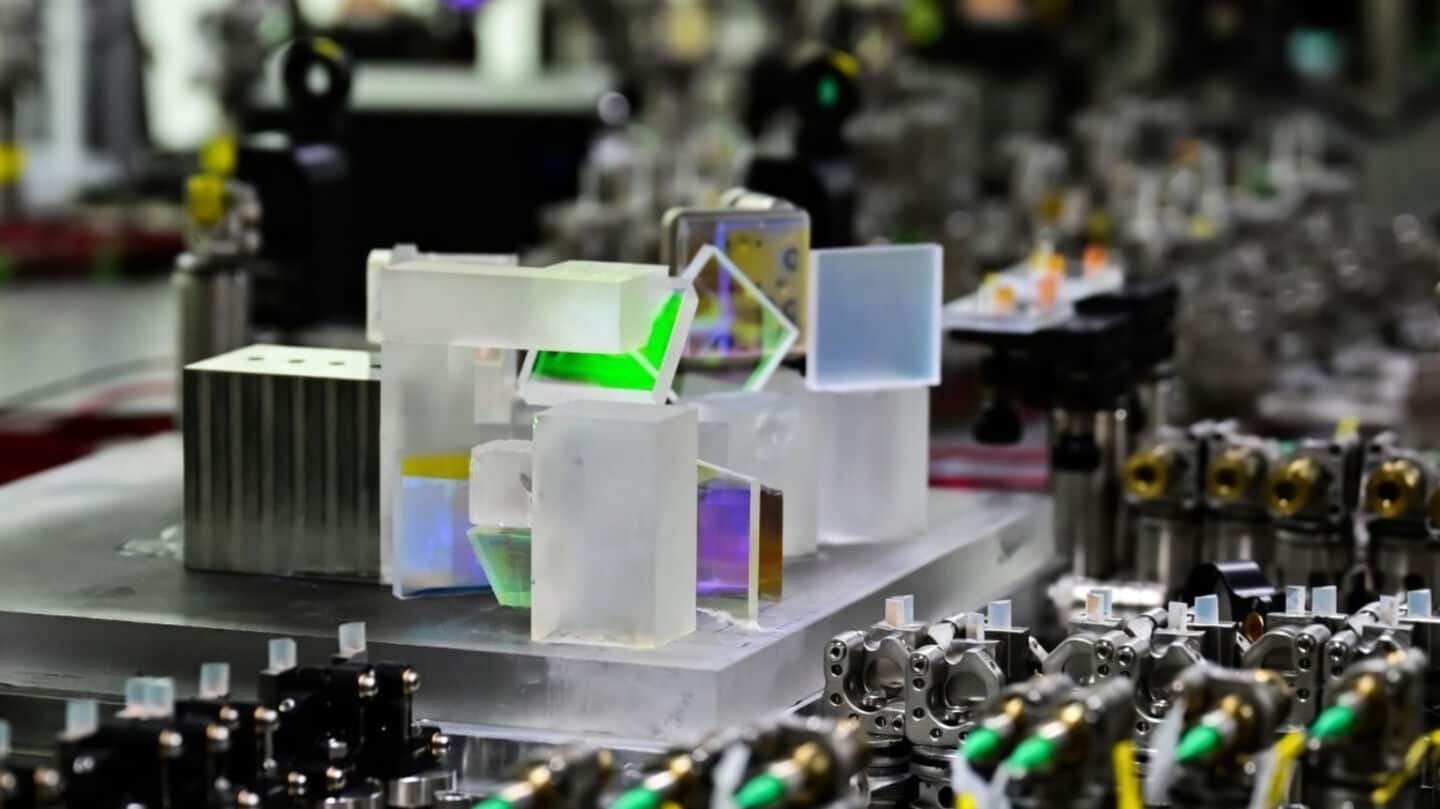
China's Jiuzhang 4.0 can outperform the world's fastest classical supercomputer
What's the story
China has unveiled its latest photonic quantum computer, Jiuzhang 4.0, which is said to be way more powerful than the world's fastest classical supercomputer. The results were published in the peer-reviewed journal Nature. The project is a part of China's rapidly advancing quantum program led by a team of scientists at the University of Science and Technology of China (USTC).
Quantum leap
Breakthrough in quantum computing
Jiuzhang 4.0 can complete a Gaussian boson sampling task in just 25 microseconds, a feat that would take the world's most powerful supercomputer, El Capitan in the US, over 10^42 years to accomplish.
This is a major milestone as Gaussian boson sampling tasks are notoriously difficult for classical computers to handle.
The team behind this breakthrough is led by Chinese quantum physicist Pan Jianwei at USTC.
Quantum edge
Details about Jiuzhang 4.0
The team behind Jiuzhang 4.0 is confident of its superiority over classical computing resources.
They said, "No realistic classical computing resources, to our knowledge, can bring the MPS [matrix product state] algorithm anywhere near the accuracy achieved by our experiment."
The new quantum computer works with 1,024 squeezed-state inputs across an 8,176-mode interferometric network, and can manipulate and detect up to 3,050 photons.