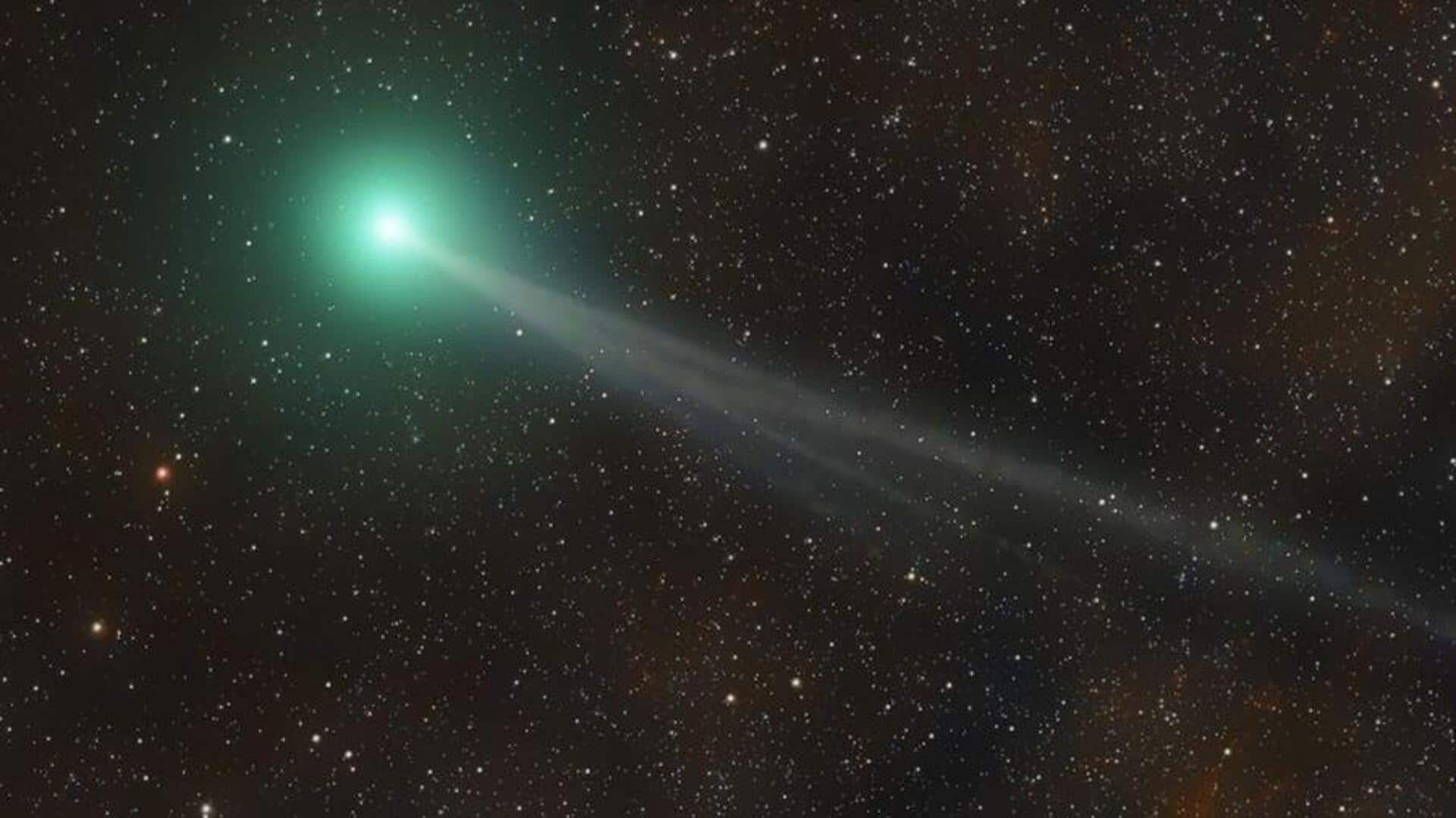
Comet 10P/Tempel 2 visible after 5 years: How to watch
What's the story
Comet 10P/Tempel 2, a comet first discovered in 1873, is currently visible from Bengaluru. The celestial body completes an orbit around the Sun every 5.5 years and was last seen in 2021. According to Deepak Choudhary, an astronomy enthusiast based in Bengaluru, the comet has been brightening throughout June and July and will continue to be visible until early August.
Visibility peak
It will be at its brightest around August 2-3
Choudhary noted that the comet will be at its brightest around August 2 and 3, after which it will slowly fade away as it moves away from both the Sun and Earth.
He captured an image of Comet 10P/ Tempel 2 on July 26 using a Seestar S50 smart telescope.
The comet is expected to reach a brightness level of around magnitude 8-9 during this period, making it visible through binoculars in dark skies.
Comet characteristics
What makes the comet special?
Choudhary explained that Comet 10P/ Tempel 2 is a periodic comet, returning every 5.5 years but not always easily visible from Earth.
Its visibility depends on how close it comes to Earth during its return and its position relative to the Sun in our sky.
He advised that the best time to see the comet will be between late July and early August due to these factors.
Observation advice
How to spot the comet
Choudhary suggested that the comet is unlikely to be visible to the naked eye as it will remain too faint for most people without optical aid.
However, it can be seen through binoculars and small telescopes with an aperture of 80-150mm.
He also recommended observing from a dark location away from city lights on a clear, moonless night for the best viewing experience.
Closest approach
When will the comet reach its perihelion and perigee?
Choudhary further explained that on August 2, the comet will be closest to the Sun.
This proximity will cause more ice to vaporize due to the Sun's heat, creating a coma and tail for the comet.
These features will make it brighter and easier to observe. The next day, August 3, it will be closest to Earth, giving skywatchers another chance to spot this celestial event.