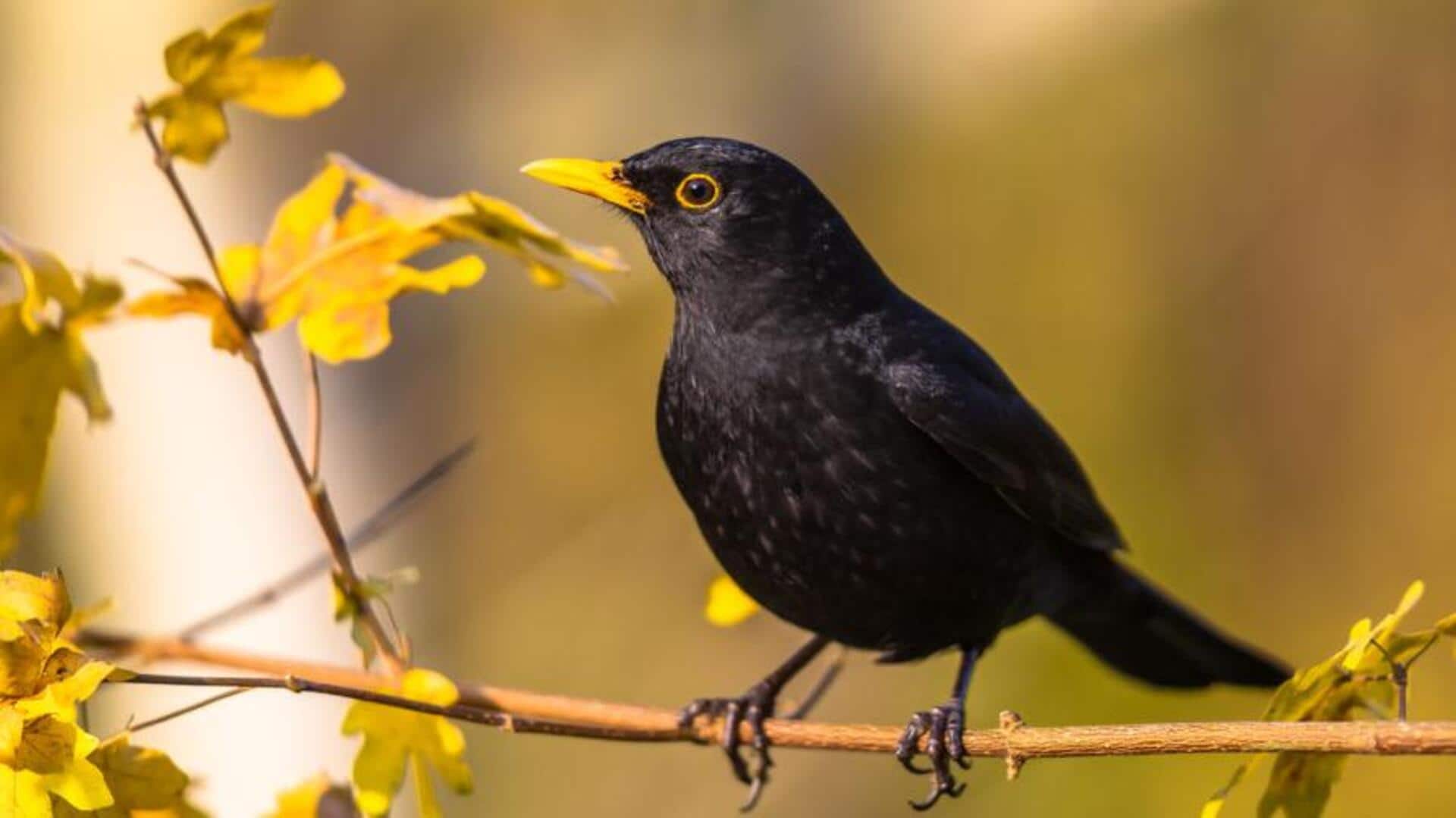
This is the most melodious bird in the world
What's the story
A recent study by researchers at the University of Tubingen in Germany has revealed that the common blackbird (Turdus merula) is the bird with the most melodious song. The research involved 84 participants who listened to recordings of 123 wild bird species and rated their vocalizations. The common blackbird topped the list with an average rating of 4.52 out of 5, thanks to its rich, mellow, and flutelike song.
Research insights
Acoustic features and human perception
The study also looked into the acoustic characteristics of birdsong and how they influence human perception.
The researchers found that people preferred softer bird sounds with a narrower frequency range, while more complex vocalizations were rated as more pleasant.
"Our results show that the combination of various acoustic features is important for how much we like a bird song," said Dr. Nadine Kalb, lead author of the study published in Frontiers.
Vocal comparison
Other birds' vocalizations
The common blackbird's song was rated higher than other birds' vocalizations.
For instance, the European goldfinch got a pleasantness score of 4.26 out of 5, while the European robin and blue tit scored lower at 4.04 and 3.92, respectively.
The barn owl's eerie screech was rated the lowest with an average score of just 1.32 among all surveyed species.
Practical implications
Impact on urban design
The study's findings could inform the design of parks, urban green spaces, and other places where people go to unwind.
"Perhaps the most important takeaway is that paying attention to birds can change the way we experience the natural world," said senior study author Dr. Christoph Randler.
He added that even when we don't understand what a bird is communicating, its song can attract our attention and evoke positive feelings.
Vocal intricacy
Complexity of songs
The researchers were surprised to find that people preferred more intricate birdsongs.
"We might intuitively expect simple, repetitive sounds to be easier and therefore more pleasant, but the opposite pattern emerged: more complex sounds tended to receive higher pleasantness ratings," noted Randler.
This finding highlights the complexity of human perception when it comes to avian vocalizations and their potential impact on our emotional well-being.