Why August 12 could be greatest skywatching day in years
What's the story
Skywatchers across North America and Europe should mark their calendars for August 12. The day will witness an unusual combination of celestial events, including a daytime solar eclipse and the peak of the Perseid meteor shower under a moonless sky. The date is further enhanced by the presence of brilliant Venus and the glowing band of the Milky Way after sunset.
Eclipse details
Total solar eclipse will cross northern Spain
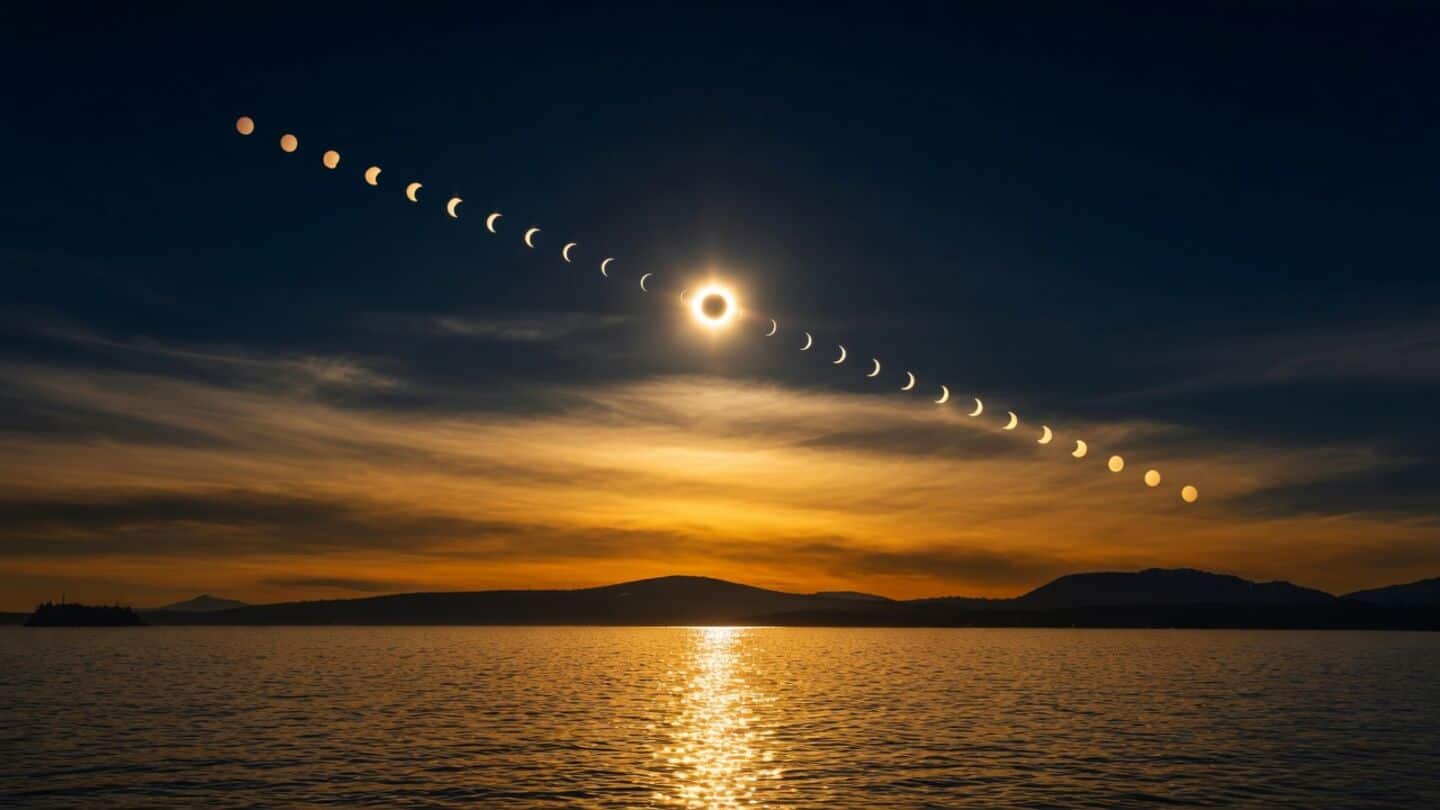
The first major event of the day will be a total solar eclipse, where the Moon will cover the Sun.
The phenomenon will be visible in a narrow band across eastern Greenland, western Iceland, and northern Spain.
However, nearly 779 million people in North America, Europe, and North Africa will witness at least a 10% partial eclipse.
Eclipse coverage
Northeast US and northern Canada will see a partial eclipse
Northern Canada will witness North America's deepest partial eclipse with parts of Nunavut in the Canadian Arctic seeing up to 93% of the Sun covered.
Eastern cities like Toronto, Ottawa, and Quebec will see between 8% and 24% coverage.
In the US, Alaska and Northeast are expected to offer best views with Fairbanks seeing 37% coverage while Boston sees 16%.
European view
What about Europe?
In Europe, London will witness a whopping 91% eclipse while Paris will see 92%.
Regardless of where you are watching from, remember to wear ISO 12312-2 certified solar eclipse glasses throughout the partial phase.
Also, make sure your binoculars, telescopes, and cameras are fitted with solar filters before aiming at the Sun.
Nighttime events
Venus at dichotomy, Perseids peak at night
After sunset, the second major event of the day will be Venus reaching dichotomy, where it appears half-illuminated.
Through a small telescope or large stargazing binoculars, skywatchers should see Venus resembling a tiny half-Moon as it moves closer to Earth.
The annual Perseid meteor shower will peak during the night hours of August 12-13 with no moonlight washing out faint meteors under truly dark skies.
Shower peak
Best time to watch the meteor shower
The best time to watch the Perseid meteor shower is from midnight to 2am local time (US), when the sky is darkest and the constellation Perseus is highest in the sky.
Observers under dark rural skies will see the Milky Way arch overhead, providing one of the finest views of our home galaxy all year.