What to expect from different stages of total solar-eclipse 2026
What's the story
On August 12, a total solar eclipse will mesmerize millions as the Moon passes in front of the Sun, blocking its light. The event will occur during the new Moon phase when the Moon moves between Earth and Sun. Normally, this alignment would miss Earth completely due to a slight tilt in its orbit. However, on this day, it will near-perfectly align with both celestial bodies. Here are the stages of the solar eclipse.
Route
Where to see the total solar eclipse
The Moon's shadow will trace a 182-mile-wide path across Earth, known as the path of totality. This is where viewers will see the Moon completely cover the Sun.
The path runs through Spain, Iceland, and Greenland.
Those outside this narrow corridor can still witness a partial solar eclipse as the Moon partially covers our star's surface.
Phases
Stages of a total solar eclipse
The total solar eclipse will have multiple stages. It will start with the partial phase, where the Moon's disk starts covering the Sun.
This first contact will be visible in Alaska at 11:34am EDT (9:04pm IST) on August 12.
The hour and a half after this will see a gradual transformation of the Sun into a crescent shape for those in the path of totality.
Total eclipse
The moment of totality
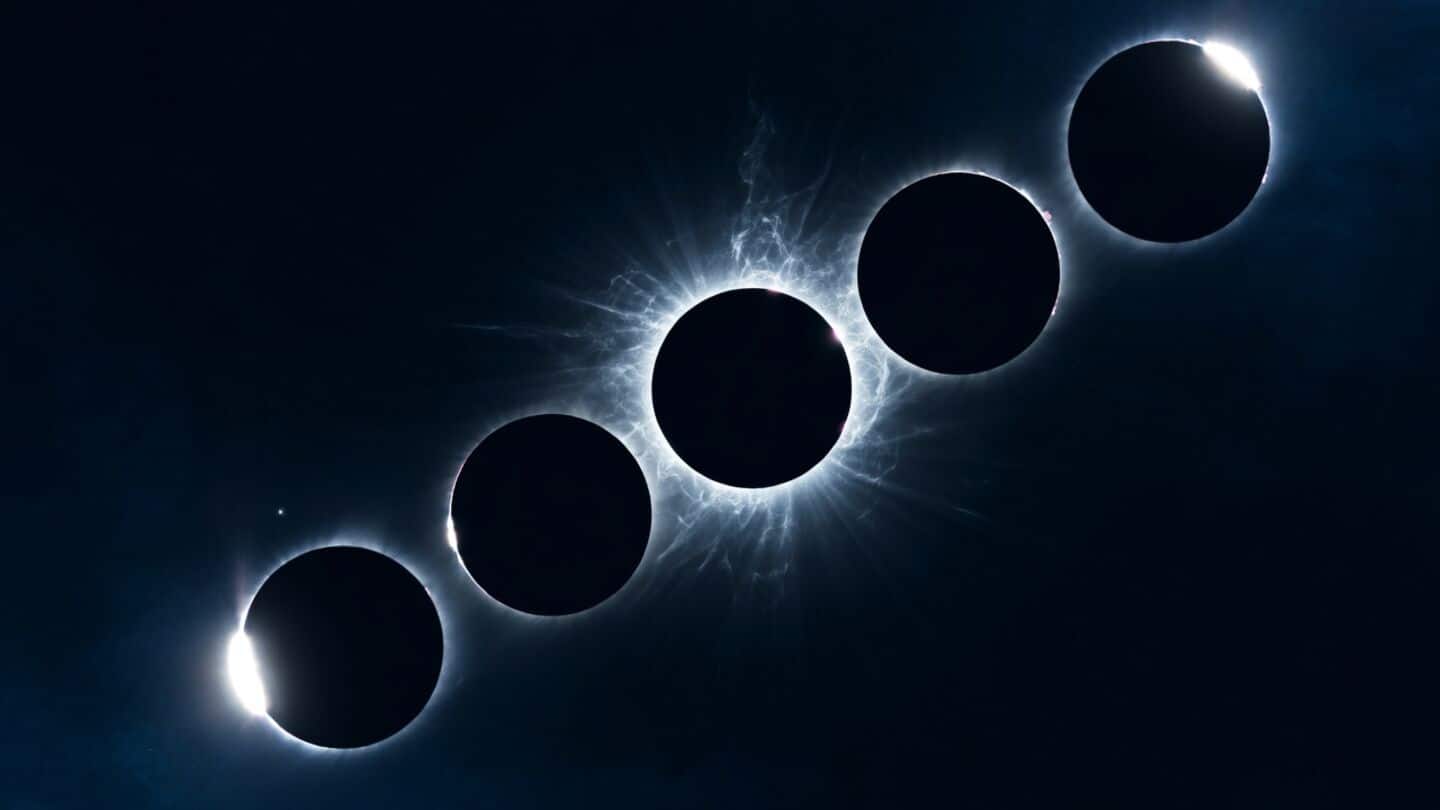
As the Moon completely covers the Sun, totality begins. This is when the Sun's corona becomes visible, creating a stunning halo around the Moon.
The maximum duration of totality will be 2 minutes and 18 seconds, during which viewers can safely remove their eclipse glasses and look directly at this celestial spectacle.
However, they must remember to wear them again before the Sun's disk reemerges from behind the Moon.
Eclipse conclusion
The next stage
The next stage of the eclipse occurs when the Sun's disk starts to reappear from behind the Moon, marking the end of totality.
This will be followed by a reverse sequence of Baily's Beads and the diamond ring effect, before transitioning into an increasingly thicker solar crescent.
The partial eclipse ends globally at 3:57pm EDT (1:27am IST the next day), as Moon's silhouette exits Sun's disk over West Africa.