Earth and Mars were created in different ways, says study
What's the story
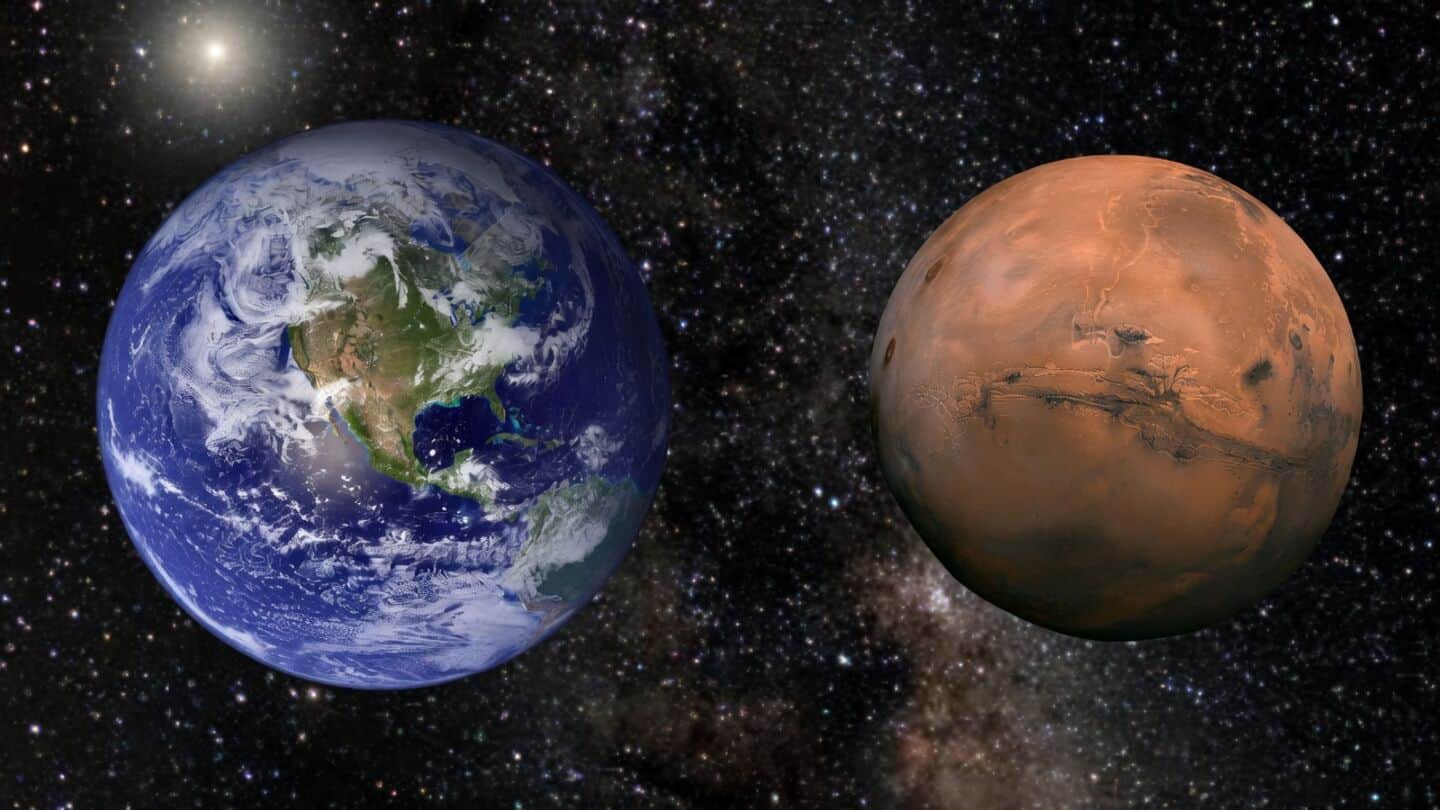
New research has revealed that although Earth and Mars were formed in the same region of the solar system, their chemistry suggests they were built in different ways. The study adds to the growing body of evidence suggesting that planets don't all form in a single manner. It also sheds light on how a disk of gas and dust around the young Sun formed the planets of today's solar system about 4.5 billion years ago.
Expert opinion
More similar formation history expected
Anders Johansen, a professor of planetary sciences at the University of Copenhagen and co-leader of the study, said, "The most surprising result was that Earth and Mars appear to have formed in different ways."
He added that one would expect two planets forming side by side in the same solar system to have a more similar formation history.
Formation theory
How did the solar system form?
Around 4.5 billion years ago, the early solar system was a chaotic environment with a rotating disk of gas and dust around the young Sun. This disk contained the first building blocks of planets.
One long-standing theory suggests that dust grains collided and stuck together to form pebbles, which then grew into kilometer-wide rocky bodies called planetesimals.
These planetesimals repeatedly crashed into each other and merged over tens of millions of years, forming planets like Earth and Mars.
Study approach
Testing the theories
The research team from Copenhagen studied the chemistry of Earth's and Mars's crust and mantle to test these competing ideas.
They focused on volatile elements like sodium, zinc, and potassium that evaporate easily at high temperatures.
The presence or absence of these elements serves as a chemical fingerprint of the heat and violence a planet went through while forming.
Despite being 4.5 billion years old, Earth's and Mars's mantles have similar compositions.
Formation models
What did the researchers find?
The research team used data on the reservoirs of volatile elements on both planets in computer models to test which formation scenarios fit best.
The results leaned toward a hybrid model.
At least 75% of Earth's mass seems to come from two young planets or protoplanets that grew large by gathering pebbles, while planetesimals supplied up to 25%.
For Mars, this balance was reversed, with roughly three-quarters of its mass coming from planetesimals and the remaining quarter from pebble accretion.
Future applications
Implications for exoplanets
The technique used by the researchers could eventually be applied to worlds beyond the solar system, extrasolar planets, or exoplanets.
As future missions discover Earth-like planets around other stars, understanding how they lose volatile elements during their formation can help predict how much water and other life-supporting substances they might have.
The study was published in the journal Nature Astronomy.