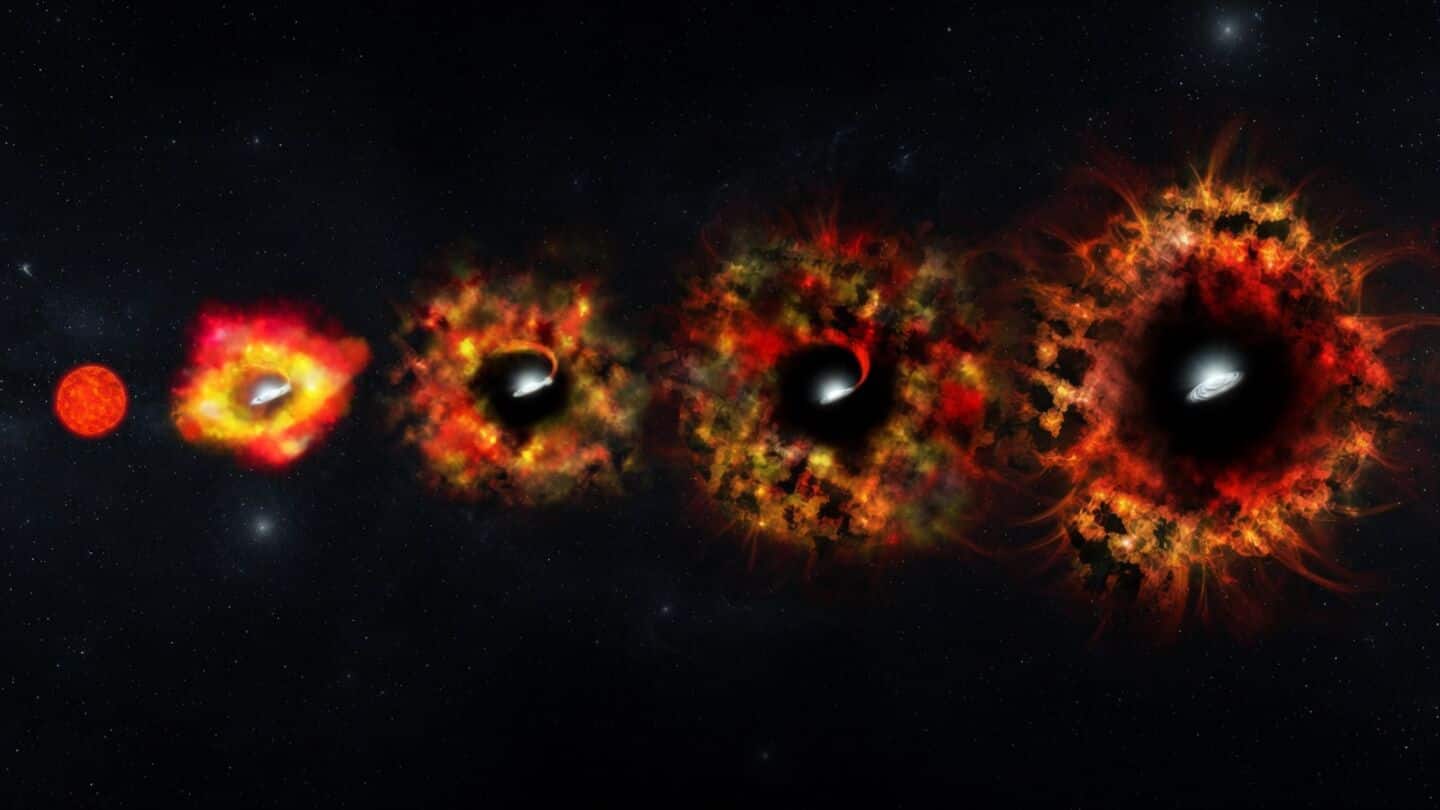
We finally know which stars turn into black holes
What's the story
A recent study has revealed that the way neutrinos oscillate between different types could help determine which stars explode as supernovas and which collapse into black holes. The research also offers potential explanations for several cosmic mysteries, including the observed discrepancy in supernova counts. Neutrinos are released when a massive star's core collapses.
Stellar dynamics
How do neutrinos help determine supernovas or black holes?
When a massive star runs out of fuel, its core collapses under its own weight.
This collapse creates extreme heat and pressure, fusing protons and electrons into neutrons.
The process also generates an enormous amount of neutrinos.
These ghostly particles normally interact very little with matter but can heat the outer layers of a star's core during such a collapse, leading to supernova explosions or black hole formation.
Particle impact
Neutrinos carry away 99% of energy
Mariam Gogilashvili, a particle astrophysicist at the University of Copenhagen's Niels Bohr Institute, emphasized the importance of neutrinos in supernovas.
She said they carry away about 99% of the energy released when a star's core collapses.
A slight change in their behavior could determine the fate of an entire star.
This research sheds light on why some massive stars explode into neutron stars while others collapse into black holes.
Particle transformation
What are 3 'flavors' of neutrinos?
Neutrinos come in three "flavors": electron, muon, and tau. Each flavor can generate a different type of particle when it collides with matter.
In 1998, scientists discovered that these particles can change from one flavor to another, a phenomenon known as oscillation.
This discovery won the 2015 Nobel Prize in Physics and opened new avenues for understanding the role of neutrinos in stellar evolution.
Influence
Study simulated collapse of 195 stars
The study simulated the collapse of 195 stars, ranging from nine to 120 solar masses.
It found that neutrino flavor change could make massive stars less likely to explode as supernovas and more likely to collapse into black holes.
This was especially true for stars between 16 and 30 times the mass of the Sun, which were particularly sensitive to neutrino physics.
Cosmic revelations
Neutrino flavor change could explain cosmic discrepancies
Gogilashvili noted that neutrino flavor change could explain why astronomers have observed fewer supernovas than expected.
It could also clarify why some of the largest red supergiant stars seem to disappear without a supernova explosion, they might collapse into black holes.
The study also suggested that neutrino flavor change could lead to less massive neutron stars, potentially explaining why lower-mass neutron stars have been discovered than previously predicted.