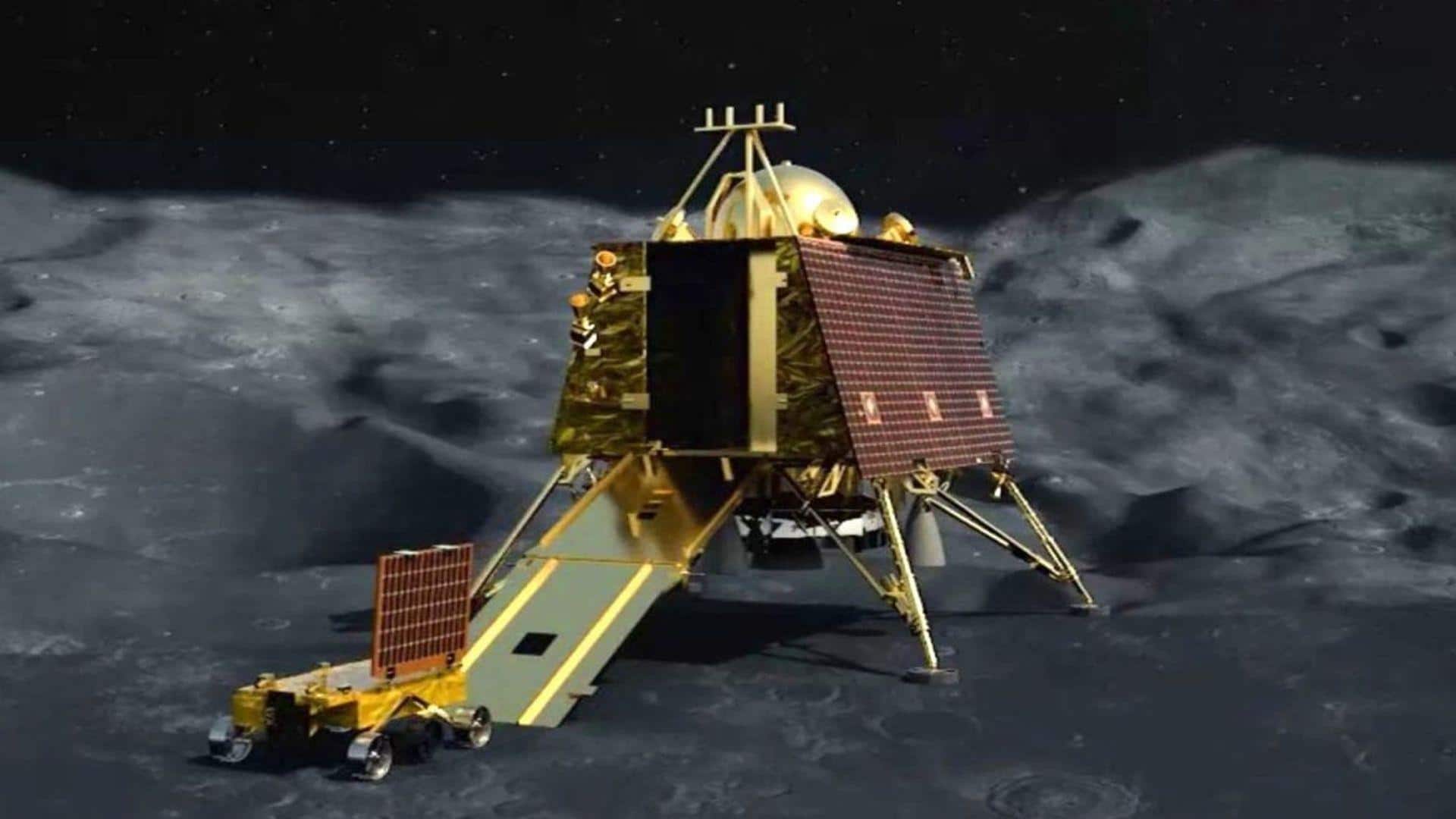
How Moon gave an orbital boost to Chandrayaan-3's propulsion module
What's the story
India's Chandrayaan-3 spacecraft experienced an unexpected orbital boost due to a gravitational interaction with the Moon. The event occurred after the spacecraft separated from its propulsion module in 2023. Astronomer Jonathan McDowell revealed on X that the abandoned propulsion module, which was left in a 125,000 x 305,000km orbit in 2024, had "a bit of a tussle with the Moon" in November 2025.
Mission details
Chandrayaan-3's mission and propulsion module's journey
The Indian Space Research Organisation (ISRO) landed Chandrayaan-3 near the lunar south pole on August 23, 2023.
After achieving its primary objectives, ISRO engineers had hoped to use the propulsion module for other tasks.
Since it had over 100kg of propellant left, a decision was made to move it into an Earth-bound orbit for further observations and important flight dynamics data collection.
Orbital changes
Propulsion module's trajectory and lunar encounters
In October 2023, a series of maneuvers were executed to increase the propulsion module's speed and initiate a Trans-Earth Injection (TEI) burn.
This put it on an elliptical orbit around Earth with an apogee of about 380,000km.
However, this extended Earth-centric trajectory brought the module within the Moon's sphere of influence again in early November 2025.
It was 'kicked' by the Moon's gravity during two close flybys, one at 3,740km on November 6 and another at 4,537km on November 11.
Orbital impact
Moon's gravity significantly altered trajectory
The Moon's gravity significantly altered the propulsion module's trajectory during these flybys.
Its long, stretched orbit changed from an elliptical of around 125,000 x 305,000km to some 365,000 x 983,000km, as per McDowell's observation, and 409,000 x 727,000km, as reported by ISRO.
The orbital inclination also changed.
These unexpected but scientifically important events were closely monitored by ISRO's tracking systems such as the Indian Deep Space Network (IDSN) and the ISRO Telemetry, Tracking and Command Network (ISTRAC).