Icy moons unlikely to lose their underground oceans easily
What's the story
A recent study has shown that even after a massive collision, icy moons can reform and retain their subsurface oceans. The research was led by Marc Neveu from the University of Maryland, who said these simulations were some of the biggest collisions they could think of. "If those don't make a difference, it's unlikely smaller ones would either," he added.
Cosmic impacts
Icy moons can break apart and come back together again
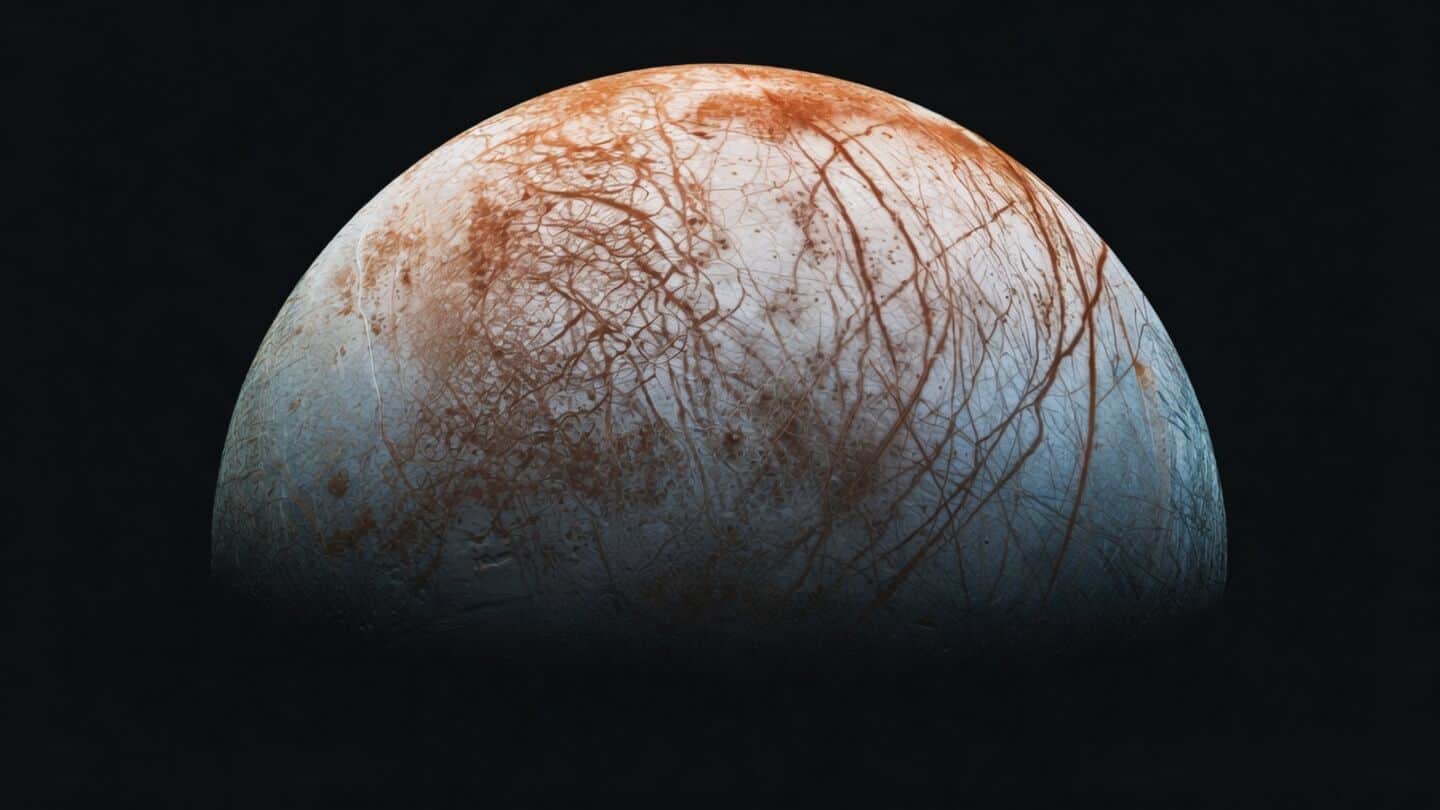
The outer solar system is filled with icy moons that could have subsurface oceans.
But these moons have also been hit by many impacts in their 4.5 billion-year history, some even large enough to break them apart completely.
For example, Saturn's moon Iapetus looks like a remnant of a shattered moon.
In some cases, the broken moon can reform through its own gravity pulling its parts back together again.
Research findings
Impacts don't really matter for subsurface ocean
Neveu's team conducted detailed simulations to find out if such massive collisions affect the chances of an icy moon hosting a subsurface ocean.
They found that if an icy moon is big enough, even the biggest collisions can't stop it from having a subsurface ocean.
"What we found was that those big collisions don't really matter as far as oceans are concerned," Neveu said.
Simulation techniques
Simulations focused on 2 different sizes of moons
The team combined two different types of simulations, each focusing on moons of two different sizes: 1,000km and 2,000km wide.
One simulation looked at what happens when a giant impact breaks one apart while the other modeled the interior of each size moon over 4.5 billion years.
The results showed that smaller moons under 1,000km across were unlikely to keep an ocean after a cataclysmic impact.
Ocean retention
Impacts can even deepen a moon's ocean
For larger moons, the ocean can actually deepen after the moon comes back together again after an impact.
"In larger moons, the energy of the crash converts into extra heat that can actually thicken up an existing ocean for a couple of billion years," Neveu explained.
However, if a moon didn't have an ocean to begin with, the simulations showed that a collision couldn't create one.
Case study
Rhea could be an example of a reformed moon
Neveu believes Saturn's moon Rhea, the second-largest of Saturn at 1,528km wide, could be a case of a reformed moon after an impact.
Its craters look softened as if they've melted. Neveu compares it to how a snowman looks deformed when the Sun melts some of its ice.
"A long-ago collision that boosted an interior ocean could help explain why the moon appears that way," he said.