Moon, Venus, Jupiter align as 'celestial triangle': How to watch
What's the story
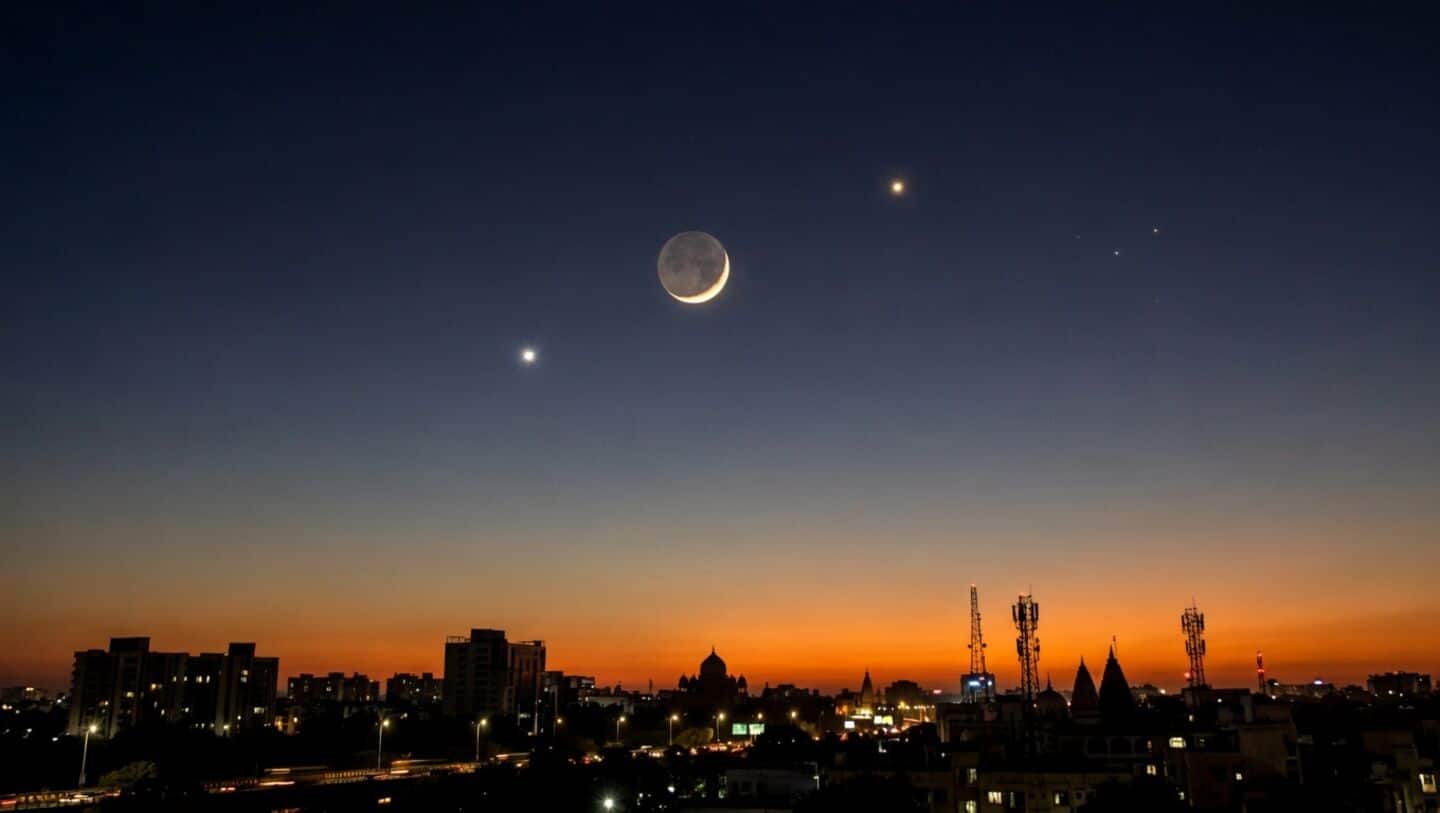
A spectacular astronomical event is set to unfold between May 18 and 20. A thin crescent Moon will pass by Venus and Jupiter, the two brightest planets visible from Earth. This celestial trio can be seen with the naked eye even in urban areas of India. The best time to catch this sight would be around 7-8:00pm IST, about half an hour after sunset.
Viewing tips
How to spot the planets and Moon
To spot this celestial alignment, look toward the west-northwest horizon.
The first object to catch your eye will be a bright white dot, Venus. A steady golden glow nearby marks Jupiter's position.
The crescent Moon will complete the trio by sitting between these two planets on May 19, creating a triangular formation across the sky.
Astronomical phenomenon
Are these planets really close to each other?
Despite their apparent closeness in the sky, Venus, Jupiter, and the Moon are not physically close to each other.
This is known as an "apparent conjunction," a line-of-sight alignment that can make distant celestial bodies appear side by side.
The Moon is about 3,58,000km away from Earth, while Venus and Jupiter are tens of millions and hundreds of millions kilometers away respectively.
Planetary brightness
Why are Venus and Jupiter so bright?
Venus shines at an apparent magnitude of -3.9, making it the brightest planet in our night sky.
This is because it is covered by thick clouds of sulfuric acid that reflect about 70% of all incoming sunlight.
Jupiter, on the other hand, has a lower apparent magnitude (-1.9) due to its distance from the Sun and its large surface area which reflects light.
Lunar illumination
Why does the Moon look golden?
The Moon appears golden when low on the horizon because its light has to pass through a thicker layer of Earth's atmosphere.
This filters out shorter wavelengths of light (blue/violet), leaving longer, warmer ones (red/orange/gold) to tint the lunar crescent.
You may also see a faint glow on the unlit portion of the Moon, earthshine, sunlight reflected off Earth's clouds/oceans and onto its dark face.