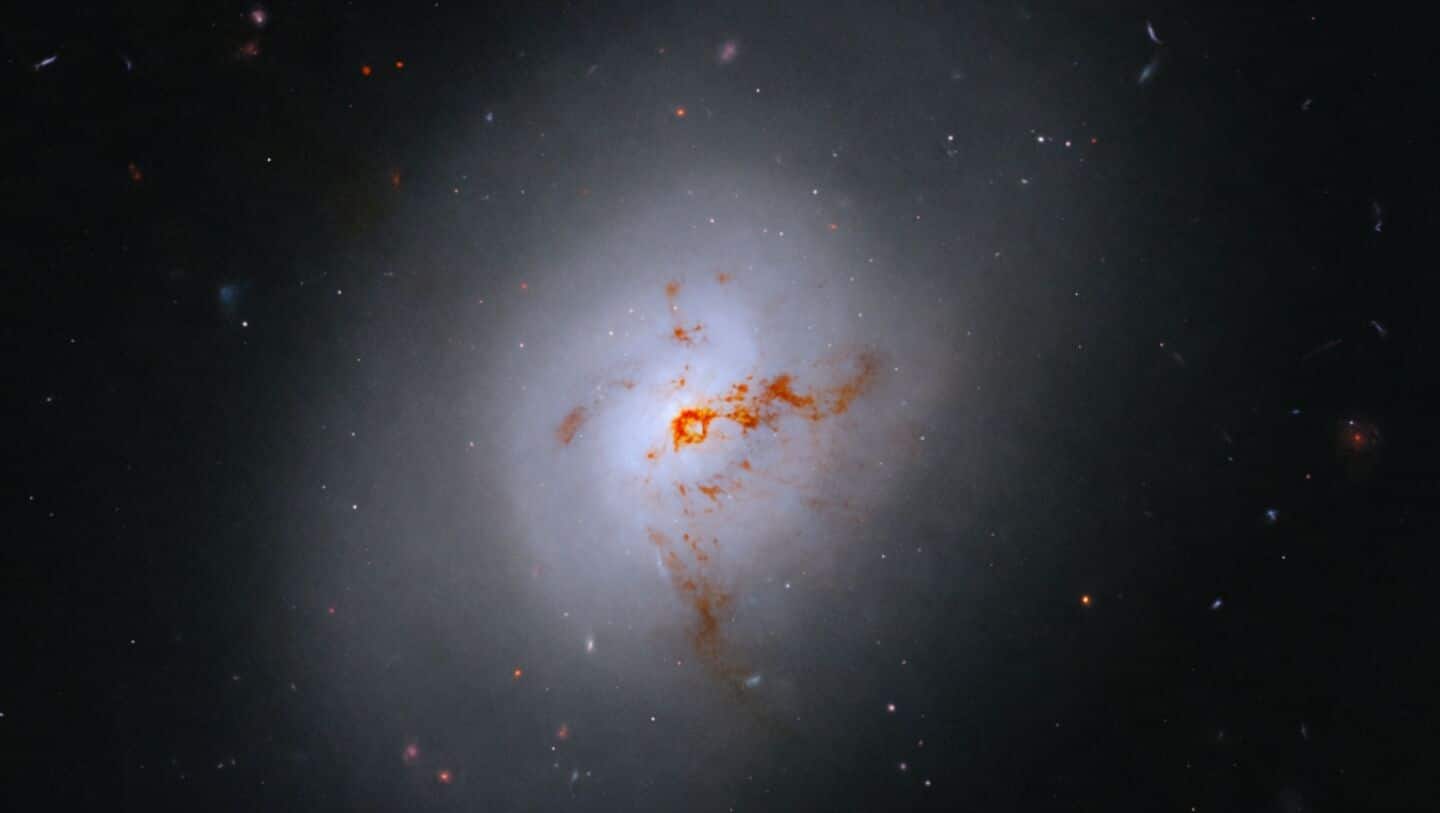
Hubble captures striking NGC 1266 galaxy 100 million light-years away
NASA's Hubble Space Telescope just captured an eye-catching shot of NGC 1266, a galaxy about 100 million light-years away in the constellation Eridanus.
What's cool? NGC 1266 has a bright center like spiral galaxies but no spiral arms and barely any new stars, making it look more like an elliptical galaxy.
The image also shows dusty clouds partly covering the galaxy, with glimmers of distant galaxies in the background.
Astronomers call NGC 1266 post-starburst galaxy
NGC 1266 is what astronomers call a post-starburst galaxy, meaning it still has young stars, but almost no new ones are forming.
That's pretty rare (about 1% of nearby galaxies fit this category).
Scientists think its odd shape comes from merging with another galaxy about 500 million years ago, which sparked lots of star-making and powered up its central black hole.
Now, only the core sees any star action, while the rest is quiet and running low on gas for future stars.