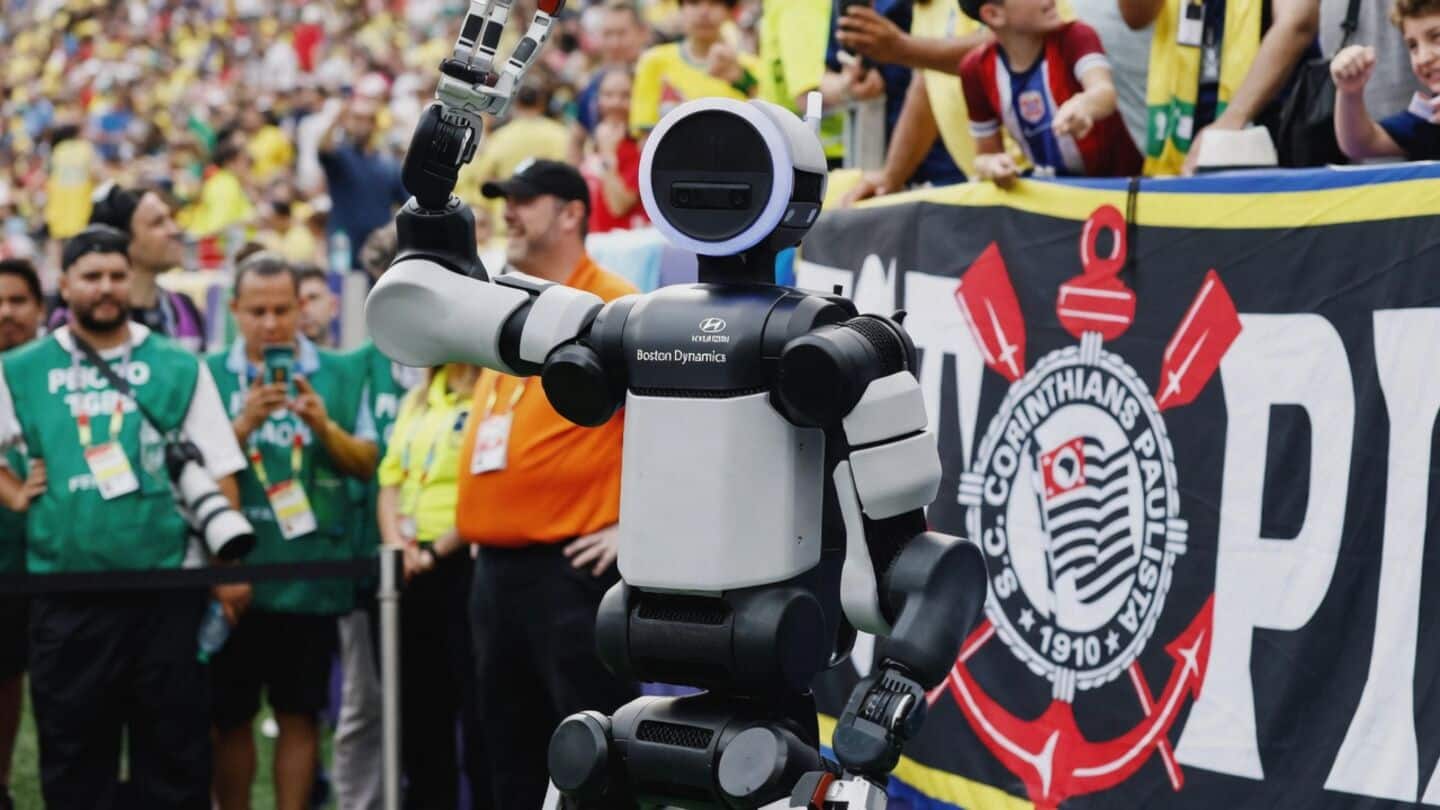
Hyundai showcases Atlas robot's football skills
What's the story
Hyundai has showcased its Atlas humanoid robot at the ongoing 2026 FIFA World Cup. The demonstration was part of a larger effort to prove that robots can safely adapt to unpredictable real-world environments before entering factories at scale. The event took place just before the Round of 16 clash between Brazil and Norway at New York/New Jersey Stadium.
Robot's debut
Atlas is Boston Dynamics' bipedal robot
Atlas, a bipedal robot developed by Hyundai's subsidiary Boston Dynamics, entertained fans with football-inspired celebrations before handing over the match ball to the referee.
This was Atlas's first public appearance since Hyundai unveiled its production-ready version at CES earlier this year.
The South Korean automaker plans to start mass-producing the humanoid robot in the US from 2028, with an annual output of up to 30,000 units.
Real-world testing
The robot walked through the players' tunnel before the match
Hyundai opted for a dynamic sporting environment to test Atlas's performance in front of large crowds and under less predictable conditions.
Before the match, Atlas walked through the players' tunnel and recreated several recognizable football celebrations. These included Brazilian striker Matheus Cunha's surfing celebration and South Korean captain Son Heung-min's well-known camera pose.
The robot then presented the official match ball to the referee, marking a symbolic moment that blended robotics with one of football's biggest tournaments.
Marketing strategy
Hyundai's 'School of Football' campaign
The performance was the final chapter of Hyundai's "School of Football" campaign, a series documenting how Atlas learned increasingly complex football movements.
Hyundai, a long-time FIFA sponsor since 1999, is serving as the tournament's official robotics partner this year.
The company said the campaign was designed to show that modern humanoid robots are capable of operating beyond structured laboratory environments by learning sophisticated physical movements while responding to changing surroundings.
Data collection
A football pitch introduces variables such as uneven terrain
A football pitch introduces variables such as uneven terrain, softer surfaces, and reduced traction.
These conditions provide valuable data on how Atlas maintains balance and adapts its movements.
Alberto Rodriguez, director of robotics behavior at Boston Dynamics, said Atlas has learned to execute and imitate motions reliably so it can adapt to whatever happens in a real instance.
Tech evolution
Public demonstrations help people better understand humanoid robots
Rodriguez said public demonstrations also serve another purpose by helping people better understand where humanoid robotics is heading.
He added the technology is "supposed to transform manufacturing first, and then our daily lives in the next decade."
Despite growing enthusiasm around humanoid robots, their increasing presence has also raised concerns about the future of work.
Labor groups in several industries have questioned whether automation could displace workers.