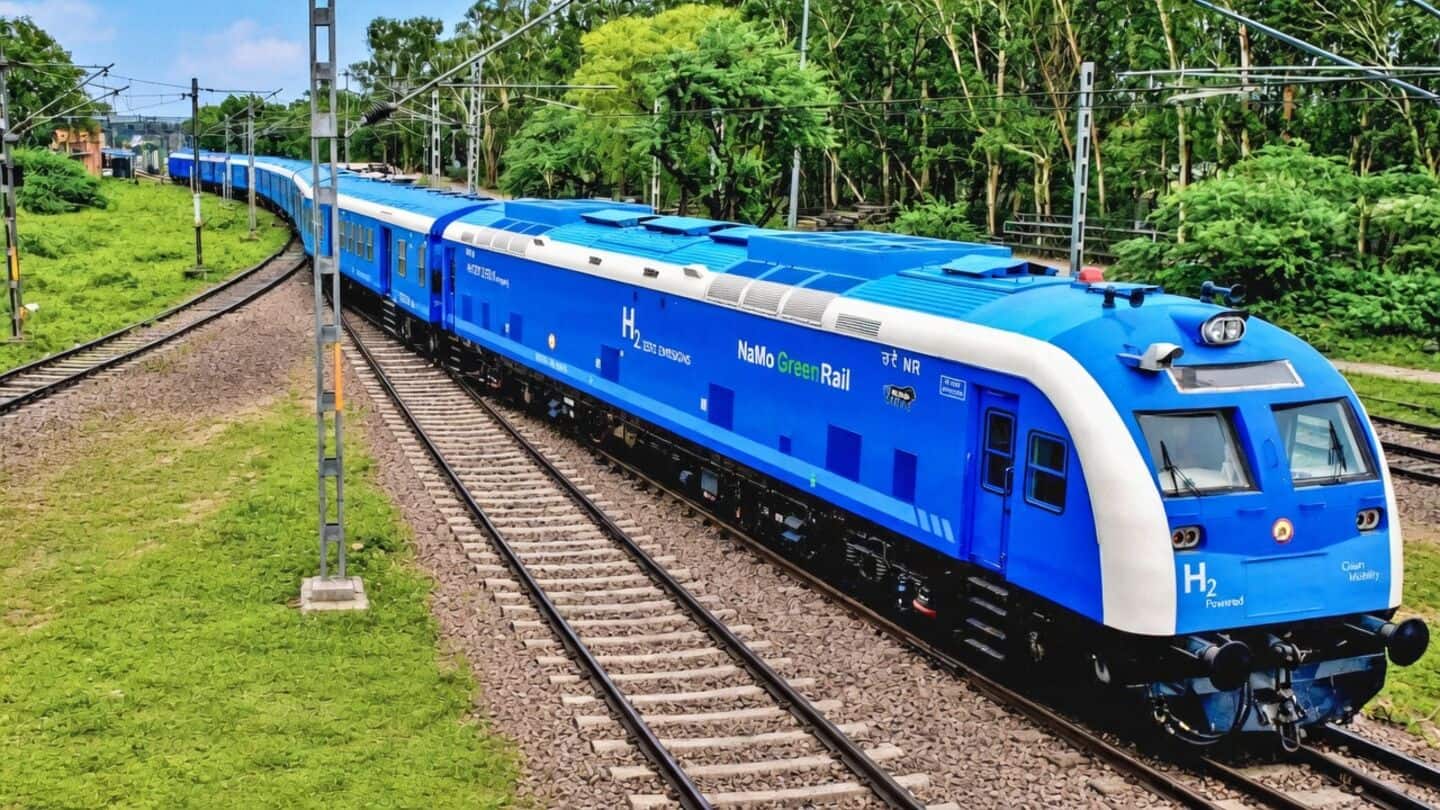
Inside India's 1st hydrogen train: How the green engine works
What's the story
India has entered a new era of clean rail transport with the launch of its first hydrogen-powered train. Prime Minister Narendra Modi flagged off the indigenously developed locomotive on Friday. The train will run on the Northern Railway's Jind-Sonipat section as part of a pilot project to demonstrate the feasibility of hydrogen-powered mobility in one of the world's largest rail networks.
Technology details
Generating electricity on board
Unlike conventional diesel locomotives, the hydrogen train generates its own electricity on board using hydrogen fuel cells.
At the heart of this system is a 1,200-kilowatt Proton Exchange Membrane Fuel Cell (PEMFC).
This technology produces electricity through a chemical reaction between hydrogen and oxygen, with water vapor and heat being its only byproducts.
Working principle
PEMFC explained
The train carries compressed hydrogen gas in high-pressure cylinders fitted inside its two Hydrogen Driving Power Cars.
This hydrogen is fed into a PEMFC, which works like a battery that never needs recharging as long as hydrogen is supplied.
Inside the fuel cell, hydrogen molecules are split into protons and electrons using a catalyst, usually made of platinum.
Eco-friendliness
How electricity is generated and stored
The electricity generated by the fuel cell powers the train's traction motors.
Oxygen from the air enters the fuel cell and combines with hydrogen protons and electrons, producing only water vapor and heat as by-products.
The electricity produced is also stored in Lithium Iron Phosphate (LFP) batteries for extra power during acceleration or energy recovery during regenerative braking.
Performance
Specifications of the train
The 10-coach train has two Hydrogen Driving Power Cars and eight trailer coaches, with a capacity of some 2,600 passengers.
It can operate at a maximum speed of 75km/h (design speed: 110km/h).
The project is supported by India's largest railway hydrogen storage and refueling facility at Jind in Haryana, which can store nearly 3,000kg of hydrogen.
The indigenous facility has been approved by the Petroleum and Explosives Safety Organisation (PESO).
Sustainability
Atmanirbhar Bharat initiative
The hydrogen train project is a major step toward the government's Atmanirbhar Bharat initiative and the National Green Hydrogen Mission.
Developed entirely in India under the technical guidance of the Research, Design & Standards Organisation (RDSO), this project also establishes infrastructure, maintenance practices, and institutional knowledge for future hydrogen mobility.