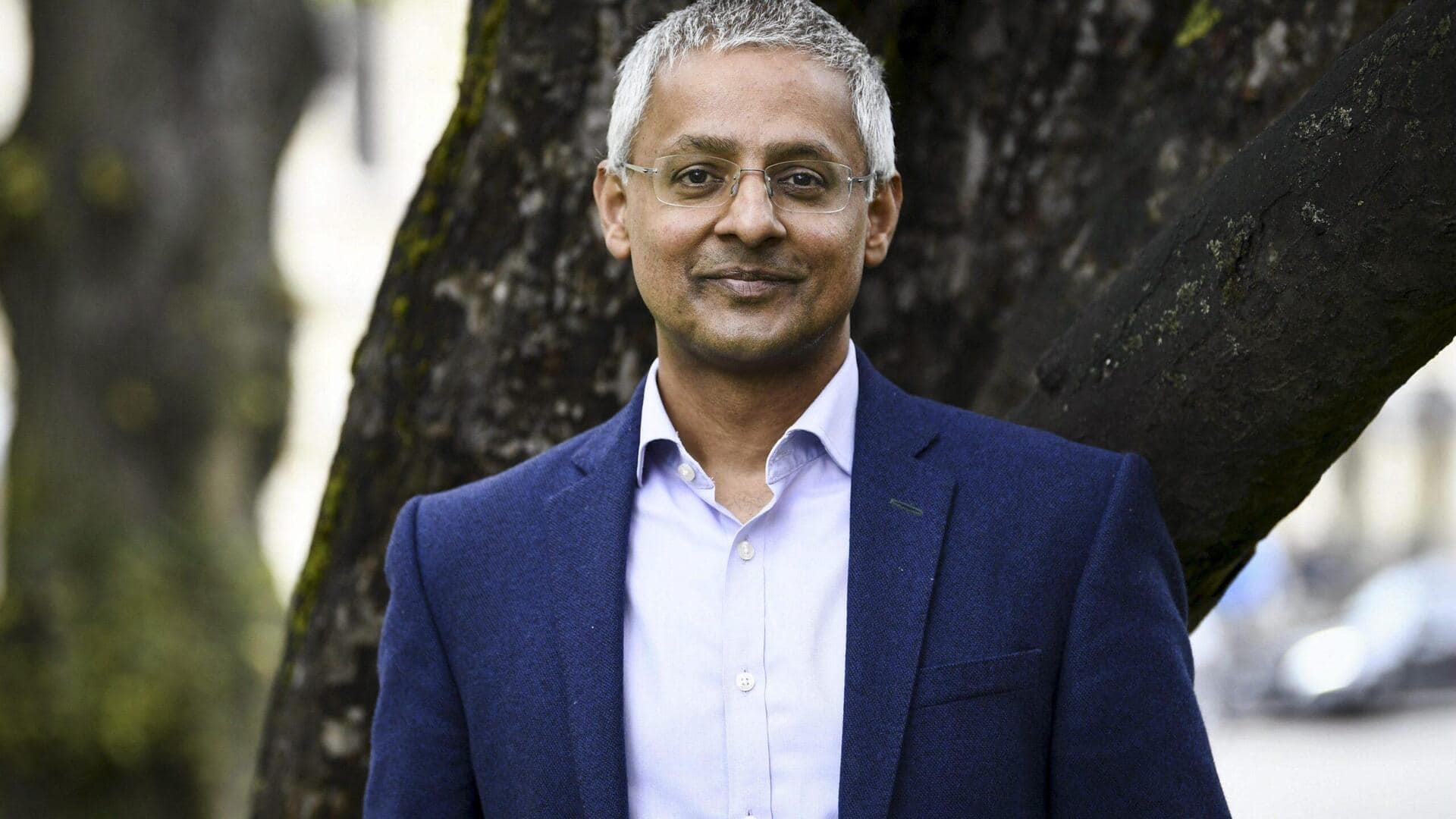
Meet Shankar Balasubramanian, Indian-origin winner of Wolf Prize in Chemistry
What's the story
Chennai-born Sir Shankar Balasubramanian has been awarded the prestigious 2026 Wolf Prize in Chemistry. The Indian-origin British national shares the honor with Cambridge University professor David Klenerman and French scientist Pascal Mayer. The trio was recognized for their groundbreaking work in developing a technology that revolutionized DNA reading, known as "Solexa" or "Illumina."
Academic achievements
Early life and education
Born in 1966 in Chennai, Balasubramanian moved to the UK with his parents when he was just a year old.
He completed his BA in Natural Science in 1988 and in 1991 earned a PhD in enzyme chemistry.
He has been a faculty member at Cambridge since 1994 and is currently the Herchel Smith Professor of Medicinal Chemistry.
Personal details
Personal life and career milestones
Balasubramanian is married to Veena Krishnan, a general practitioner. The couple has two sons, Sachin (2002) and Sashi (2004).
In 2017, he was knighted in the Queen's New Year's Honours for his contributions to science and medicine.
He co-founded Solexa with Klenerman in 1998 and commercialized their single-molecule fluorescence method for DNA sequencing.
Awards
Other awards and recognitions
Balasubramanian's list of accolades is long and impressive. He won the Millennium Technology Prize in 2020, the Breakthrough Prize in 2022, and the Canada Gairdner International Award in 2024.
The Wolf Prize is often seen as a predictor for Nobel Prizes, with Chemistry World's news editor tipping Balasubramanian and Klenerman for this year's chemistry Nobel.
The awards will be presented in June 2027.
Impact
Impact on genetic research and medical diagnostics
Balasubramanian's work on next-generation DNA sequencing has transformed genetic research and medical diagnostics.
The technology allows scientists to study genetic variations associated with inherited diseases, analyze mutations in cancer cells, and monitor the evolution of infectious pathogens.
It has also enabled precision medicine, where genetic information can inform treatment decisions and strategies.