
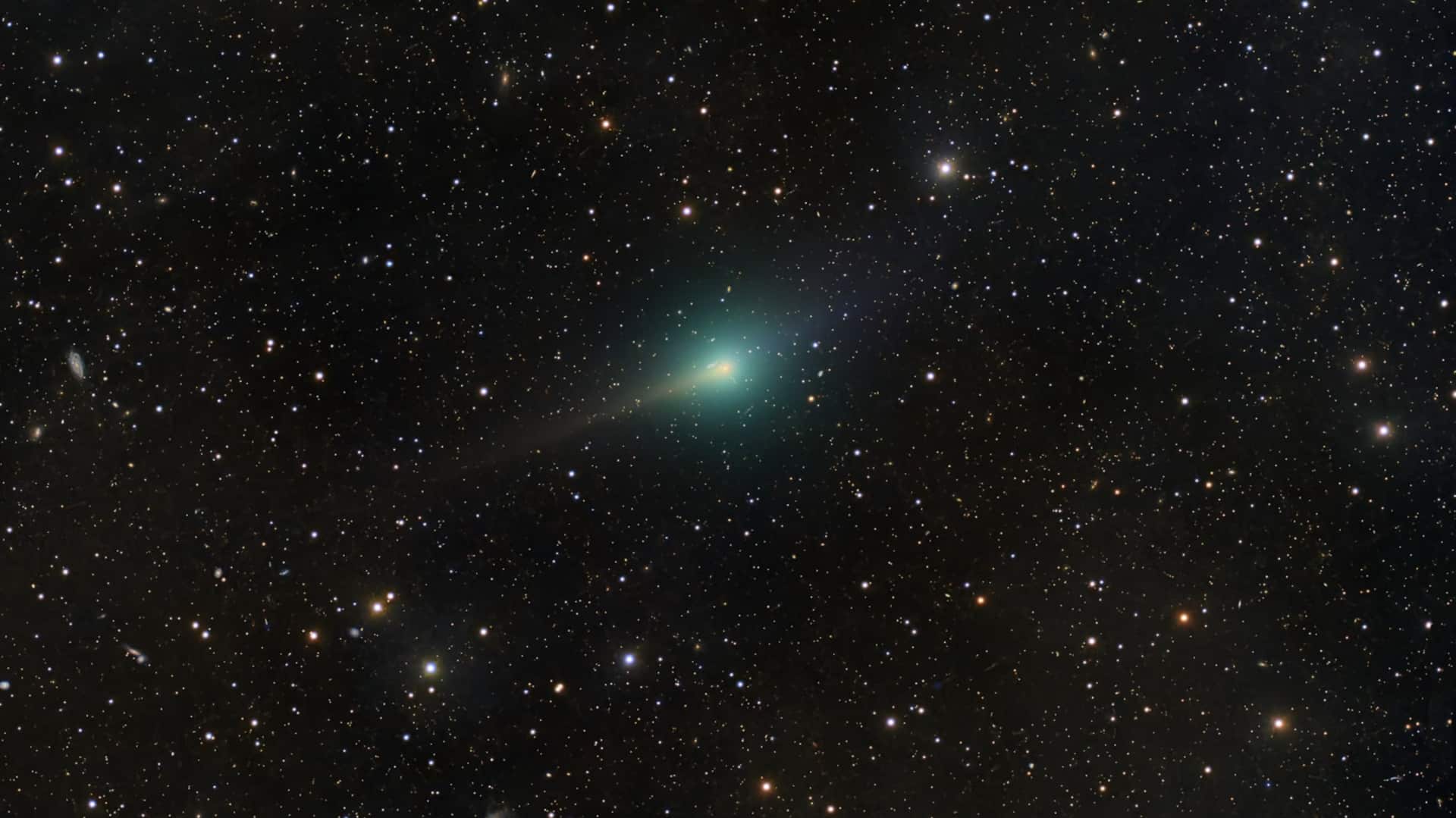
Interestellar comet passes Earth tonight: How to watch once-in-a-lifetime event
What's the story
Interstellar comet 3I/ATLAS, a rare celestial object from beyond our solar system, is set to make its closest approach to Earth today. The comet was first spotted in June 2025 by Asteroid Terrestrial-impact Last Alert System (ATLAS) survey telescope Chile. A few weeks later, it was confirmed as an interstellar visitor due to its unique speed and trajectory. Prior to 3I/ATLAS, only two interstellar visitors have been confirmed: the mysterious 1I/ʻOumuamua in 2017 and the comet 2I/Borisov in 2019.
Scientific importance
Comet 3I/ATLAS's journey and significance
3I/ATLAS is a comet—a frozen mix of ice, dust, and gases that heats up and grows a long tail as it nears the Sun. Most comets originate in the Kuiper Belt or the distant Oort Cloud within our solar system. But 3I/ATLAS is different: it formed beyond our solar system and is only passing through. Once it leaves, it will never return, making this a rare chance to study material from another star system.
Viewing tips
How to view comet 3I/ATLAS's closest approach
The comet will reach its closest point to Earth at 1am EST (6am GMT) today, coming within 270 million kilometers of us. However, it won't be visible to the naked eye or regular binoculars. Your best bet to watch this interstellar visitor is through a telescope. You can also use skywatching apps to find where exactly in the night sky 3I/ATLAS is located.
Online viewing
Live stream of comet 3I/ATLAS's closest approach
If you can't see 3I/ATLAS from your location, you can watch it online via a livestream by The Virtual Telescope Project. The broadcast will show views from telescopes in Manciano, Italy, and is scheduled to begin at 11pm EST on December 18 (4:00 GMT on December 19). However, the start time may change depending on weather conditions at the observation site.