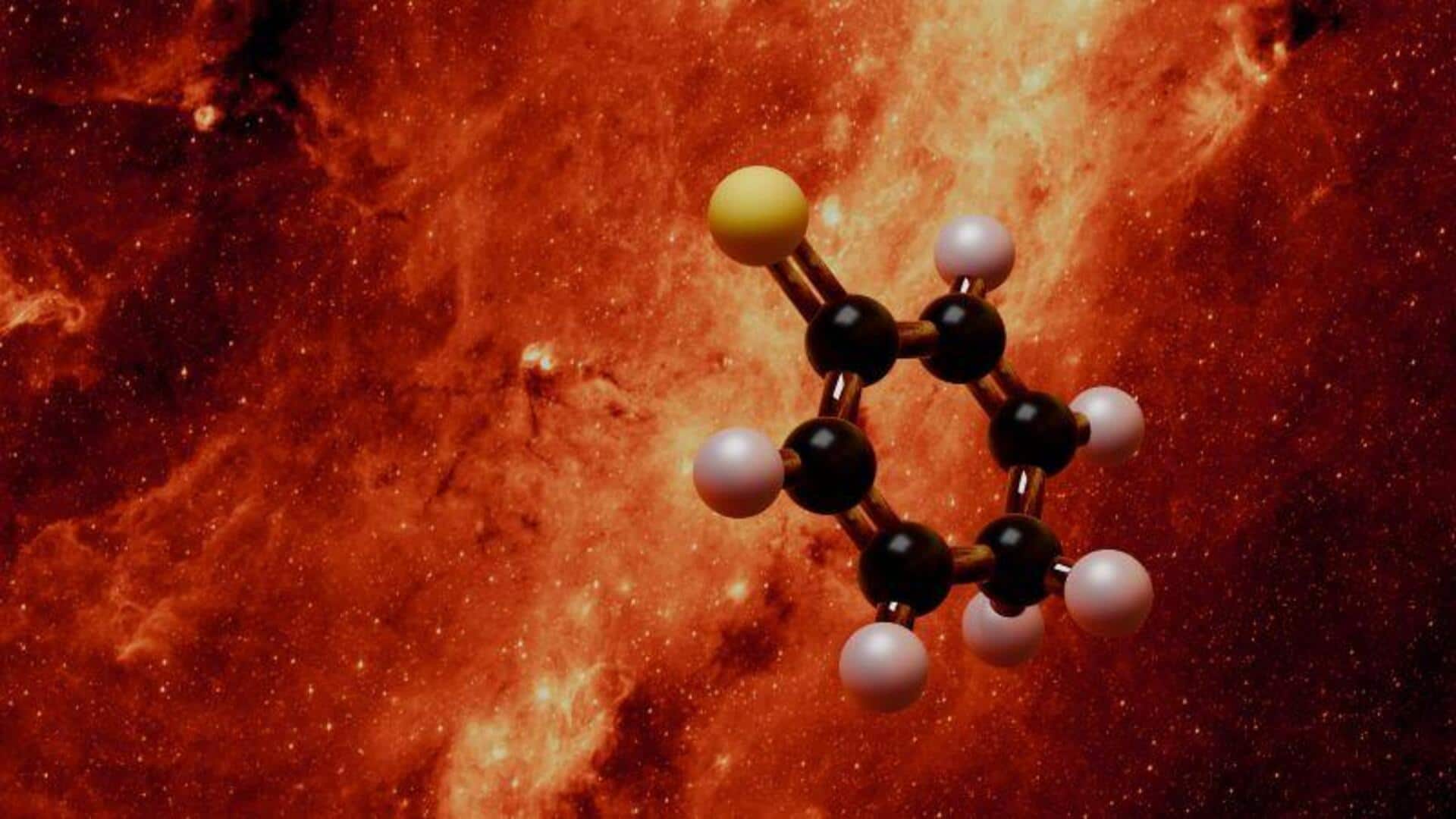
A molecule that hints at life's origins found in space
What's the story
In a groundbreaking discovery, scientists have found the largest organic molecule containing sulfur in interstellar space. The molecule, called 2,5-cyclohexadiene-1-thione, consists 13 atoms and is believed to be a "missing link" in our understanding of the cosmic origins of life's chemistry. The finding was published last week in the journal Nature Astronomy.
Elemental importance
Why is sulfur important?
Sulfur, the 10th most abundant element in the universe, is a key ingredient in amino acids, proteins, and enzymes on Earth.
However, despite its abundance, large sulfur-bearing molecules have been hard to find in interstellar space.
This has led scientists like Mitsunori Araki from Germany's Max Planck Institute for Extraterrestrial Physics to wonder why these molecules aren't more common.
Molecular breakthrough
'Missing link' in understanding life's chemistry
The newly discovered molecule, which also includes carbon and hydrogen, is the largest sulfur-bearing molecule ever found in space.
Araki said, "Before this one, the largest only had nine atoms, but it was already a rare case because most detected sulfur-bearing molecules only had three, four or five atoms."
This discovery fills the gap between simple space chemistry and complex building blocks of life found in comets and meteorites.
Discovery site
Molecular cloud where the molecule was found
The molecule was found in a molecular cloud called G+0.693-0.027, located about 27,000 light years away from Earth.
These clouds are cold and dense concentrations of dust and gas that allow for the formation of molecules, acting as stellar nurseries where baby stars eventually form.
Valerio Lattanzi from the Max Planck Institute explained these clouds could lead to planetary systems like our own solar system.
Methodology
How researchers synthesized and identified the molecule
The researchers first synthesized the molecule by applying an electric discharge to thiophenol, a foul-smelling liquid that contains sulfur, carbon, and hydrogen.
They then obtained a precise "radio fingerprint" of the molecule and compared it with existing telescope data from the observation of the cloud.
This method helped confirm their discovery in this molecular cloud where sulfur molecules were quite abundant.
Future prospects
More discoveries expected in future
The discovery of this molecule adds to a growing catalog of more than 300 molecules observed in space so far.
Araki said this finding suggests that many more sulfur-bearing molecules, perhaps even bigger ones, could be detected in the future.
This opens up exciting possibilities for further exploration and understanding of the complex chemistry that exists in our universe.