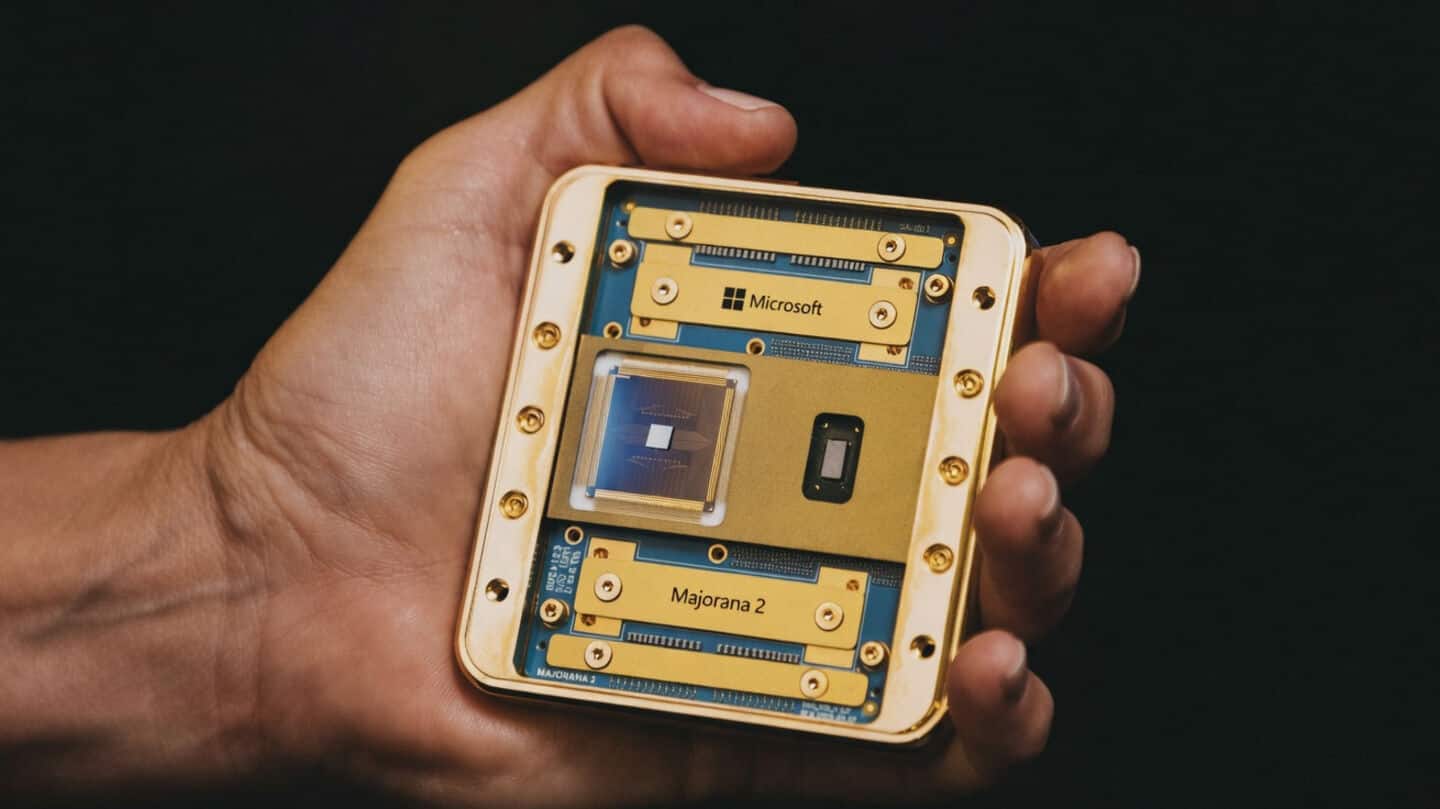
Microsoft's Majorana 2 chip may make quantum computing practical soon
What's the story
Microsoft has unveiled the Majorana 2, its next-generation topological quantum chip. The new chip is said to be 1,000 times more reliable than its predecessor, Majorana 1. The improvement comes from a new material stack and the use of Microsoft Discovery's agentic AI. Chetan Nayak, a technical fellow at Microsoft and corporate vice president of quantum hardware, explained that the team improved Majorana 1's material stack for a more stable topological phase in Majorana 2.
Design upgrades
Majorana 2's qubit lifetimes exceed an impressive 20 seconds
The Majorana 2 chip replaces the aluminum superconductor of its predecessor with lead.
It also updates the semiconductor active region to a combination of indium arsenide and indium arsenide antimonide.
These changes are said to improve qubit performance.
Nayak noted that in the aluminum-based Majorana 1, qubit lifetimes ranged from one to 12 milliseconds.
However, in Majorana 2, these lifetimes exceed an impressive 20 seconds, an improvement of over 1,000 times stability-wise.
Roadmap acceleration
Microsoft accelerates timeline for practical quantum computer
The impressive progress with Majorana 2 has prompted Microsoft to accelerate its timeline for a scalable, practical quantum computer.
"We have cut our timeline in half and now aim to reach this target by 2029," Nayak said.
The company is working on a fault-tolerant prototype quantum computer based on topological qubits, hoping to use quantum computing to solve some of the world's most difficult problems.
Tool release
Discovery app launched
Along with the Majorana 2 announcement, Microsoft has also released Discovery, the app that helped improve its Majorana chips.
The tool is designed to apply agentic workflows to research and development programs.
It is now available on GitHub and can be accessed using a GitHub Copilot account by researchers looking to leverage this innovative technology in their work.