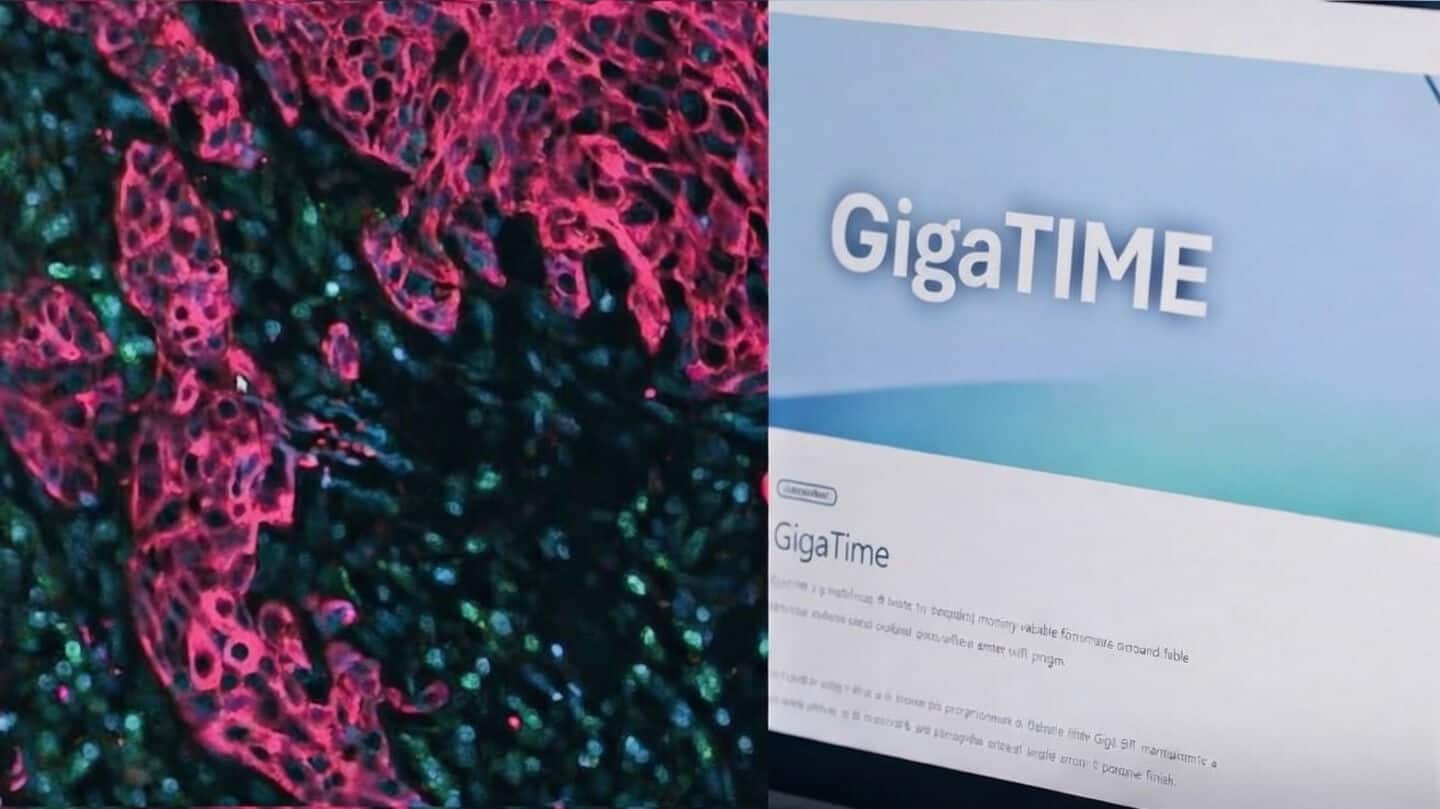
'GigaTIME': Microsoft's new AI could speed up cancer tissue analysis
What's the story
Microsoft has unveiled a groundbreaking artificial intelligence (AI) technology, GigaTIME, capable of converting standard pathology slides into complex protein-mapping data. The innovation could drastically reduce the time and cost of analyzing cancer tissues, making advanced diagnostics and treatment research more accessible globally. The announcement was made by CEO Satya Nadella on X.
Technological advancement
GigaTIME model generates spatial proteomics data at scale
The GigaTIME model, developed by Microsoft in collaboration with Providence Health & Services and the University of Washington, is designed to generate spatial proteomics data at scale. It was trained on large-scale datasets containing millions of cells. The model can convert basic input images into colorful multiplex immunofluorescent images, indicating protein activation levels. These patterns are crucial for understanding disease progression and predicting patient responses to specific drugs.
Research details
Trained on dataset of 40 million cells
In a research paper published in the journal Cell, scientists revealed that GigaTIME was trained on a dataset of 40 million cells with paired H&E and mIF images across 21 protein channels. The model was then applied to data from over 14,000 cancer patients across 51 hospitals and more than 1,000 clinics within the Providence system. This study generated a massive virtual dataset of some 300,000 multiplex immunofluorescent images covering 24 types of cancer and over 300 subtypes.
Research implications
First population-scale study of tumor immune microenvironment
The study identified over 1,200 statistically significant associations between protein activation patterns and clinical factors like biomarkers, cancer stage, and patient survival. The researchers say this is the first population-scale study of the tumor immune microenvironment based on spatial proteomics. "By translating readily available H&E pathology slides into high-resolution virtual mIF data," they said in their paper, "GigaTIME provides a novel research framework for exploring precision immuno-oncology through population-scale TIME analysis and discovery."
Twitter Post
Take a look at Nadella's post
We’ve trained a multimodal AI model to turn routine pathology slides into spatial proteomics, with the potential to reduce time and cost while expanding access to cancer care. pic.twitter.com/OCptXdsUm1
— Satya Nadella (@satyanadella) March 15, 2026