Why Milky Way flipped on its side 10B years ago
What's the story
A team of astronomers from Durham University has revealed that the Milky Way was flipped on its side after a violent collision with a dwarf galaxy known as Gaia Sausage. The cataclysmic event took place about 10 billion years ago, long before the solar system came into existence. The research findings were shared at the Royal Astronomical Society's National Astronomy Meeting in Birmingham.
Collision details
'Disc flip' took hundreds of millions of years
The Milky Way absorbed the stars of the incoming dwarf galaxy, Gaia Sausage, but not without a major shift.
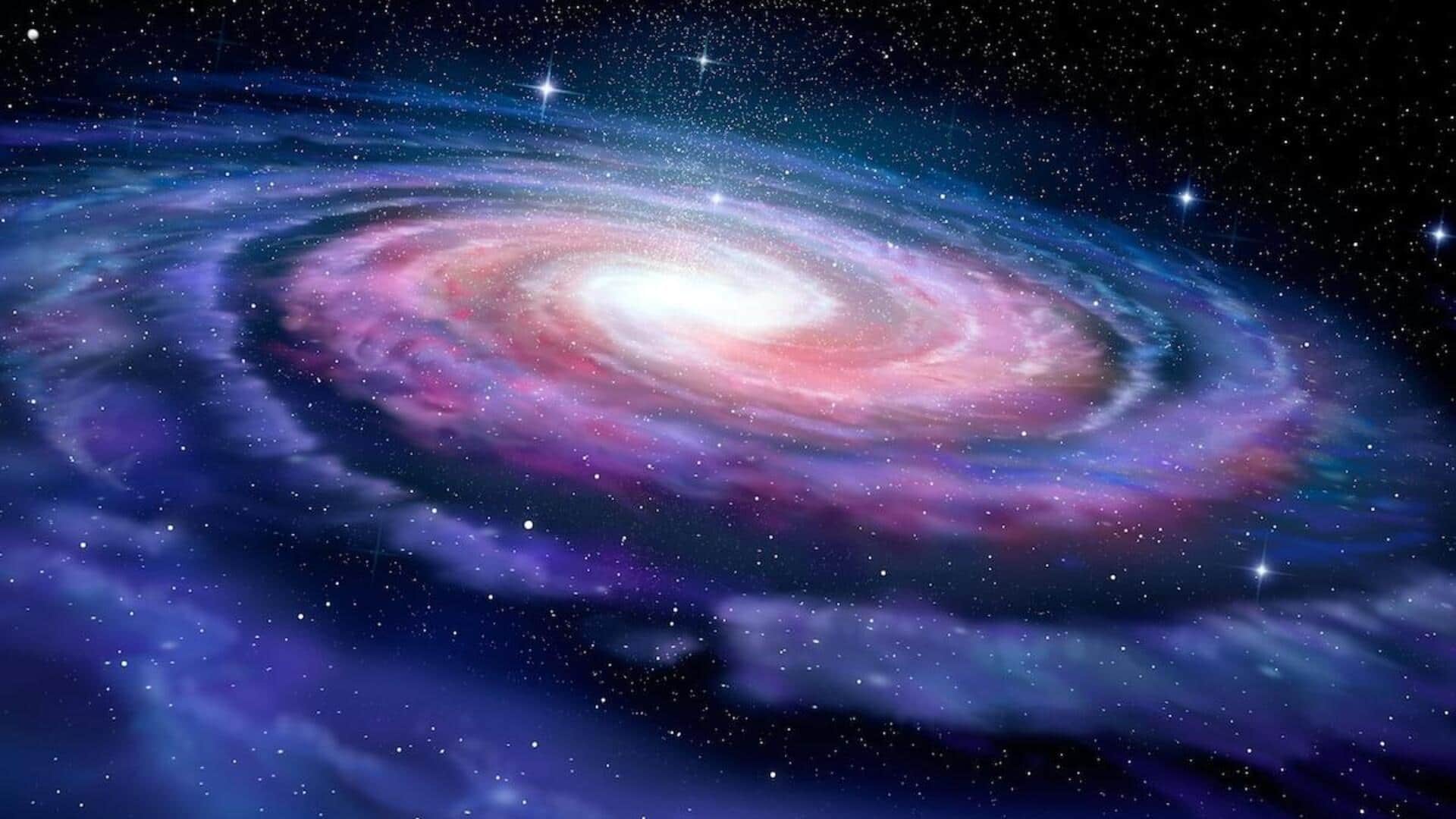
The chaos from this event is believed to have flipped the entire disk of our galaxy by over 90 degrees into its current position.
Lead researcher Kirill Batrakov said that this "disk flip" likely took hundreds of millions of years to complete.
Halo enigma
Discovery of the disk flip
The researchers stumbled upon the disk flip while studying the unusually slow rotation of stars in the Milky Way's halo.
This is a thin, roughly spherical cloud of stars surrounding our galaxy.
Most of these stars were originally part of smaller galaxies that strayed too close to the Milky Way and merged over time.
The European Space Agency's Gaia mission had previously shown that stars in this region rotate much slower than those in other parts of the galaxy.
Simulation findings
Simulations reveal impact of galaxy collisions
To explain the slow rotation of stars in the halo, the Durham team turned to computer simulations of Milky Way-like galaxies.
The simulations showed that such galaxies experience a "disk flip" after head-on collisions with nearby galaxies like Gaia Sausage.
This finding further supports the theory that our galaxy was flipped on its side after a major collision with this dwarf galaxy.
Future
Next change in a few billion years
The Gaia Sausage collision, which is now recognized as the last major merger in our galaxy's history, fundamentally reshaped the Milky Way. It created the central bulge and dominated the stellar halo.
Despite being classified as dwarf galaxy, Gaia Sausage contained stars, gas, and dark matter more than 10 billion times heavier than our Sun.
The next major upheaval could occur when another nearby dwarf galaxy called Large Magellanic Cloud merges with the Milky Way in a few billion years.