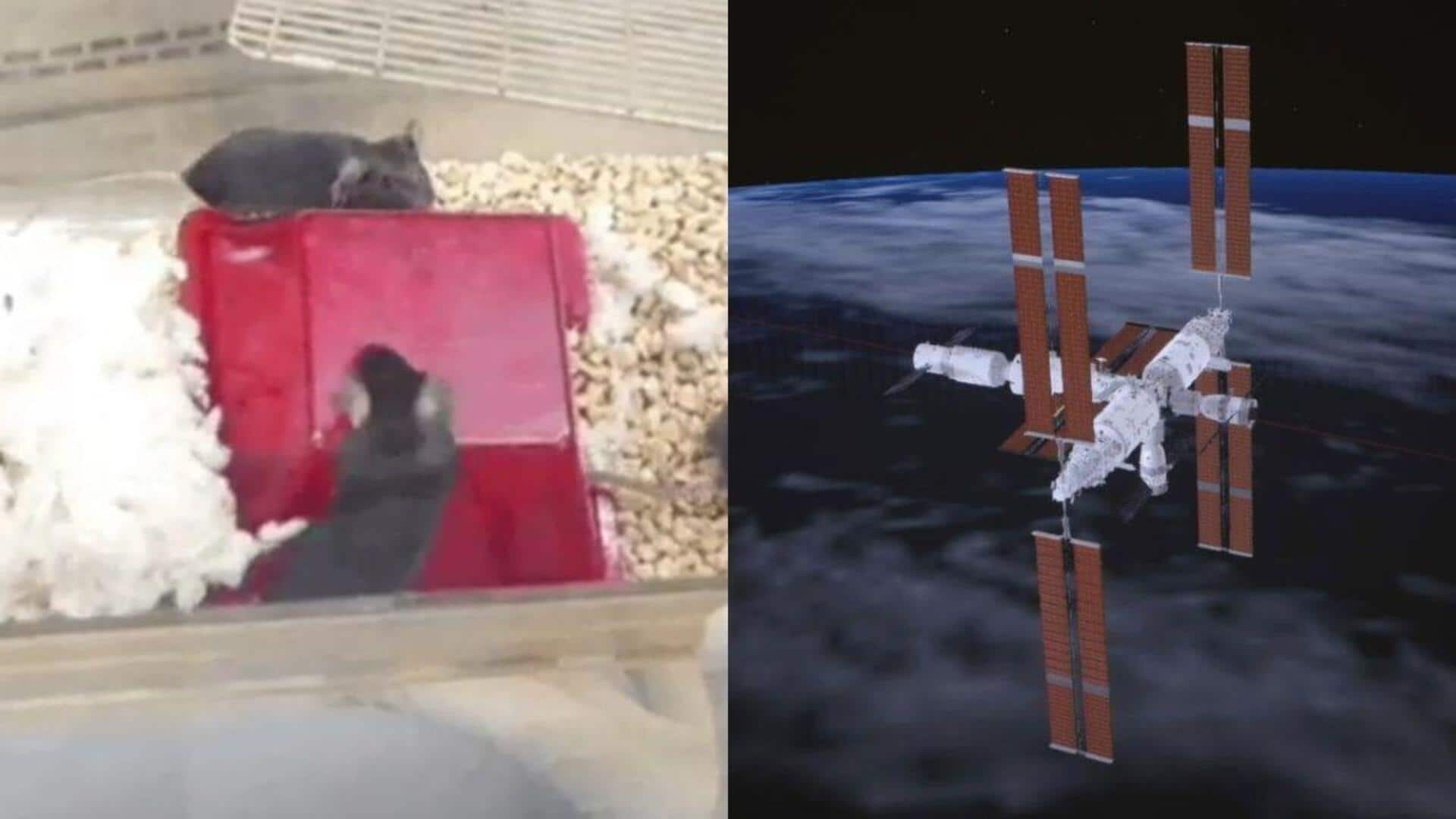
Mouse gives birth to 28 pups after returning from space
What's the story
A female mouse that spent almost two weeks aboard China's Tiangong Space Station has given birth to a total of 28 pups in three litters. The extraordinary finding was made after the rodent returned to Earth from the Shenzhou-21 mission. The data provides valuable insights into how microgravity conditions may affect mammalian reproduction, and raises questions about potential hormonal, genetic, and physiological changes induced by space travel.
History
One of four rodents sent to the Tiangong
The female mouse was one of four rodents sent to the Tiangong station for around two weeks of microgravity research.
The experiment aimed to study muscle and bone changes in space, the effects of weightlessness on organ systems, and also reproductive biology under altered gravity conditions.
After returning from orbit, the mouse gave birth to nine pups in December 2025, followed by another litter of 10 and a third one with nine more in February 2026.
Research implications
Research aims to understand deep-space exploration challenges
The findings of this study, led by Chinese space life-science researchers, are particularly significant as they highlight the potential effects of microgravity on mammalian reproduction.
While scientists have not definitively linked microgravity to increased fertility, the data has prompted further investigation into how space travel may trigger hormonal, genetic and physiological responses in living organisms.
This research is critical for understanding long-term biological stability during deep-space exploration missions.
Biological impact
Effects of spaceflight on living organisms
Spaceflight exposes the living organisms to microgravity, radiation, and altered circadian cycles.
Previous studies have shown that weightlessness might lead to muscle atrophy, bone loss, and immune system changes.
However, reproduction remains one of the least understood areas of space biology.
The results of this mouse study suggest that short-term exposure to microgravity may not permanently impair reproductive capability and could even trigger temporary biological shifts in mammals.