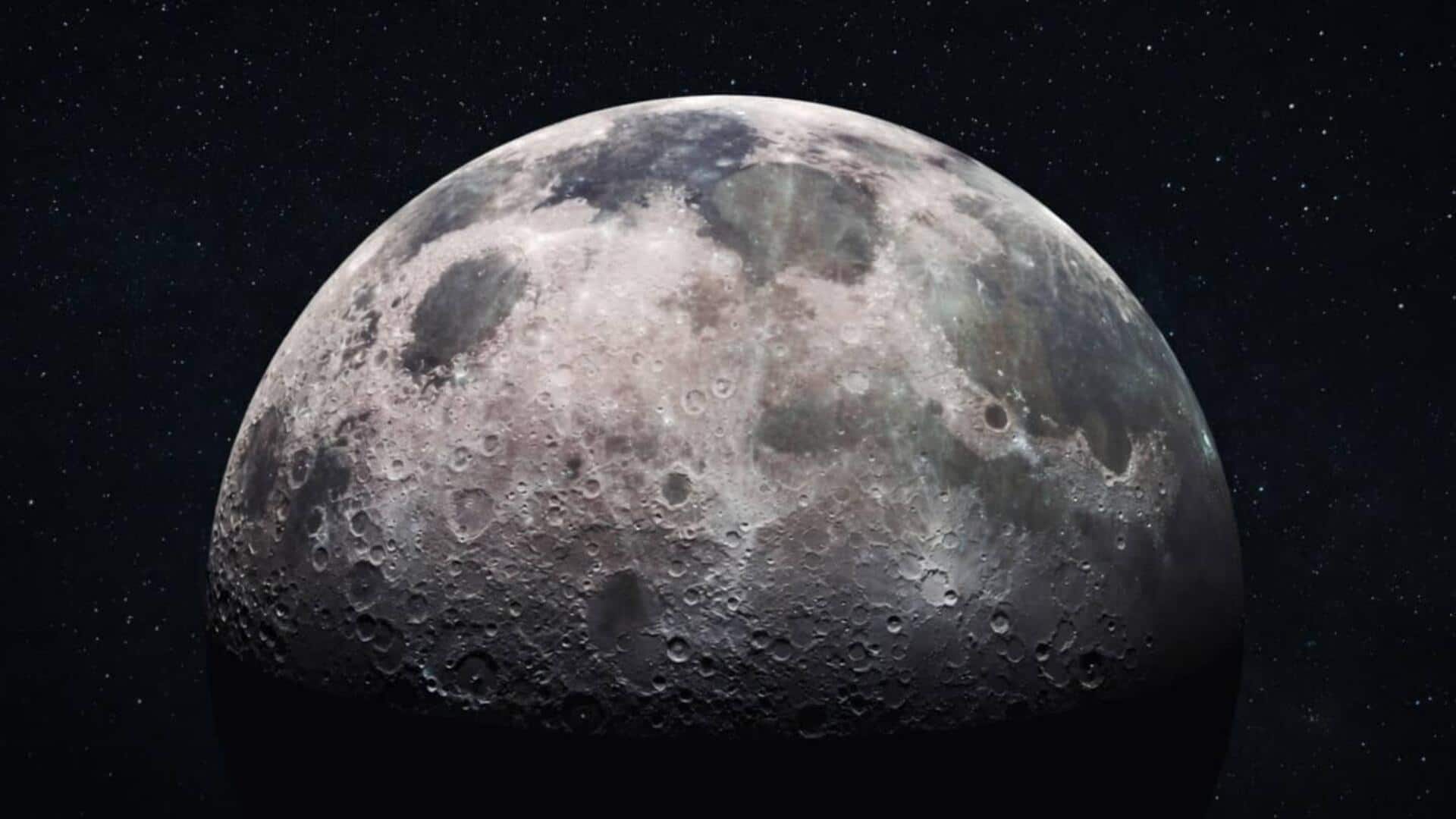
We finally know how to ensure power supply on Moon
What's the story
A group of six students from the New Jersey Institute of Technology (NJIT) has won a $15,000 (around ₹14.3 lakh) prize from NASA. Their innovative proposal is to create a lunar power station using a swarm of 1,100 autonomous satellites. The concept was presented at NASA's first ORBIT Challenge in Houston and is aimed at solving the energy challenge on the Moon's South Pole.
Power issues
Why is there an energy challenge on the Moon?
NASA is working toward sustained human activity on the lunar surface. However, the lunar South Pole poses a major energy challenge due to prolonged periods of darkness.
Some areas can go without sunlight for about two weeks, making it difficult for surface solar panels to provide continuous power.
This could jeopardize critical systems in future lunar habitats, including life support and oxygen supplies.
Innovative solution
How can a swarm of satellites help?
The NJIT team's solution, dubbed the Orbital Solar Energy Harvesting Swarm (OSEHS), involves a fleet of autonomous satellites collecting solar energy in space.
This energy would then be transmitted to receivers on the lunar surface using microwave beams.
Instead of relying on one large spacecraft, the team envisions some 1,100 six-foot-wide satellites working together as a swarm.
Future prospects
What's next for the project?
The students simulated 12 spacecraft in a formation around the Sun to study how their swarm could respond to failures without intervention from Earth.
They believe swarm robotics could make their system more resilient.
The proposal was chosen as one of 10 finalists in NASA's Space Track from hundreds of university entries.
Beyond the competition, they hope to turn this tech into a start-up and explore its potential for powering data centers on Earth.